The Pre-Revenue Founder's LinkedIn Playbook: Building Credibility When You Have No Metrics
Learn how to build LinkedIn authority as a pre-revenue founder. Discover content strategies that establish credibility through expertise, not traction, and turn 'still figuring it out' into thought leadership.

Shanjai Raj
Founder at Postking
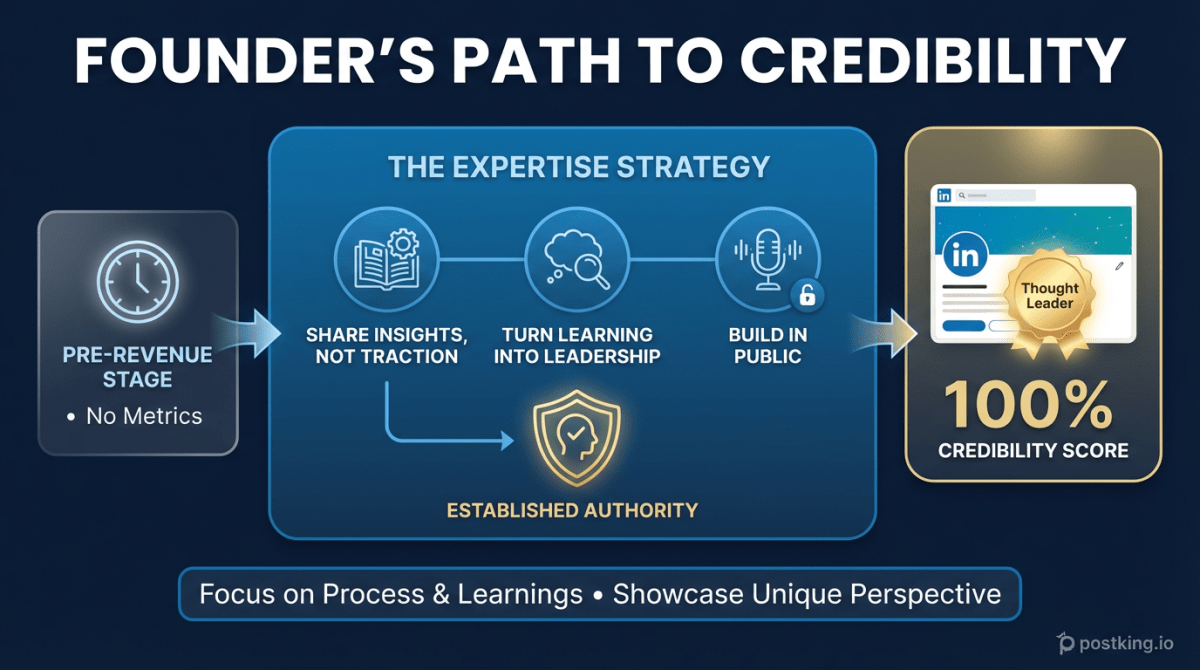
You have zero customers. No ARR to screenshot. No growth charts that go up and to the right.
And every time you open LinkedIn, you see founders posting about their latest funding round, their MRR milestones, their customer wins. Meanwhile, you're sitting there wondering what you could possibly post that doesn't feel like a lie.
Here's what nobody tells you: some of the most compelling founder content on LinkedIn comes from people who haven't made their first dollar yet. The founders building audiences before product-market fit often have an advantage over those who wait until they have "something to show."
This isn't about faking it. It's about recognizing that your journey, your insights, and your process have value right now, not just after you hit some arbitrary revenue milestone.
The Imposter Syndrome Trap
Let's address this directly: feeling like a fraud because you have no metrics is normal. Every founder I know has felt it.
But here's what's actually happening. You're comparing your behind-the-scenes to everyone else's highlight reel. That founder posting about hitting $100K MRR? They spent two years in the wilderness before that. They just didn't post about it.
The comparison game will destroy you. Worse, it will keep you silent during the exact period when building an audience would be most valuable.
Your lack of metrics isn't a weakness. It's a different angle. You're not burdened by maintaining a success narrative. You can be raw about the uncertainty. And audiences on LinkedIn are hungry for authenticity over polished success stories.
Content Pillars That Don't Require Metrics
Most LinkedIn content strategy advice assumes you have results to share. You don't. So you need different pillars.
Pillar 1: Industry Expertise and Analysis
You started this company because you understand something about your industry that others don't. That expertise existed before your first line of code.
Share it.
What to post:
- Trends you're seeing in your target market
- Analysis of how incumbents are failing customers
- Predictions about where your industry is heading
- Commentary on news affecting your space
Example post structure:
"Three things I keep hearing from [your target customer] that no one is talking about:
- [Specific pain point with context]
- [Another insight from your research]
- [A trend you've identified]
This is why I'm building [what you're building]. The market is ready for a different approach."
You don't need customers to have expertise. You need deep understanding of the problem space. If you've done proper customer discovery, you have that.
Pillar 2: Customer Discovery Learnings
Every conversation you have with potential customers is content gold. Not because you're exaggerating traction, but because you're sharing real insights from real conversations.
The key is framing. You're not claiming to have customers. You're sharing what you learned from talking to people who might become customers.
What to post:
- Patterns from discovery interviews
- Surprising things potential customers said
- Assumptions that got challenged
- Problems that turned out to be bigger (or smaller) than expected
Example post:
"Talked to 23 [target customers] this month. One thing surprised me.
I assumed their biggest pain point was [X]. Turns out, [Y] keeps them up at night way more.
Three quotes that stuck with me:
'[Actual quote from interview]' '[Another quote]' '[Third quote]'
Building in public means sharing the learning process, not just the wins. This changed what we're building."
This is honest. You're not claiming these are customers. You're sharing research. And it positions you as someone doing the work to understand the market.
Pillar 3: The Building Process
People love watching things get made. The journey of building a company from scratch is inherently interesting, even without revenue.
What to post:
- Technical challenges you're solving
- Product decisions and the reasoning behind them
- Tools and processes you're using
- Weekly or monthly progress updates
Example post:
"Week 8 of building [product name]. Here's what's working and what's not:
Working:
- [Specific thing]
- [Another thing]
Not working:
- [Honest admission]
- [Another challenge]
Next week's focus: [What you're tackling]
Building in public because accountability helps. What would you prioritize?"
This builds an audience invested in your success. When you do launch, you have people rooting for you.
Pillar 4: Problem Education
Sometimes the best founder content doesn't mention your company at all. It educates your target audience about the problem you're solving.
If you're building accounting software for restaurants, post about restaurant financial challenges. If you're building developer tools, post about the workflows your tool improves.
Why this works:
- Establishes you as an expert in the problem space
- Attracts your exact target audience
- Creates demand before you have a solution to sell
- Requires zero metrics, just knowledge
Turning Uncertainty Into Thought Leadership
Here's a counterintuitive truth: uncertainty can be a content advantage.
Founders with traction have a narrative to maintain. They can't easily admit they're not sure about something. They've raised money on a specific thesis. They have employees who need confidence.
You have freedom. You can explore ideas out loud. You can change your mind publicly. You can ask genuine questions.
Uncertainty-based content that works:
The genuine question post:
"Building in [your space]. Genuinely torn on something.
[Describe the decision you're facing]
Option A: [One approach and its tradeoffs] Option B: [Alternative approach and its tradeoffs]
For those who've built in this space, which path did you take? What would you do differently?"
The changing-my-mind post:
"I've been wrong about [something in your industry].
Six months ago, I thought [previous belief]. After [what you've learned], I now think [new perspective].
Here's what changed my mind: [The specific evidence or experience]"
The honest struggle post:
"The hardest part of building pre-revenue isn't what I expected.
It's not the fundraising uncertainty. It's not the technical challenges.
It's [something genuine and specific].
Any other founders feel this? How do you handle it?"
These posts generate engagement because they're real. LinkedIn is drowning in manufactured confidence. Authentic uncertainty stands out.
Real Examples That Attracted Early Customers
Let me share what actually works. These patterns come from pre-revenue founders who built audiences that converted to early customers.
The deep-dive educational series
One founder building a tool for sales teams spent three months posting exclusively about cold email. Not about their product. About the craft of cold outreach. Frameworks. Examples. Mistakes to avoid.
By the time they launched, they had 2,000 followers who were their exact target customer. Early adopters came from that audience.
The customer interview synthesis
A founder building for HR teams posted summaries of every customer discovery call. Not violating confidentiality, just sharing patterns: "Talked to 12 HR directors this week. The #1 thing they wish they could change..."
This positioned them as someone who deeply understood the market. When they launched their beta, those same HR professionals who'd been engaging with the posts signed up.
The build-in-public documentation
A developer building a SaaS tool posted weekly screenshots of their progress. The good and the bad. Bugs. Wins. Design decisions.
They built a community invested in their success. Early users came from people who'd been following the journey for months.
Specific Post Frameworks for Pre-Revenue Founders
Let's get tactical. Here are templates you can adapt.
The insight from research post:
"I've talked to [number] [target customers] in the last [timeframe].
One pattern keeps coming up that surprised me: [The insight]
[2-3 sentences expanding on why this matters]
This is shaping how I think about [your space]. Anyone else seeing this?"
The contrarian take post:
"Unpopular opinion about [your industry]:
[Your take that challenges conventional wisdom]
Here's why I think this:
[Reason 1] [Reason 2] [Reason 3]
Am I wrong? Would love to hear from people who disagree."
The behind-the-scenes post:
"What building a startup actually looks like (pre-revenue edition):
Monday: [What you actually did] Tuesday: [What you actually did] Wednesday: [What you actually did]
No glamour. No hockey stick charts. Just the work.
[Optional: What you're learning from this phase]"
The asking-for-help post:
"Building [brief description of what you're building].
I'm stuck on [specific challenge].
[Context about what you've tried]
If you've solved this before, I'd genuinely appreciate any advice. DMs open."
This last one does something powerful: it shows vulnerability while demonstrating you're actively building. And it often generates the best conversations.
Building Credibility Through Expertise, Not Results
For a complete guide to LinkedIn for founders, including profile optimization and content pillars, check out our comprehensive resource. But the core principle for pre-revenue founders is this:
You build credibility by demonstrating expertise and work ethic, not by showcasing results you don't have yet.
Expertise signals that don't require traction:
- Deep knowledge of your target customer's problems
- Informed perspectives on industry trends
- Technical competence (if relevant)
- Quality of thinking in your posts
- Consistency in showing up
Work ethic signals that don't require traction:
- Regular progress updates
- Volume of customer conversations
- Iteration on your approach
- Learning and adapting publicly
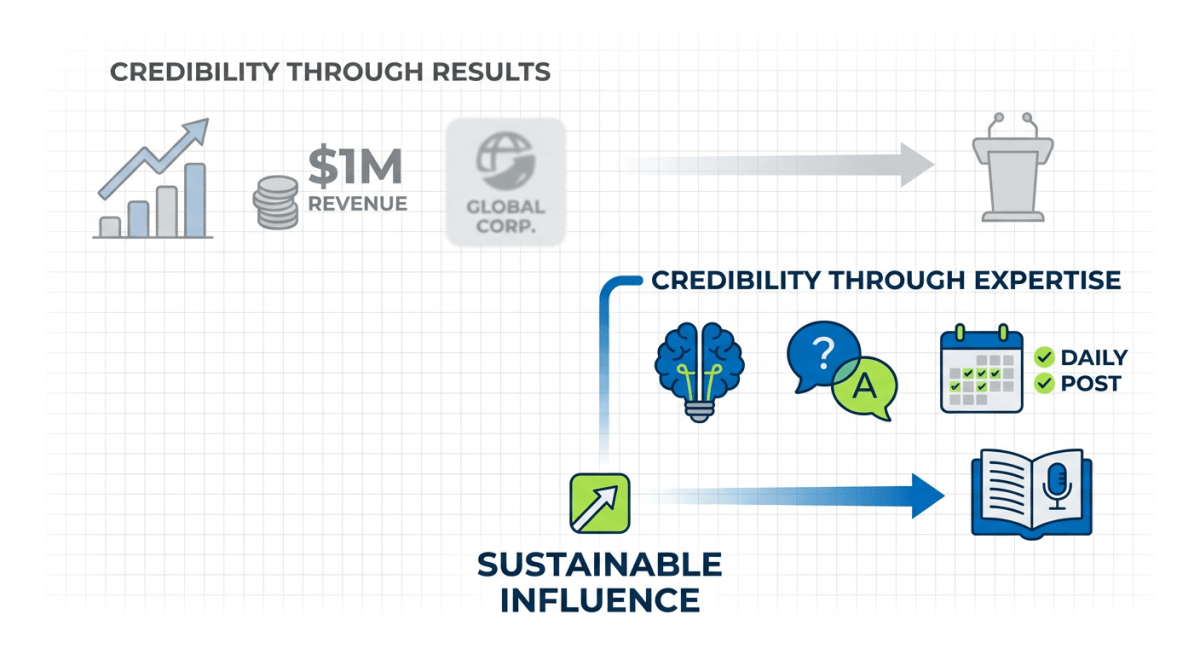 Credibility Paths for Pre-Revenue Founders
The founders who build the strongest pre-revenue LinkedIn presence focus obsessively on these signals. When they eventually do have results, the audience is already there.
The Practical Routine
You're building a company. You don't have infinite time for content.
Here's a sustainable approach:
Weekly time investment: 2-3 hours
- 1 hour: Write 2-3 posts for the week
- 30 minutes daily (in small chunks): Engage with comments and other posts
Content cadence: 2-3 posts per week
More isn't better at this stage. Consistency matters more than volume.
The simple system:
- Keep a running note of interesting moments from your week (customer calls, insights, challenges)
- Sunday evening: Review notes and draft 2-3 posts for the week
- Schedule posts for Tuesday, Wednesday, Thursday
- Spend 10-15 minutes after each post engaging with comments
That's it. No complex content calendar. No production team. Just consistent documentation of your journey.
What to Avoid
A few patterns that hurt pre-revenue founders on LinkedIn:
Fake it till you make it language: Don't imply traction you don't have. "We're seeing amazing results" when you have no customers will backfire. People can tell.
Premature founder flexing: Posts about "lessons from building my company" hit different when your company is two months old with no users. Save the retrospective wisdom for when you have real lessons.
Constant pitching: If every post is about your product, you'll build no audience. Remember the 60-30-10 rule: 60% value content, 30% personal content, 10% promotional. Pre-revenue, lean even more toward value.
Comparison and complaints: Don't post about how hard fundraising is or how you're struggling compared to other founders. It doesn't build credibility. Process the hard stuff elsewhere.
Waiting for permission: The biggest mistake is waiting until you have metrics to start posting. Every day you wait is audience-building time you'll never get back.
The Long Game
Here's what happens if you do this right:
In month 1, you'll feel like you're posting into a void. Engagement will be minimal. That's normal.
By month 3, you'll notice familiar names in your comments. People following your journey.
By month 6, you'll have potential customers reaching out. Investors asking for updates. People rooting for your success.
When you finally have metrics to share, you won't be announcing to strangers. You'll be updating friends.
That's the real opportunity for pre-revenue founders on LinkedIn. Not pretending to have traction you don't have. Building an audience that will be there when you do.
Start this week. Document one thing you learned from a customer conversation, one insight about your industry, or one challenge you're facing.
Post it.
Your first 1,000 followers don't care about your ARR. They care about your thinking, your journey, and your authenticity. You have all of those right now.
Ready to start building your LinkedIn presence? Use Postking's free post formatter to structure your posts for maximum readability, or create professional carousels to share your insights in a more visual format.
Related Reads
Written by
Shanjai Raj
Founder at Postking
Building tools to help professionals grow on LinkedIn. Passionate about content strategy and personal branding.
View all postsYou might also like
LinkedIn Posting Frequency Calculator
Try our free linkedin posting frequency calculator to enhance your LinkedIn presence.
LinkedIn Post Ideas Generator
Try our free linkedin post ideas generator to enhance your LinkedIn presence.
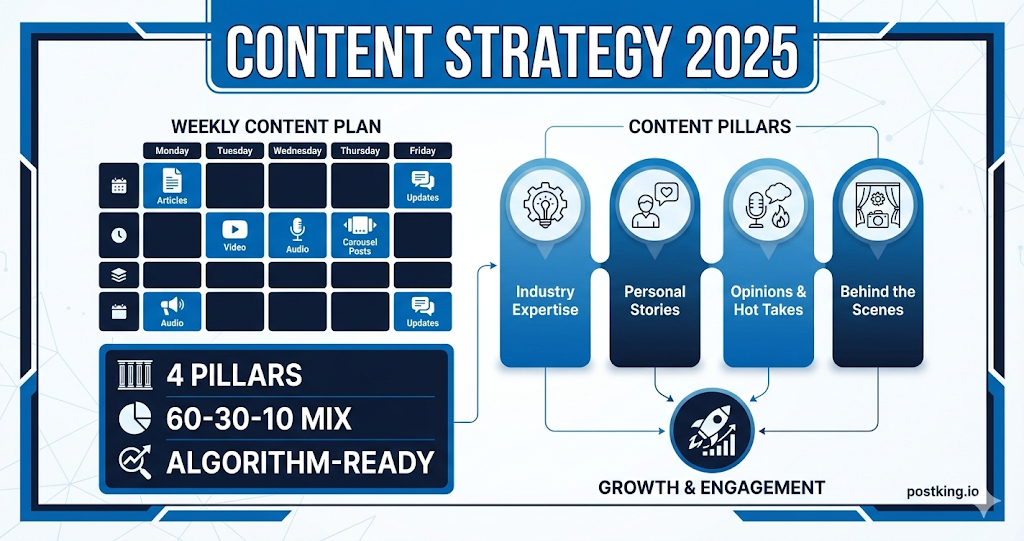
LinkedIn Content Strategy for 2026: The Complete Framework
Build a LinkedIn content strategy that actually works in 2026. Includes the 4-pillar framework, content mix ratios, posting schedules, and algorithm-proof tactics backed by latest data.
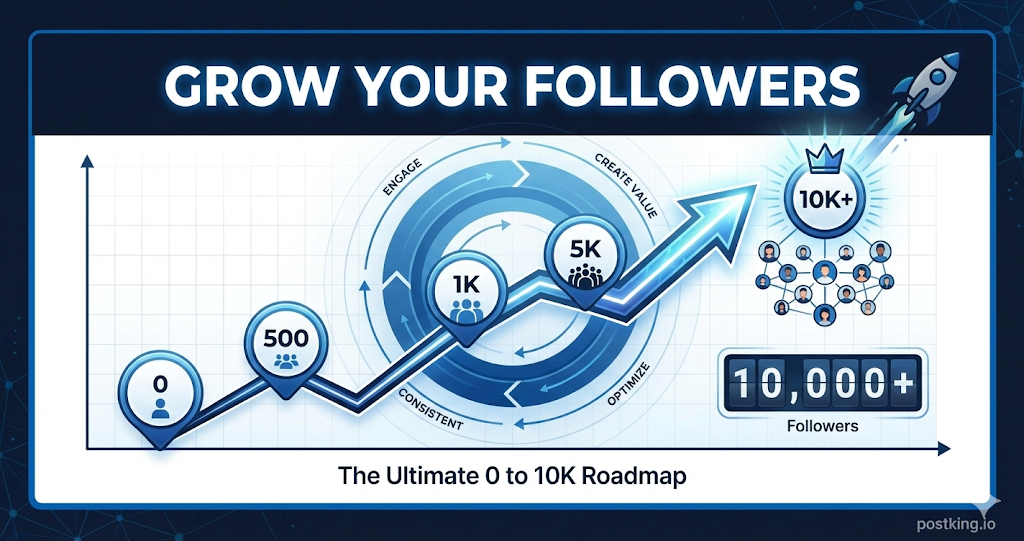
How to Grow LinkedIn Followers: A Realistic Guide to Organic Growth
Learn proven strategies to grow your LinkedIn following organically. Covers the follower growth flywheel, content that attracts followers, engagement tactics, and realistic timelines from 0 to 10,000 followers.
LinkedIn Post Formatter
Try our free linkedin post formatter to enhance your LinkedIn presence.
LinkedIn Client Acquisition for Coaches and Consultants (2026)
A client-focused LinkedIn strategy for coaches and consultants. Build authority, attract high-ticket clients, and convert profile views into calls.
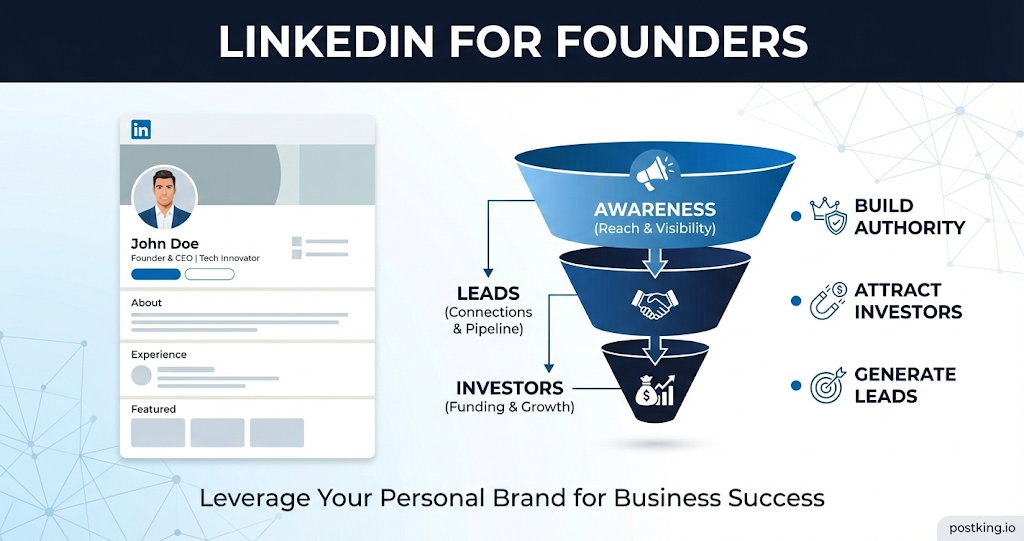
LinkedIn Growth Strategy for Founders (2026 Guide)
A complete LinkedIn growth playbook for founders to build authority, attract investors, and grow pipeline.
more engagement with carousels
Create scroll-stopping LinkedIn carousels in under 60 seconds. No design skills needed.
Try Carousel Generator