LinkedIn Client Acquisition for Coaches and Consultants (2026)
A client-focused LinkedIn strategy for coaches and consultants. Build authority, attract high-ticket clients, and convert profile views into calls.

Shanjai Raj
Founder at Postking
78% of consultants say referrals are their primary source of new clients. But here's what that statistic misses: most of those referrals happen after someone checks your LinkedIn profile first.
The referral might come from a warm introduction, but the deal closes (or dies) based on what that prospect finds when they look you up. Your profile is working even when you're not actively posting. And if you are posting, those referrals come faster and more frequently.
Coaches and consultants have a unique advantage on LinkedIn. You're not selling a product someone can compare on a feature matrix. You're selling transformation, expertise, and trust. That's exactly what LinkedIn content does well, when you know how to use it.
Why LinkedIn Beats Every Other Platform for Service Providers
Instagram and TikTok reward entertainment. Twitter rewards hot takes. LinkedIn rewards expertise.
For coaches and consultants, this matters because your buyers are already there. 89% of B2B marketers use LinkedIn for lead generation, and 62% say it generates leads for them effectively. Those numbers aren't just for software companies. They represent executives, business owners, and decision-makers actively looking for people who can help them solve problems.
The platform's structure works in your favor too:
Longer shelf life. A LinkedIn post stays visible for 24-48 hours, sometimes longer. Instagram stories disappear in 24 hours. Tweets fade in minutes. On LinkedIn, a strong post can bring you profile visits for days.
Professional context. When someone reads your content on LinkedIn, they're already in "work mode." They're thinking about business problems, growth, and who might help them. You don't need to interrupt their entertainment, you're meeting them where they're already focused.
Built-in credibility signals. Your profile shows your experience, recommendations, and connections. These social proof elements transfer automatically to your content. A first-time viewer can validate your expertise in 30 seconds.
Direct messaging that works. LinkedIn DMs have higher response rates than cold email because people expect business conversations there. When someone reaches out after seeing your content, you're having a warm conversation, not a cold pitch.
Profile Optimization: Attract Clients, Not Just Connections
Most coaches have profiles that read like resumes. Years of experience. Certifications earned. Clients served.
None of that answers what your prospect actually wants to know: "Can this person solve my specific problem?"
Headline Formula for Coaches and Consultants
Your headline shows up everywhere: search results, comments, connection requests, posts. It's your first impression 90% of the time.
Stop with: "Executive Coach | ICF Certified | 15 Years Experience"
Start with: "I help [specific audience] achieve [specific outcome] | [proof point]"
Examples that work:
- "I help first-time founders close their first 10 enterprise deals | Former VP Sales at Salesforce"
- "Leadership coach for technical leaders who just got promoted | 200+ engineers turned effective managers"
- "I help burned-out agency owners build teams that run without them | Built and sold 2 agencies"
Front-load the outcome. Put your credentials at the end, if at all. People care about what you can do for them before they care about your qualifications.
For more headline optimization tactics, check out our LinkedIn headline guide.
About Section: The First Three Lines Matter Most
LinkedIn shows only the first 3 lines of your About section before the "see more" button. Those lines need to hook visitors or they'll never read the rest.
Weak opening: "I'm a certified executive coach with 15 years of experience helping leaders..."
Strong opening: "Most new VPs fail within 18 months. Not because they lack skills, but because nobody prepared them for the politics, the isolation, and the pressure of decisions that actually matter."
The second version creates tension. It speaks to a specific fear. It makes the right person think "that's exactly what I'm dealing with."
Structure your About section like this:
- Hook (lines 1-3): A bold statement that speaks directly to your ideal client's situation
- Problem (next 2-3 sentences): Describe what happens when they don't solve this problem
- Your approach (1 paragraph): How you work differently from others (without giving away the methodology)
- Proof points (bullet list): 3-5 specific results, not vague claims
- Call to action: What should they do next?
Featured Section: Your Proof Gallery
The Featured section sits right below your headline. Use it strategically to showcase:
- Lead magnets: A free assessment, framework PDF, or checklist that captures email addresses
- Case studies: Anonymized client transformations with specific numbers
- Video content: A 2-minute video of you explaining your philosophy builds trust faster than text
- High-performing posts: Your best content, pinned for new visitors
Don't clutter this section. Three to four items maximum. Each one should answer: "Why should I trust this person?"
Content Pillars That Showcase Expertise Without Giving Away the Store
Here's the tension every coach faces: "If I share my best insights, why would anyone pay me?"
This thinking is backwards. The people who pay for coaching aren't paying for information. They're paying for implementation, accountability, and personalized guidance. Free content that demonstrates your expertise is what makes them confident enough to pay.
But there's a difference between sharing what and sharing how. Share what you know. Keep the how, the detailed methodology that makes you effective, for paying clients.
Pillar 1: Problem Articulation
Your ideal clients often don't know exactly what's wrong. They feel the symptoms but haven't diagnosed the cause. When you articulate their problem better than they can, they assume you must have the solution.
What to share:
- Specific scenarios your clients face before they hire you
- The hidden costs of not solving this problem
- Why common "solutions" don't actually work
- Patterns you see across similar clients
Example post:
"The leadership team keeps telling you to 'scale yourself.' What they actually mean: stop being the bottleneck. But nobody explains how to do that when every decision lands on your desk because the team isn't ready.
The real problem isn't delegation. It's that you hired smart people but kept making all the decisions anyway. Now they wait for you by default.
The fix takes 90 days, not 90 minutes. But it starts with one shift: next decision that hits your inbox, ask yourself, 'Who on my team could make this call if I gave them the context?'
Then give them the context. And walk away."
This post demonstrates expertise, offers a useful insight, and creates curiosity about the full methodology.
Pillar 2: Framework Previews
Share the existence of your frameworks without the complete playbook. Give enough to be useful. Keep enough to be valuable.
What to share:
- The name and structure of your methodology (e.g., "The 3-Phase Leadership Transition")
- One or two components with practical application
- Why this framework exists (the problem that inspired it)
- A teaser of results clients achieve with it
Example:
"After coaching 100+ first-time managers, I noticed the same three phases everyone goes through:
Phase 1: The Imposter (months 1-3) You wonder why they promoted you. You overcorrect by either micromanaging or being too hands-off.
Phase 2: The Firefighter (months 4-8) You're constantly putting out fires. The team is functional but you're exhausted. Everything still flows through you.
Phase 3: The Multiplier (month 9+) You finally learn that your job isn't doing the work, it's building the team that does the work.
Most managers get stuck in Phase 2 indefinitely. The shift to Phase 3 requires unlearning everything that made you successful as an individual contributor.
That's what we work on in coaching."
The framework provides value. The final line positions coaching as the path to implementing it.
Pillar 3: Client Stories (Anonymized)
Results speak louder than claims. But client confidentiality matters. Here's how to share transformations without exposing identities.
What to share:
- The before state (in enough detail to be relatable)
- The turning point (a key insight or shift)
- The after state (with specific, measurable outcomes)
- The lesson for readers (something they can apply regardless of coaching)
Example:
"Worked with a founder who was doing $80K/month but couldn't break past it. Every time they got close to $100K, something would pull them back. Team issues, personal stuff, 'bad luck.'
Took three sessions to figure out the pattern. Every time the business grew, they unconsciously created chaos. Picked fights with partners. Made unnecessary pivots. Started new projects.
The $80K ceiling wasn't a business problem. It was an identity problem. That was the number where they'd always felt 'successful.' Going beyond it meant becoming someone new.
We spent six months on identity work, not strategy. The business hit $200K/month within a year.
Sometimes the obstacle isn't the obstacle."
No names. No industry. But enough detail that similar founders recognize themselves.
Pillar 4: Contrarian Perspectives
Coaches who agree with everything are forgettable. Taking a stand, even a controversial one, attracts the right clients and repels the wrong ones.
What to share:
- Industry conventional wisdom you disagree with
- Practices you refuse to use and why
- Trends you think are overrated
- Hard truths your competitors won't say
Example:
"Unpopular opinion: most leadership assessments are expensive horoscopes.
You answer 200 questions. You get a report that says you're a 'Strategic Visionary with Collaborative Tendencies.' You nod along because it sounds right. It gets filed somewhere and never affects anything.
Here's what assessments can't tell you: how you'll react when the board wants to fire your best friend, or how you'll handle discovering your VP has been lying for six months.
Character gets revealed under pressure, not through questionnaires.
Save the assessment budget. Put your leaders in challenging situations and watch what happens. That's the real assessment."
This post will lose followers who love assessments. That's fine. It will attract leaders who think the same way and want a coach who challenges conventional thinking.
The Pre-Qualification Content Strategy
Every post you write should do some pre-qualification. You want prospects to self-select before they ever DM you. The goal isn't maximum leads, it's maximum qualified leads.
Signal your price range without stating it:
"I work with founders who've already hit product-market fit. If you're still figuring out if anyone wants what you're building, you're not ready for scale coaching, and that's okay. Build first. We can talk when you've validated the model."
This post filters out early-stage founders who can't afford (or don't need) high-ticket coaching.
Signal your style:
"Fair warning: I don't do gentle accountability. If you tell me you'll do something by Tuesday and you don't do it, we're having a conversation about that. Some clients love this. Others find it too intense. Know yourself before you reach out."
Now prospects know what they're signing up for. People who want a supportive listener will go elsewhere. People who want a demanding coach will be even more interested.
Signal your niche:
"My clients are all in the same boat: they built something successful but now they're trapped by it. The business can't run without them. They can't take a vacation. Every decision flows through them. If that's not you, this content won't resonate."
You've just filtered for exactly the problem you solve. Everyone else scrolls past. The right people lean in.
 Pre-Qualification Content Framework
Building a Content System That Runs Alongside Client Work
The number one reason coaches stop posting: client work takes over. When you're deep in sessions, content creation falls off the calendar. You disappear for weeks. You lose momentum. You have to start over.
The fix isn't discipline. It's systems.
The Content Banking Method
Spend one focused session per week (60-90 minutes) filling a content bank. Not writing finished posts, just capturing ideas when they're fresh.
After client sessions, ask yourself:
- What question did they ask that others probably wonder about?
- What breakthrough happened that could inspire a post?
- What pattern am I seeing across multiple clients?
- What did I explain that I've never shared publicly?
Capture the raw idea immediately. Write the full post later.
During reading and research, save anything that sparks a reaction. Agree or disagree, you have a take. That's content.
After conversations and events, notice what comes up repeatedly. If you're explaining the same concept three times a week, it's a post.
If capturing your thoughts feels tedious, tools like PostKing let you record your ideas out loud and turn them into polished posts. Talk through a client insight in 5 minutes. Get a structured post you can edit and schedule.
The Batching Ritual
Pick one morning per week. Block 2-3 hours. Write 3-5 posts in one session.
Why batching works:
- You only need to "get into the zone" once
- Ideas compound as you write
- You're not stressed about creating something on the day
- You can schedule everything and forget about it
The rest of the week, you just engage with comments and DMs. The hard work (creation) is already done.
Repurposing for Maximum Leverage
One piece of coaching expertise can become five pieces of content:
- A LinkedIn text post (the core idea)
- A carousel breaking down the framework (visual learners engage differently)
- A short video (builds personal connection)
- A comment reply (when the same question keeps coming up)
- A newsletter deep-dive (for your owned audience)
If you've already written a blog post, recorded a podcast, or given a talk, that content can be broken into LinkedIn posts. Work smarter, not harder.
For carousel creation, our LinkedIn carousel generator helps coaches turn frameworks into visual content that gets saved and shared.
The "Value-First" Approach That Converts
Here's the mistake most coaches make on LinkedIn: they post helpful content but never connect it to their paid work. The audience learns from them but never thinks about hiring them.
The fix is what I call the value-first loop:
- Share freely (build trust and demonstrate expertise)
- Hint at depth (suggest there's more behind the curtain)
- Open a door (invite interested people to take a next step)
- Make the ask occasionally (directly mention how to work with you)
Most posts are step 1 and 2. Occasionally you do step 3 (soft CTAs like "DM me if this resonates"). Rarely you do step 4 (direct pitches, launch announcements).
The ratio matters. If every post ends with "book a call," you sound desperate. If you never mention how to work with you, you're a content creator, not a business.
Rough ratio for coaches:
- 70% pure value (no CTA or a very soft one)
- 20% door-openers ("DM me if you want my framework PDF")
- 10% direct asks ("I have 2 spots open for Q1, here's how we work together")
Soft CTAs That Work
- "If this resonates, curious what you've tried"
- "Drop a comment if you want me to go deeper on any part of this"
- "I wrote a longer guide on this, DM 'guide' if you want it"
- "If you're dealing with this right now, happy to share what's worked for my clients"
Converting Interest to Conversations
When someone engages meaningfully with your content, you've earned the right to reach out.
Not with: "Thanks for the comment! Want to hop on a call?"
But with: "Saw your comment about struggling with the same thing. Curious what you've already tried?"
Open a conversation about their situation. Learn what they're dealing with. Then, if it's a fit, offer to help.
This is the opposite of cold outreach. They came to you. They raised their hand. Now you're just being helpful.
Tracking What Actually Matters
Likes are nice. Followers are nice. But coaches and consultants need clients, not audiences.
Metrics that matter:
- Profile views from your ideal audience: Are decision-makers looking at your profile? Check your profile analytics weekly.
- DM conversations started: How many new conversations came from content this month?
- Qualified calls booked: How many of those conversations became discovery calls?
- Clients closed from LinkedIn: Track your actual revenue from the platform.
Metrics that don't matter as much:
- Follower count (1,000 right-fit followers beat 10,000 random ones)
- Post impressions (reach without resonance is noise)
- Vanity engagement (motivational quotes get likes but don't close deals)
Review monthly: "How many paying clients came from LinkedIn this month?" That's the only number that determines if your strategy is working.
The Freebie-Seeker Problem
Every coach knows this frustration: people who consume everything free but never pay for anything.
Content attracts both buyers and freebie-seekers. You can't eliminate the second group, but you can filter for the first.
Strategies that work:
Be specific about who you serve. Generalist content attracts generalist audiences. "I help B2B sales teams who've plateaued at $5M ARR" is much more filtering than "I help businesses grow."
Price anchor naturally. Mention past client contexts that signal premium pricing: "One founder I worked with was doing $3M/year..." This sets expectations without stating rates.
Create friction before value. A 3-question form before your free guide filters out people who aren't serious. If they won't answer three questions, they won't buy coaching.
Stop over-giving. If your free content is complete and comprehensive, why would anyone pay? Share what generously. Keep how for clients.
Qualify in your CTAs. Instead of "DM me to learn more," try "DM me if you're actively looking to solve this in Q1." The second version filters for urgency and intent.
Putting It Together: Your Weekly LinkedIn Routine
Here's a realistic schedule that runs alongside client work:
Monday (60 minutes): Write 2-3 posts for the week. Schedule them.
Tuesday-Thursday (15 minutes each): Reply to comments on your posts. Engage with 5-10 posts from your target audience.
Friday (30 minutes): Review DMs. Start conversations with engaged prospects. Check analytics.
Monthly (60 minutes): Review what performed. Identify patterns. Adjust content pillars if needed.
Total time: ~4 hours per week. That's manageable even during busy client periods.
The Long Game for Coaches
LinkedIn isn't a quick fix. The first month might feel like shouting into a void. You'll post and nothing will happen.
But around month 3-4, something shifts. People start recognizing your name. They remember that post you wrote. They refer their friends to your profile.
By month 6-12, inbound leads become consistent. Your referrals increase because people share your posts. Discovery calls start with "I've been following you for months."
The coaches who win on LinkedIn are the ones who keep showing up when it feels pointless. Consistency beats intensity every time.
Start with 3 posts per week for 90 days. Then evaluate. But don't evaluate at week 2. The algorithm, and your audience, need time to understand who you are and what you offer.
Your expertise deserves to be seen. LinkedIn is where your clients are already looking. The only question is whether they'll find you, or find your competitor.
Ready to start? Pick one content pillar from this guide. Write your first post today. Don't overthink it. Your future clients are waiting.
Related Reads
Written by
Shanjai Raj
Founder at Postking
Building tools to help professionals grow on LinkedIn. Passionate about content strategy and personal branding.
View all postsYou might also like
LinkedIn Posting Frequency Calculator
Try our free linkedin posting frequency calculator to enhance your LinkedIn presence.
LinkedIn Post Ideas Generator
Try our free linkedin post ideas generator to enhance your LinkedIn presence.
How to Get Inbound Leads on LinkedIn as a Consultant: The Authority-First Approach
Stop chasing clients. Learn how consultants build authority through content, turn engagement into natural conversations, and create a sustainable inbound lead system that works while you're serving clients.
LinkedIn Profile Optimization for Consultants: Convert Profile Views Into Discovery Calls
Learn how consultants should optimize their LinkedIn profiles differently than job seekers. Includes conversion-focused strategies for every profile section, how to showcase results without breaking confidentiality, and strategic CTA placement to turn visitors into paying clients.
LinkedIn Hook Generator
Try our free linkedin hook generator to enhance your LinkedIn presence.
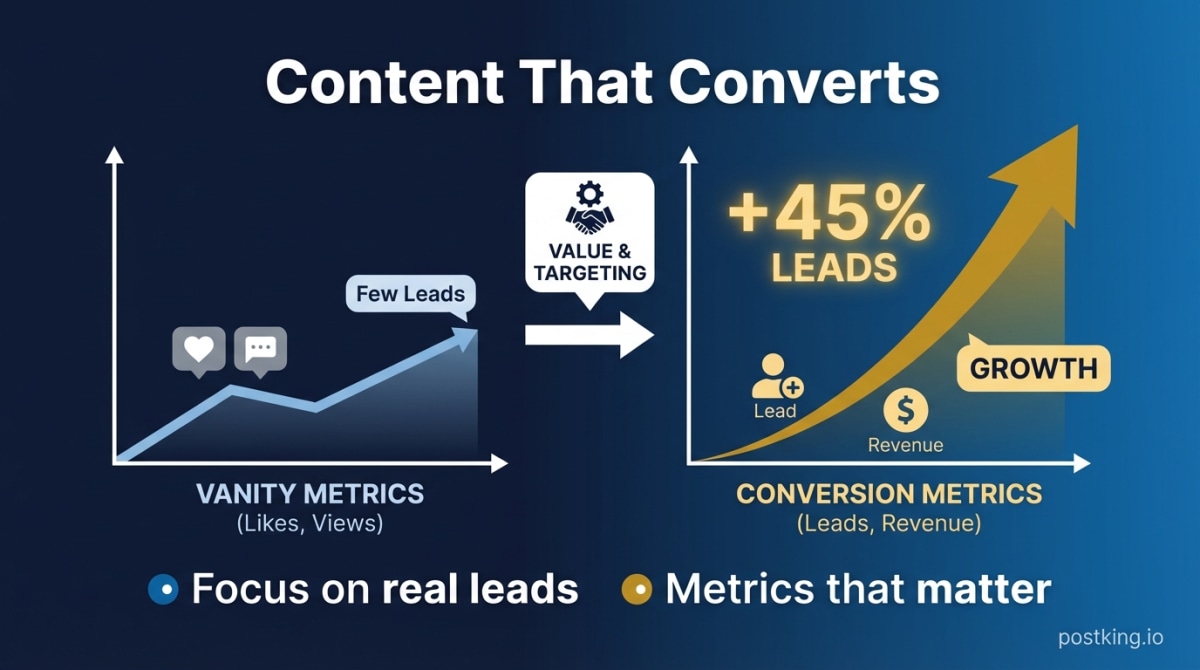
LinkedIn Content That Actually Converts (Not Just Gets Likes)
Stop chasing vanity metrics. Learn why viral posts rarely drive revenue, how to create content that generates leads, and the metrics that actually matter for founders.
How to Grow LinkedIn Followers: A Realistic Guide to Organic Growth
Learn proven strategies to grow your LinkedIn following organically. Covers the follower growth flywheel, content that attracts followers, engagement tactics, and realistic timelines from 0 to 10,000 followers.
more engagement with carousels
Create scroll-stopping LinkedIn carousels in under 60 seconds. No design skills needed.
Try Carousel Generator