LinkedIn Growth Strategy for Founders (2026 Guide)
A complete LinkedIn growth playbook for founders to build authority, attract investors, and grow pipeline.

Shanjai Raj
Founder at Postking
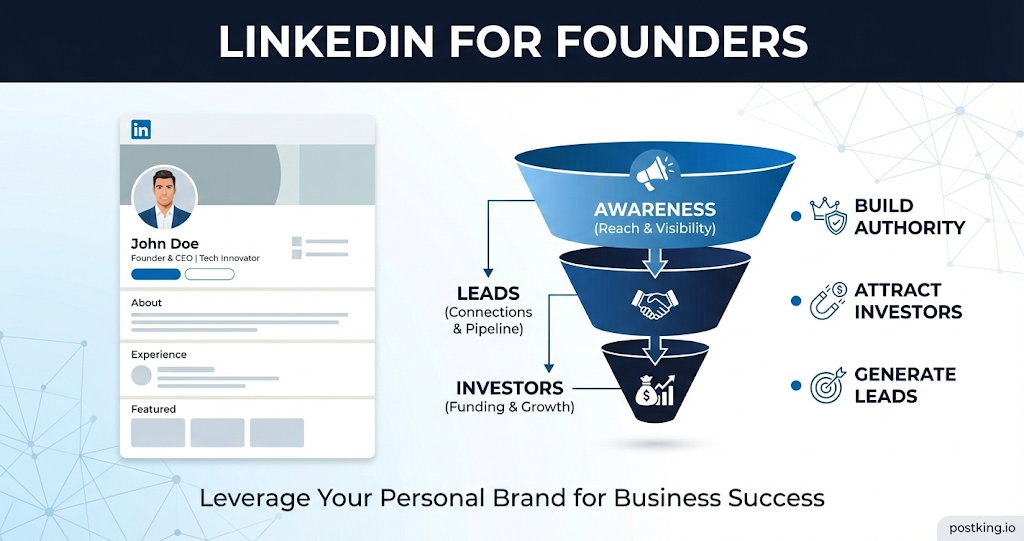
84% of investors research founders on social media before taking a meeting.
That statistic alone should tell you why LinkedIn isn't optional anymore. Your profile is running due diligence 24/7, whether you're actively fundraising or not.
Here's what makes this interesting: only 1% of LinkedIn's users post content weekly, yet the platform generates over 9 billion impressions per week. The gap between supply and demand for quality content is massive. For founders willing to show up consistently, the opportunity is wide open.
This guide covers everything: optimizing your profile for investor and customer discovery, the content pillars that actually work for founders, building in public without giving away the farm, and a realistic weekly routine that doesn't require becoming a full-time content creator.
The Founder Advantage on LinkedIn
You have something most LinkedIn users don't: a real story with real stakes.
Employees can share career tips. Consultants can offer advice. But founders live in the trenches. You make high-stakes decisions with incomplete information. You've felt the weight of making payroll. You've pivoted when the market shifted. You've hired, fired, raised money, lost deals, and learned lessons the hard way.
That authenticity is your edge.
Posts from founder accounts get 561% more reach than posts from company pages. People engage with people, not logos. And in a platform filled with generic "thought leadership," raw founder experiences cut through.
But there's a strategic layer here too. Your LinkedIn presence directly affects:
- Investor conversations: VCs and angels check your profile before meetings. A strong presence signals you understand marketing and can represent the company.
- Talent acquisition: Top candidates research founders. Your content shapes whether A-players want to join your mission.
- Customer trust: In B2B especially, buyers want to know who's behind the product. A credible founder profile accelerates sales cycles.
- Partnership opportunities: Inbound interest from potential partners, podcast hosts, and conference organizers comes from visibility.
The compounding effect is real. One founder, Adam Robinson of Retention.com, generated $4M ARR while attributing much of his growth to LinkedIn content. He spent 65% of his time on content, which sounds extreme until you realize it replaced most of his outbound sales motion.
You don't need to go that far. But you do need to take it seriously.
Profile Optimization for Founders
Your profile isn't a resume. It's a landing page.
Every element should answer one question for visitors: "What's in this for me?" Whether that visitor is an investor evaluating your credibility, a prospect considering your product, or a candidate researching your company, your profile should speak to them.
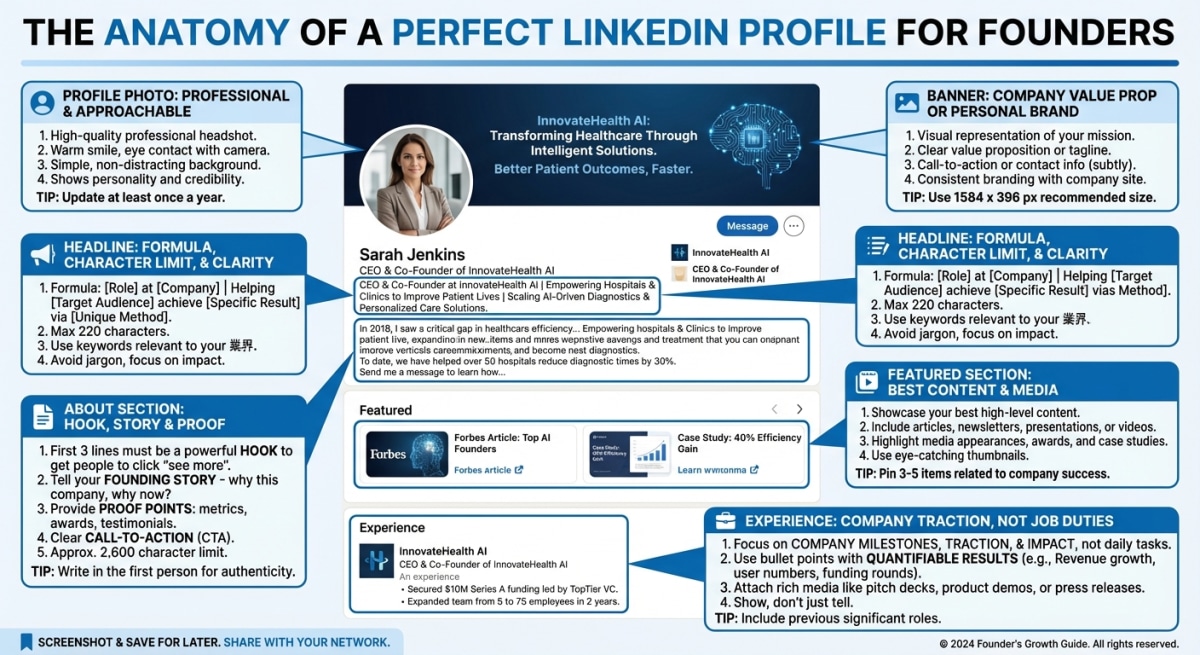 Founder's LinkedIn Profile Anatomy
Profile Photo
Investors and customers form first impressions in milliseconds. Your photo should convey competence and approachability.
What works: Professional headshot with good lighting, solid or blurred background, and an expression that matches your brand (confident smile for consumer brands, more serious for enterprise).
What doesn't: Selfies, cropped group photos, outdated images from 10 years ago, or casual vacation shots.
A professional photographer costs $200-400. Worth it. But a smartphone in good natural light works if budget is tight.
Banner Image
Most founders leave this as LinkedIn's default blue gradient. That's wasted real estate.
Your banner (1584 x 396 pixels) should reinforce your positioning. Options:
- Your company's value proposition in text
- A simple tagline with your logo
- Social proof (as seen in TechCrunch, Forbes 30 Under 30, etc.)
- Visual representation of your product or mission
Keep critical content on the right side and center. Your profile photo overlaps the lower left.
Headline (220 characters)
The default headline is just your title and company. That tells people nothing about why they should care.
Formula that works for founders: [Role] at [Company] | [Who You Help] | [Proof Point or Mission]
Examples:
- "CEO at Fintech X | Helping SMBs automate payments | Forbes 30 Under 30"
- "Founder at DevTools Co | Building the GitHub for data teams | $2M ARR, bootstrapped"
- "Co-Founder at HealthTech | Reducing hospital readmissions by 40% | Y Combinator W24"
Front-load the most important keywords in the first 100 characters. That's what shows in search results and notifications.
For more headline formulas and examples, check out our complete LinkedIn headline guide.
About Section (2,600 characters)
This is where most founders fail. They either leave it blank or write a corporate biography that reads like a press release.
The first 3 lines are everything. That's what shows before "see more." Hook them or lose them.
Structure that works:
- Hook (lines 1-3): Lead with a bold statement, a key metric, or a question that resonates with your target audience
- Story (next 3-4 paragraphs): Why you started this company. What problem you're solving. What drives you.
- Proof points (bullet list): 3-5 specific achievements, metrics, or credentials
- Call to action: What do you want readers to do? Connect? Book a demo? Check out your product?
Write in first person. "I started this company because..." reads more authentic than "John founded XYZ to address..."
Featured Section
Pin your best content here. This appears near the top of your profile and lets you control what visitors see first.
What to feature:
- Your highest-performing LinkedIn post
- A product demo or explainer video
- Press coverage or podcast appearances
- Case studies or customer success stories
- A link to your company's website with a compelling description
Experience Section
Here's where founders get it wrong: they treat this like a resume, listing responsibilities.
Nobody cares that you "focus on long-term strategy" or "oversee operations." They want to know about your company and its traction.
Use your experience section as another About section for your company:
First sentence: What does your company do? (Clear, jargon-free) Second sentence: Key traction metrics (revenue, users, growth rate, notable customers) Third sentence (optional): Recent milestone or what you're working on
Example:
"BuildCo is a construction management platform that helps general contractors reduce project delays by 30%. We've grown to $3M ARR with 200+ contractors on the platform, including three of the top 50 ENR firms. Currently expanding into commercial real estate."
That tells an investor or customer everything they need in three sentences.
For a complete profile optimization walkthrough, see our LinkedIn profile optimization guide.
Content Pillars for Founders
Not all founder content performs equally. The most successful founders on LinkedIn rotate between four distinct content types, each serving a different purpose.
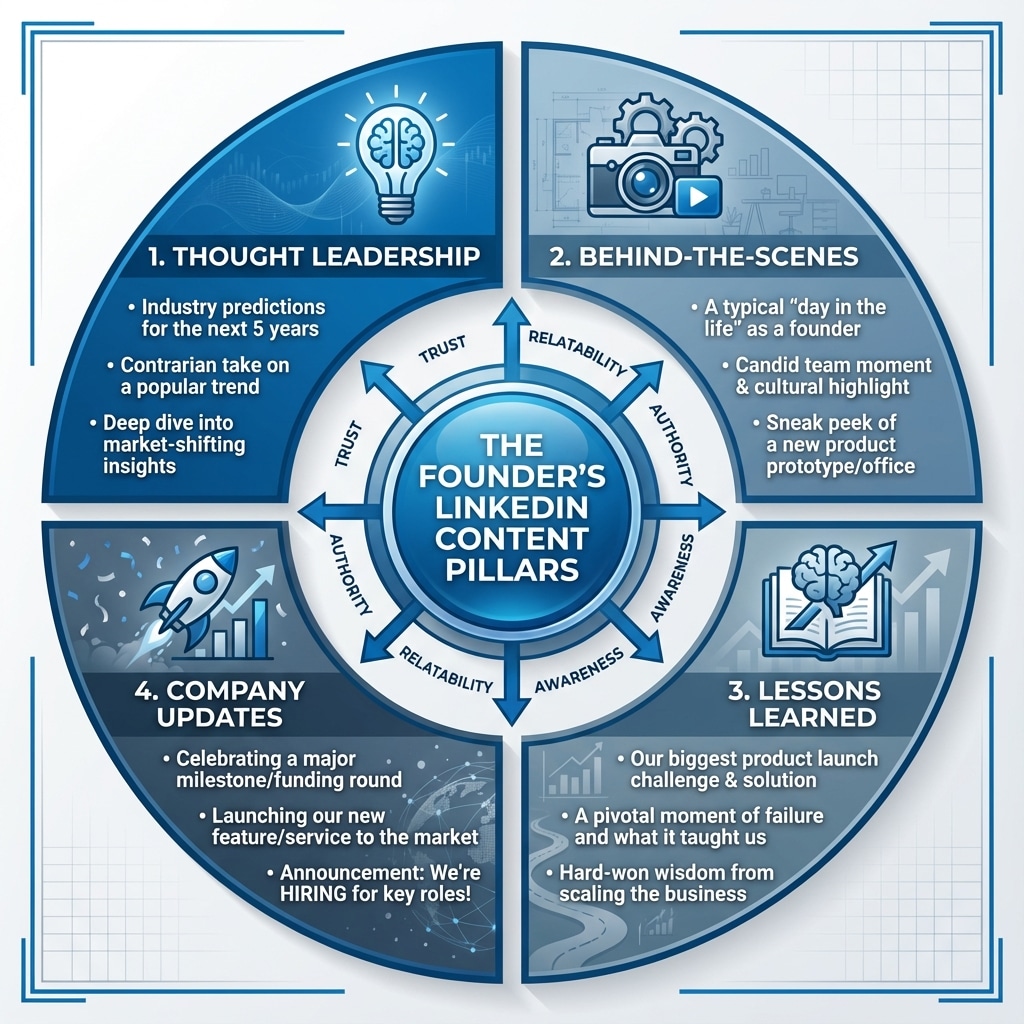 Content Pillars for Founders
Pillar 1: Thought Leadership
This is where you share industry insights, market analysis, and informed opinions. It positions you as someone who understands the landscape deeply.
What to post:
- Predictions about where your industry is heading
- Analysis of trends affecting your customers
- Contrarian takes on conventional wisdom
- Commentary on industry news
Example topics:
- "Three shifts in B2B buying that most vendors are ignoring"
- "Why I think [industry trend] is overhyped"
- "What our customer data tells us about [market behavior]"
Frequency: 1-2x per week
Why it works: Investors want to fund founders who understand their market. Customers want to buy from experts. Thought leadership content proves you're paying attention.
Pillar 2: Behind-the-Scenes
Pull back the curtain on founder life. Show the human side of building a company.
What to post:
- A day in your life as a founder
- Photos from team meetings, offsites, or product sessions
- Your workspace, tools, or routines
- Celebrating team wins (new hires, anniversaries, small victories)
Example topics:
- "What my calendar actually looks like during fundraising"
- "Our team's Friday retrospective tradition"
- "The whiteboard session that led to our biggest feature"
Frequency: 1x per week
Why it works: It builds relatability. People want to connect with humans, not polished corporate personas. These posts often drive the most engagement because they feel real.
Pillar 3: Lessons Learned
Share hard-won wisdom. Talk about failures, pivots, and mistakes. This is what "building in public" really means.
What to post:
- A mistake you made and what it taught you
- Why you pivoted from your original idea
- What you'd do differently if starting over
- Advice you wish you'd received earlier
Example topics:
- "We burned $50K on a feature nobody used. Here's what we learned."
- "I hired for skills instead of values. Never again."
- "The customer feedback that made us rebuild everything"
Frequency: 1-2x per week
Why it works: Vulnerability builds trust. When you share failures, you demonstrate self-awareness and growth mindset qualities investors specifically look for. These posts also tend to go semi-viral because they resonate emotionally.
Pillar 4: Company Updates
Share milestones, launches, and news about your company. But do it in a way that provides value, not just announcements.
What to post:
- Funding announcements (with context on what it means)
- Product launches (focusing on the customer problem solved)
- Customer wins (with permission, and focusing on their success)
- Hiring updates (with personality and culture context)
Example topics:
- "We just crossed $1M ARR. Here's exactly how we got here."
- "Launching our new feature today. Here's why we built it."
- "We're hiring our first sales rep. Here's what we're looking for."
Frequency: As relevant (1-2x per month for most companies)
Why it works: These posts keep your network informed and create FOMO. But the key is framing it as a story or insight, not a press release. "We raised $5M" is boring. "We raised $5M after 47 investor rejections. Here's what finally worked" is compelling.
Building in Public: Strategy and Boundaries
"Building in public" has become a buzzword, but when done right, it's one of the most effective strategies for founders on LinkedIn.
The core idea: share your journey transparently as it unfolds. The wins, the losses, the decisions, the lessons. This builds an audience invested in your success before you even ask them to buy or invest.
Adam Robinson is the clearest example. He shared specific revenue numbers, growth metrics, and even screenshots of his dashboard. His audience watched his company grow in real-time. That transparency turned followers into customers.
But there's a smart way and a reckless way to build in public.
What to Share
- Revenue milestones (if comfortable)
- User growth or engagement metrics
- Lessons from experiments that failed
- Strategic decisions and your reasoning
- Challenges you're facing (without catastrophizing)
- What you're learning along the way
What to Keep Private
- Anything that could help competitors directly replicate your strategy
- Specific pricing experiments before you've learned from them
- Details about investor conversations before deals close
- Customer names without permission
- Internal conflicts or personnel issues
- Financial struggles that could undermine confidence in your company
The Strategic Filter
Before posting, ask: "Does this help my audience while also serving my business goals?"
If it's purely self-promotional, it won't resonate. If it gives away competitive advantages, it's reckless. The sweet spot is content that's genuinely useful to others while positioning you and your company favorably.
One more thing: building in public works best when you're building something worth watching. If your company isn't making progress, constant updates will highlight that. Start with occasional posts and increase frequency as you have more wins to share.
Attracting Investors Through Content
Your LinkedIn content is doing investor relations whether you intend it to or not. VCs and angels scroll the platform daily. Your posts shape their perception long before you send a cold email or get a warm intro.
Strategic content positions you as someone worth betting on.
What Investors Look for in Founder Content
Market understanding: Posts that demonstrate you deeply understand your industry, customers, and competitive landscape signal that you're not just building a product you're building a business.
Self-awareness: When you openly discuss mistakes and learnings, it shows maturity. Investors have seen founders who can't admit when they're wrong, and it rarely ends well.
Traction signals: Casually mentioning metrics (revenue, users, growth rate) in context normalizes your success and creates social proof without being braggy.
Communication skills: Your posts are a proxy for how you'll represent the company. Clear, compelling writing suggests you can pitch, sell, and rally a team.
Content That Attracts Investor Attention
- Industry analysis that shows you understand the market deeply
- Behind-the-scenes posts that demonstrate operational competence
- Customer success stories that prove product-market fit
- Fundraising lessons (after you've closed) that show you understand the process
- Strategic decisions with clear reasoning
What Turns Investors Off
- Constant self-promotion without substance
- Generic motivational content with no specificity
- Complaining about how hard fundraising is (while actively fundraising)
- Overly polished content that feels corporate or inauthentic
- No content at all (signals you don't understand modern marketing)
The Long Game
The founders who benefit most from LinkedIn for fundraising are those who built their presence before they needed it. When you have an engaged audience of investors already following you, a fundraising announcement reaches the right people automatically.
Start now, even if you're not raising for another year.
Generating Leads and Customers
For B2B founders especially, LinkedIn can become your primary lead generation channel. The key is providing value first, consistently, until you've earned the right to sell.
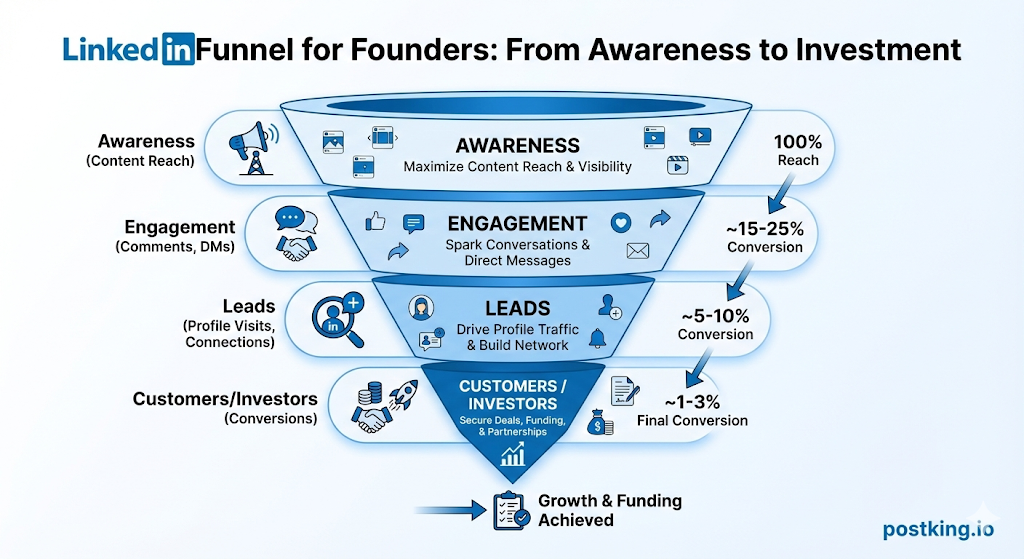 LinkedIn Funnel for Founders
The Value-First Approach
The founders who generate the most leads from LinkedIn rarely post about their product directly. Instead, they:
- Share insights that help their target customers
- Engage thoughtfully in comments on relevant posts
- Build genuine relationships through DMs
- Let their profile and Featured section do the selling
When you consistently help people with zero expectation, some percentage will naturally check out what you're building.
Tactical Lead Generation
Profile as landing page: Your profile should clearly communicate who you help and how. Include a link to your product or a relevant lead magnet in your Featured section.
Content that attracts your ICP: Every post should be written with your ideal customer in mind. What problems do they face? What insights would help them? What do they care about?
Strategic engagement: Don't just post and disappear. Spend 15-20 minutes daily commenting thoughtfully on posts from prospects, partners, and industry voices. This builds visibility and relationships.
DM conversations: When someone engages with your content repeatedly, start a conversation. Not a pitch. A genuine conversation about what they're working on.
Soft CTAs: Occasionally end posts with a low-commitment call to action. "If you're dealing with [problem], my DMs are open" works better than "Book a demo."
LinkedIn Events and Lives
LinkedIn Events let you host webinars directly on the platform. For founders, this is underutilized.
Host a monthly webinar on a topic your customers care about. Promote it to your network. The attendee list becomes a warm lead list, and the event itself establishes authority.
LinkedIn Live is even more powerful for those approved for access. Live content gets priority in the algorithm, and the real-time interaction builds connection faster than static posts.
The Weekly Routine for Busy Founders
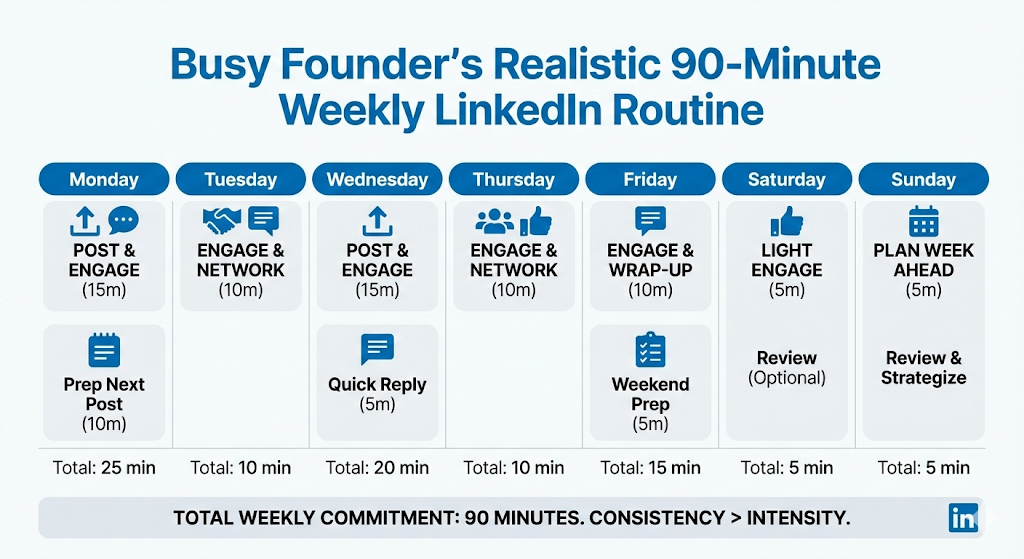
Here's the reality: you don't have 2 hours a day to spend on LinkedIn. You're running a company. You need a system that works in the margins.
 Founder's Weekly LinkedIn Routine
The 90-Minute Week
This routine takes 60-90 minutes per week total, spread across the week:
Monday (30 minutes): Write and schedule your posts for the week. Batch creation is more efficient than daily writing. Use a tool to schedule them.
Tuesday, Thursday (15 minutes each): Engage. Comment on 5-10 posts from people in your network prospects, investors, industry peers. Thoughtful comments, not "Great post!" fluff.
Wednesday, Friday: Respond to comments on your posts. Engage with anyone who took the time to respond to you.
Weekend: Optional. Capture any content ideas that come up. Light engagement if you have spare moments.
The Content Queue
The hardest part is consistently having something to say. Build a content queue:
-
Weekly capture: Keep a note on your phone. When something interesting happens frustration with a tool, a customer conversation, a realization jot it down.
-
Monthly brainstorm: Once a month, spend 30 minutes turning those notes into post outlines.
-
Repurpose everything: A customer call insight becomes a post. A team meeting discussion becomes a behind-the-scenes post. An email response becomes a thought leadership post.
You're already doing interesting things daily. The work is capturing and packaging them, not creating from scratch.
Tools That Help
- Scheduling: Any tool that lets you write posts in advance and schedule them (LinkedIn's native scheduling works fine)
- Formatting: Use Postking's free LinkedIn post formatter to structure posts for maximum readability
- Carousels: Postking's carousel generator turns ideas into visual slide decks that get 3x more engagement
- Analytics: LinkedIn's built-in analytics show what's working. Check monthly at minimum.
Common Mistakes Founders Make
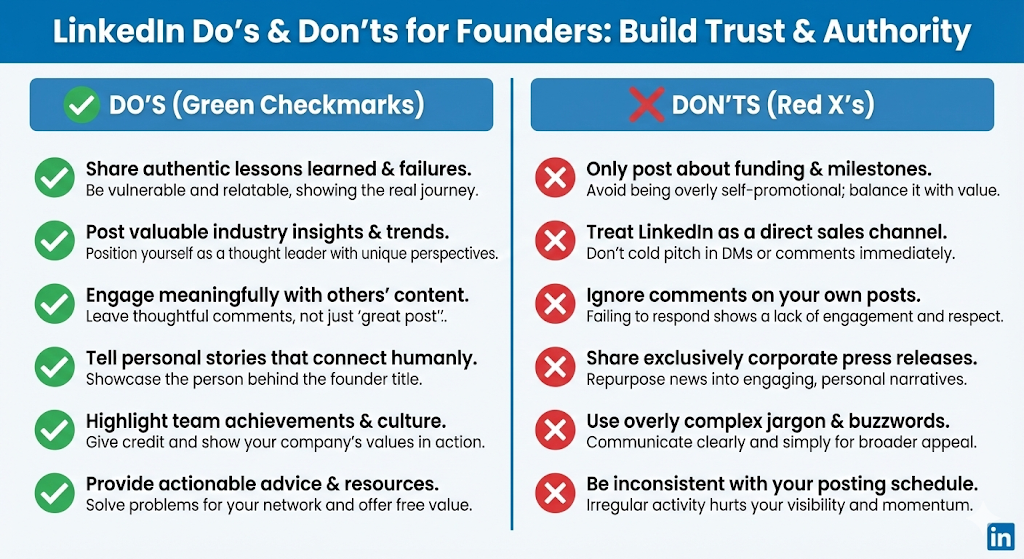
After analyzing hundreds of founder LinkedIn profiles and posts, these patterns kill results:
 LinkedIn Do's and Don'ts for Founders
Mistake 1: Treating LinkedIn Like a Press Release Channel
"Excited to announce..." posts get minimal engagement. Nobody cares about your announcement they care about what it means for them.
Instead of: "We're thrilled to announce our $5M Series A" Try: "We just raised $5M after 47 investor rejections. Here's the one thing we changed that finally worked."
Mistake 2: Only Posting About Your Company
If every post is about your product, you're just running ads. Mix in industry insights, personal lessons, and content that helps your audience even if they never become customers.
Mistake 3: Being Too Polished
The posts that perform worst are the ones that feel like they went through a marketing team. LinkedIn rewards authenticity. Write like you're talking to a friend, not issuing a statement.
Mistake 4: Inconsistent Posting
Random bursts of activity followed by weeks of silence don't build an audience. Consistency matters more than volume. Two posts per week, every week, beats ten posts one week and none the next three.
Mistake 5: Never Engaging
Posting without engaging with others is like showing up to a networking event, giving a speech, and leaving. Spend as much time in comments as you do on your own posts.
Mistake 6: Vague Value Propositions
"We help companies grow" tells me nothing. Be specific about who you help and how. Specificity signals expertise.
Mistake 7: Ignoring DMs
When someone reaches out after your content resonates, respond. Even if it's not an immediate opportunity. These relationships compound.
Learning From Successful Founders
A few founders worth studying for their LinkedIn approach:
Adam Robinson (Retention.com): The poster child for building in public. Shares specific revenue numbers, growth metrics, and raw lessons. Generated massive reach and directly attributed revenue to his LinkedIn presence.
Wes Kao (Maven): Repurposes blog content into digestible LinkedIn posts and carousels. Proves you don't need to create net-new content just repackage what you already have.
Robin Choy (HireSweet): Creates content solving specific pain points for one clear audience (recruiters). Sparks genuine conversations and turns comments into new content.
Common patterns:
- They all post consistently (minimum 2-3x per week)
- They all engage heavily in comments, their own and others'
- They all share specific, concrete details rather than generic advice
- They all balance personal content with professional insights
Your Action Checklist
Start here. Do these in order:
This Week:
- Update your headline using the formula: [Role] + [Who You Help] + [Proof Point]
- Rewrite your About section. Hook in the first 3 lines. Story. Proof points. CTA.
- Update your Experience section to focus on company traction, not job duties
- Add a banner image with your value proposition
This Month:
- Choose your content pillars (pick 2-3 to start)
- Create a content queue with 10+ post ideas
- Set up your weekly routine (schedule time on your calendar)
- Post at least 8 times (2 per week)
Ongoing:
- Spend 15-20 minutes daily engaging with others' posts
- Respond to every comment on your posts
- Review analytics monthly and double down on what works
- Capture content ideas as they happen
The Bottom Line
LinkedIn won't build your company for you. But for founders in 2026, ignoring it is leaving opportunity on the table.
Your competitors are building their personal brands. Investors are checking profiles before taking meetings. Customers are researching founders before signing contracts. Top talent is evaluating leadership before applying.
The founders who show up consistently with authentic, valuable content will win disproportionate attention in their markets.
You don't need to become a full-time content creator. You need 90 minutes per week and a system.
Start this week. Your future fundraising, recruiting, and sales efforts will thank you.
Ready to improve your LinkedIn content? Create professional carousels that get 3x more engagement, or use our free post formatter to structure your posts for maximum readability.
Related Reads
Written by
Shanjai Raj
Founder at Postking
Building tools to help professionals grow on LinkedIn. Passionate about content strategy and personal branding.
View all postsYou might also like
LinkedIn Posting Frequency Calculator
Try our free linkedin posting frequency calculator to enhance your LinkedIn presence.
LinkedIn Post Ideas Generator
Try our free linkedin post ideas generator to enhance your LinkedIn presence.
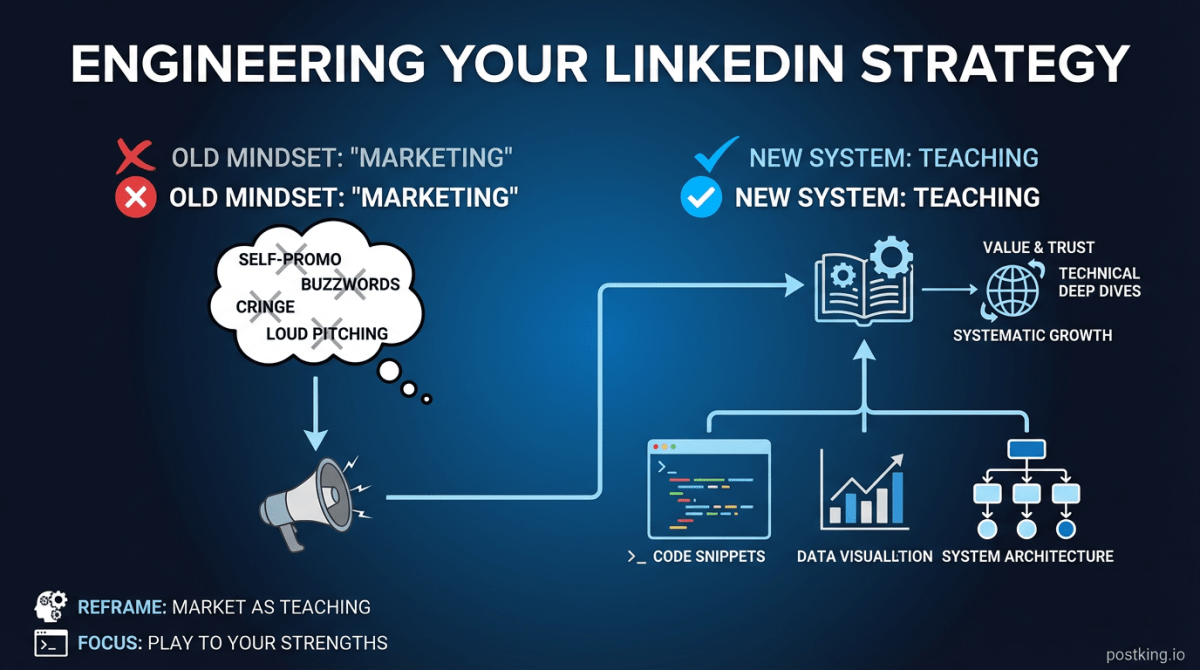
How Technical Founders Grow on LinkedIn Without Marketing
A practical LinkedIn strategy for technical founders to build authority without cringe or oversharing.
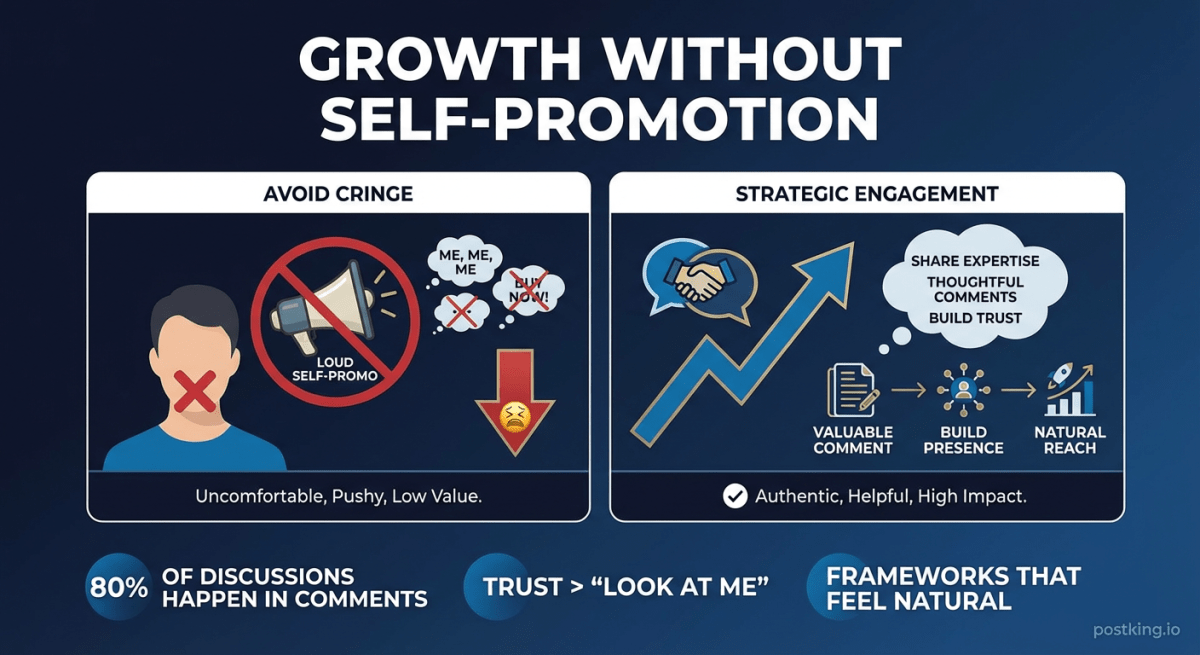
LinkedIn Strategies for Founders Who Hate Self-Promotion
A practical guide for introverted founders and anyone who finds self-promotion uncomfortable. Learn frameworks that feel natural, the comment-first strategy, and how to build presence without making yourself cringe.
LinkedIn Headline Generator
Try our free linkedin headline generator to enhance your LinkedIn presence.
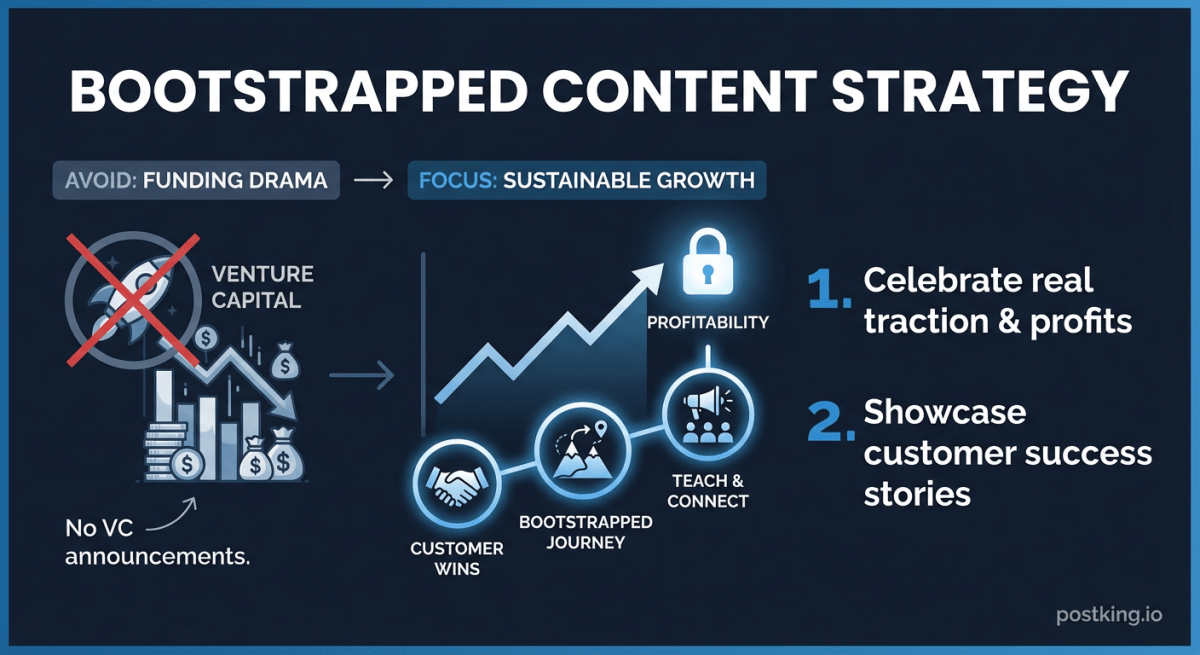
LinkedIn Growth Strategy for Bootstrapped Founders (2026)
A practical growth playbook for bootstrapped founders. Build authority, attract customers, and grow without relying on paid spend.
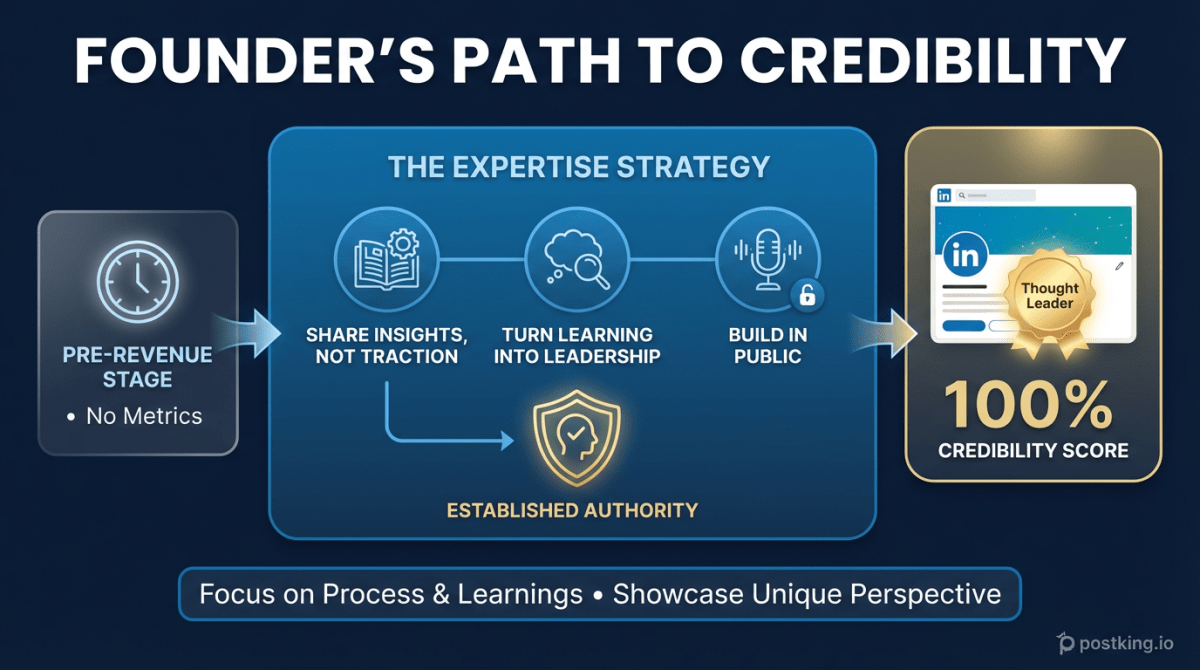
The Pre-Revenue Founder's LinkedIn Playbook: Building Credibility When You Have No Metrics
Learn how to build LinkedIn authority as a pre-revenue founder. Discover content strategies that establish credibility through expertise, not traction, and turn 'still figuring it out' into thought leadership.
more engagement with carousels
Create scroll-stopping LinkedIn carousels in under 60 seconds. No design skills needed.
Try Carousel Generator