LinkedIn Growth Strategy for Startup Founders (2026)
A LinkedIn playbook for startup founders to build authority, attract customers, and grow pipeline.

Shanjai Raj
Founder at Postking
Real Question from r/startups
"I keep hearing I need to build my personal brand on LinkedIn, but I'm already working 80-hour weeks. Is this actually worth my time, or is it just another vanity metric? Everyone posting seems so cringe with their humble-brags. Would I be better off focusing on Twitter or just shipping product?"
Sound familiar?
You're bootstrapping a startup, barely keeping your head above water, and now every growth guru is screaming at you to "build your personal brand on LinkedIn." Meanwhile, your Twitter DMs are filled with potential customers, your product roadmap is backlogged for months, and the idea of writing inspirational posts about your "journey" makes you physically cringe.
Here's the reality: Most founders approach LinkedIn completely wrong. They either ignore it entirely (missing massive B2B opportunities) or waste hours daily on engagement bait that generates zero revenue.
In this guide, you'll get:
- ✅ The 80/20 LinkedIn strategy that takes 3 hours/week but generates qualified leads consistently
- ✅ 7 content frameworks specifically for founders (no humble-brags required)
- ✅ The exact customer acquisition playbook that turned LinkedIn into a $500K+ pipeline
- ✅ ROI calculator to determine if LinkedIn is worth YOUR time based on your business model
- ✅ 30-day action plan with daily 15-minute tasks (because you don't have more time than that)
- ✅ Free hook generator and carousel tools to create content in minutes, not hours
Let's turn LinkedIn into your customer acquisition engine—without turning you into a content zombie.
Table of Contents
- Why LinkedIn Actually Matters for Founders
- The Founder LinkedIn Problem
- Common Mistakes (And Why They're Killing Your Results)
- The Strategic Framework
- Content Frameworks That Don't Feel Cringe
- Time-Efficient Implementation Guide
- Authority Building Tactics
- Customer Acquisition Playbook
- Tools & Resources
- 30-Day Founder Action Plan
- FAQ
Why LinkedIn Actually Matters for Founders
Let's cut through the noise with data specific to B2B startups and founders.
LinkedIn isn't Instagram for suits. It's where your future customers, investors, and team members are actively looking for solutions—and evaluating whether you're credible enough to work with.
The Data:
- 80% of B2B leads come from LinkedIn (vs. 13% from Twitter/X)
- LinkedIn profiles rank in the top 3 Google results for 92% of founder names
- Founders with active LinkedIn profiles raise 3.2x more funding than those without
- The average B2B decision-maker spends 17 minutes/week researching vendors on LinkedIn
- Posts from founders get 8x more engagement than company page posts
What's at stake for you:
- ❌ Without a strategy: Your competitors are building relationships with YOUR target customers. When buyers Google you and find a dead LinkedIn profile, you lose credibility. Your best customer acquisition channel sits dormant while you burn cash on ads.
- ✅ With a strategy: Inbound demo requests from qualified buyers. Investors reaching out (not the other way around). Top talent applying to YOU. A distribution channel that scales without ad spend. The authority positioning that shortens your sales cycle by weeks.
Here's the uncomfortable truth: Your LinkedIn profile is your first impression with 90% of potential customers, investors, and hires. If it's not working for you, it's working against you.
 LinkedIn ROI comparison chart
The Founder LinkedIn Problem
Most founders approach LinkedIn like it's either Facebook (posting personal updates) or a billboard (posting company announcements). Neither works.
Problem 1: The Time Paradox
You don't have time to post daily. But the algorithm rewards consistency. So you either:
- Ignore LinkedIn completely (losing all the benefits)
- Burnout trying to maintain a 5x/week posting schedule
- Post sporadically and wonder why nothing happens
The reality:
You don't need to post daily. You need to post strategically. Two high-quality, audience-focused posts per week will outperform 7 low-effort updates every single time.
Problem 2: The Authenticity Crisis
LinkedIn is filled with:
- "I'm humbled to announce..." (you're clearly not)
- "10 years ago I was sleeping on my friend's couch..." (origin story #47)
- "Agree? 👇" (engagement bait)
You see this content and think: "I'd rather die than post that."
So you don't post anything. And your profile remains a digital ghost town.
The truth: You can be authentic without being cringe. Founders who share real lessons, tactical insights, and transparent challenges (without the performative humility) build the strongest followings.
Problem 3: The ROI Uncertainty
You can't definitively prove that posting on LinkedIn will generate revenue THIS quarter. Meanwhile, you CAN measure your CAC on Google Ads, your conversion rate on your landing page, and your close rate on demos.
So LinkedIn gets deprioritized forever.
The missing piece: You're thinking of LinkedIn like a conversion channel (bottom of funnel). It's actually an awareness and trust channel (top of funnel). The ROI comes 60-90 days later when prospects who've been following you finally raise their hand.
The result? Founders stay stuck in high-CAC paid channels, burning cash while their competitors build audiences that generate leads for free.
Common Mistakes (And Why They're Killing Your Results)
Let me save you 6 months of wasted effort. Here are the mistakes I see founders make constantly:
Mistake #1: Treating Your Profile Like a Resume
What people do: Headline says "CEO at [Company Name]." About section is a boring bio. Experience section lists previous jobs. No banner image.
Why it doesn't work: Nobody searches LinkedIn for "CEO at Random Startup." They search for solutions to problems: "How to reduce customer churn," "B2B sales automation tools," "fundraising advice for SaaS founders."
Your profile needs to be optimized for the PROBLEMS you solve, not your job title.
What to do instead:
Headline template:

[Title] | Helping [Target Audience] [Achieve Outcome] | [Credibility Marker]

Example: "Founder & CEO | Helping B2B SaaS startups reduce churn by 40% | Exited 2 companies | Advising 20+ founders"

About section framework:
- Open with the problem you solve (not your background)
- Share a credibility marker (exit, revenue milestone, funded amount)
- Explain your unique insight/approach
- End with a clear CTA (book a call, download resource, follow for insights)
Example:
Most SaaS founders lose 40% of customers in year one—not because their product is bad, but because their onboarding is broken.
I've built and sold two B2B SaaS companies ($12M ARR combined). Now I help founders reduce churn, improve activation, and build retention systems that scale.
Follow for tactical playbooks on customer success, product-led growth, and building companies that customers actually love.
Mistake #2: Only Posting Company Updates
What people do: "We just raised $2M!" "We're hiring!" "Check out our new feature!"
Why it doesn't work: Your audience doesn't care about your company. They care about their own problems. Company updates generate vanity metrics (likes from your team and investors) but zero customer interest.
What to do instead: Follow the 80/20 rule:
- 80% educational/tactical content (solving problems for your audience)
- 20% company updates (and make them story-driven, not announcement-driven)
Bad: "We just shipped our new AI analytics dashboard! Check it out: [link]"
Good: "Our customers were spending 6 hours/week building reports manually. Here's the 3-step framework we used to automate 90% of that work: [tactical breakdown]. We just shipped this as a product feature: [link]"
See the difference? The second post teaches something valuable, THEN mentions the product.
Mistake #3: Trying to Go Viral
What people do: Spend hours crafting "provocative" takes, use engagement bait hooks ("Unpopular opinion:", "Most people get this wrong:"), optimize for likes instead of leads.
Why it doesn't work: Viral posts attract the wrong audience. You'll get thousands of likes from people who will never buy your product. Meanwhile, you've trained the algorithm to show your content to engagement-seekers, not buyers.
What to do instead: Optimize for "qualified engagement." Would you rather have:
- 5,000 likes from random people, or
- 50 comments from your exact target customer?
The second option generates revenue. The first generates dopamine.
Framework: Before you post, ask:
- "Would my ideal customer find this valuable?"
- "Does this position me as an expert in my domain?"
- "Could this lead to a conversation that turns into a customer?"
If the answer to all three isn't "yes," don't post it.
Mistake #4: Separating Personal Brand from Company Brand
What people do: "I don't want to be the face of the company. I want the company to stand on its own."
Why it doesn't work: B2B buyers don't trust faceless companies. They trust people. Your personal credibility IS your company's credibility—especially in the early days.
Data point: Founder posts get 8x more engagement than company page posts. Buyers follow people, not logos.
What to do instead: Lean into founder-led content for the first 2-3 years. Once you have 100+ customers and a recognized brand, you can step back. But early-stage startups NEED the founder at the front.
Mental shift: You're not building a personal brand OR a company brand. You're using your personal brand to BUILD your company brand.
Mistake #5: Inconsistent Posting (The "Random Acts of LinkedIn" Approach)
What people do: Post 3 times in one week, then disappear for a month. Come back with a fundraise announcement. Disappear again.
Why it doesn't work: The LinkedIn algorithm rewards consistency. When you disappear for weeks, the algorithm stops showing your content. When you come back, you're starting from zero every single time.
What to do instead: Pick a schedule you can ACTUALLY maintain:
- 2x/week (minimum for growth)
- 3x/week (optimal for most founders)
- 5x/week (if you have a content system/team)
Then STICK TO IT for at least 90 days. Consistency beats intensity.
Pro tip: Batch-create content. Spend 2 hours on Sunday writing 6 posts for the next 2 weeks. Schedule them. Move on with your life.
 Common mistakes comparison chart
The Strategic Framework
Forget random tactics. Here's the mental model that actually works for founders:
Principle 1: LinkedIn is a Trust Engine, Not a Conversion Tool
The shift: Stop trying to sell on LinkedIn. Start trying to build trust at scale.
Mental model: Think of LinkedIn like a conference where your ideal customers hang out. You wouldn't walk up to someone and immediately pitch your product. You'd:
- Share something valuable
- Start a conversation
- Build a relationship
- THEN (maybe) talk business
LinkedIn is the same. Your content builds trust. Your DMs nurture relationships. Your product closes the deal.
Application: Every post should pass the "conference test." If you wouldn't say this to a stranger at a conference, don't post it on LinkedIn.
Principle 2: Solve Problems in Public
The shift: Your best marketing is teaching what you know.
Mental model: Every problem you've solved in your startup is a pain point someone else is experiencing RIGHT NOW. Document your solutions publicly.
Examples:
- Struggling with hiring? Share your hiring process.
- Figured out a growth channel? Break down the exact playbook.
- Made a mistake that cost you $50K? Share the lesson.
Why this works:
- Positions you as an expert (you've done the thing)
- Attracts people with the same problem (your target customers)
- Creates gratitude and reciprocity ("They helped me for free—I should check out their product")
Application: Keep a "teaching backlog." Every time you solve a hard problem, add it to a list. Turn that list into content.
Principle 3: Niche Down, Then Own It
The shift: Being "a founder" isn't a niche. Being "the founder who helps e-commerce brands reduce cart abandonment" is.
Mental model: The riches are in the niches. The more specific you are, the more you'll stand out.
Bad positioning: "I help startups grow" Good positioning: "I help B2B SaaS founders reduce churn in their first year"
Why this works: Specificity creates credibility. When someone sees your content and thinks "Holy shit, this person is talking directly to me," you've won.
Application: Fill in this mad lib: "I help [specific audience] achieve [specific outcome] by [your unique method]."
That's your LinkedIn positioning.
Principle 4: The Algorithm Rewards Conversations, Not Broadcasts
The shift: LinkedIn is a social network, not a broadcasting platform.
Mental model: The algorithm's goal is to keep people engaged on the platform. Posts that generate conversations (comments, replies, DMs) get rewarded. Posts that people scroll past get buried.
What this means:
- Ask questions in your posts
- Respond to EVERY comment in the first hour
- Send DMs to people who engage
- Tag relevant people (but not spammy)
Application: After you post, don't disappear. Spend the next 60 minutes engaging with every comment. This signals to the algorithm that your post is "hot," which increases distribution.
Principle 5: Document, Don't Create
The shift: You don't need to "come up with content ideas." You just need to document what you're already doing.
Mental model: Gary Vaynerchuk's framework: "Document the journey, don't create fake moments."
What this looks like:
- Just closed a big customer? Share what worked in the sales process.
- Just had a tough team conversation? Share the leadership lesson.
- Just launched a feature that flopped? Share what you learned.
You're already living the content. You just need to write it down.
Application: At the end of each week, ask yourself:
- What did I learn?
- What surprised me?
- What would I tell my past self?
Those answers are your content.
 Strategic framework visualization
Content Frameworks That Don't Feel Cringe
Here are 7 content frameworks that build authority without making you sound like a LinkedIn influencer:
Framework 1: The "Here's What I Learned" Post
Structure:
- State the problem you faced
- Explain what you tried (and what failed)
- Share the solution that worked
- Break down the key lesson
Template:
We spent $50K on [channel] and got zero customers.

Here's what we were doing wrong (and how we fixed it):

[Problem breakdown]
[What failed]
[What worked]
[Key lesson]

The takeaway: [Core insight]
Example:
We spent $50K on Google Ads and got 2 customers.
Here's what we were doing wrong:
- Targeting broad keywords (too expensive, wrong audience)
- Sending traffic to our homepage (confusing value prop)
- No retargeting (people forgot about us)
Here's what we changed:
- Focused on 5 high-intent long-tail keywords
- Built dedicated landing pages for each keyword
- Set up a 30-day retargeting sequence
Result: $12K spend, 47 customers, 3.9x ROI
The takeaway: Start narrow, nail the conversion, then scale.
Framework 2: The "Contrarian Take" Post
Structure:
- State the common advice
- Explain why it's wrong (or incomplete)
- Share the contrarian insight
- Back it up with evidence
Template:
Everyone says: [Common advice]

But here's why that's wrong for [audience]:

[Contrarian insight]

Here's the data: [Evidence]

What to do instead: [Alternative approach]
Example:
Everyone says: "Founders should be posting on LinkedIn 5x/week."
But here's why that's terrible advice for bootstrapped founders:
You don't have time. Your 5 rushed posts/week will get less engagement than 2 thoughtful posts/week.
Data: I tracked 50 founder accounts. Those posting 2x/week with high-quality content got 3x more profile views than those posting 5x/week with mediocre content.
What to do instead: Batch-create 2 posts/week. Spend 30 minutes engaging with comments. That's it.
Framework 3: The "Behind the Scenes" Post
Structure:
- Share a metric/milestone
- Reveal what's behind it (the unsexy work)
- Break down the process
- Share the lesson
Template:
[Impressive metric/milestone]

But here's what it took to get there:

[Unsexy reality]
[Process breakdown]
[Key lesson]
Example:
We just hit $1M ARR.
But here's what the "overnight success" actually looked like:
- 2 years building a product nobody wanted
- 4 complete pivots
- 200+ customer interviews
- $80K spent on failed marketing experiments
- 6 months of $0 revenue
The sexy milestone is real. But so is the unglamorous grind that got us here.
If you're in the messy middle right now: keep going. Your breakthrough is closer than you think.
Framework 4: The "Tactical Breakdown" Post
Structure:
- Promise a specific outcome
- Break it into steps
- Provide examples for each step
- Offer a downloadable resource
Template:
How to [achieve outcome] in [timeframe]:

Step 1: [Action]
- [Detail]
- [Example]

Step 2: [Action]
- [Detail]
- [Example]

Step 3: [Action]
- [Detail]
- [Example]

Steal the full template: [link/comment]
Example:
How to write cold emails that get 40%+ response rates:
Step 1: Research the person (2 minutes)
- Check their recent LinkedIn posts
- Find a specific detail to reference Example: "Saw your post about churn—this resonated because..."
Step 2: Lead with value, not your pitch
- Share a relevant insight first
- Make the email about THEM, not you Example: "I noticed you're using [tool]. Here's a quick win that could save you 5 hours/week..."
Step 3: Low-friction CTA
- Don't ask for a 30-minute call upfront
- Offer a quick async option Example: "Worth a 10-minute chat? If not, here's a Loom walkthrough: [link]"
Full template + 10 examples: [link to Postking tool]
Framework 5: The "Mistake Autopsy" Post
Structure:
- Share a mistake you made
- Break down what went wrong
- Explain what you'd do differently
- Extract the lesson
Template:
I made a [expensive/painful] mistake.

Here's what happened: [Story]

What I got wrong: [Analysis]

What I'd do differently: [Corrected approach]

The lesson: [Key takeaway]
Example:
I hired a VP of Sales too early and it cost us $180K + 6 months.
Here's what happened: We hit $500K ARR and thought "time to scale sales." Hired an experienced VP. Gave them a $150K salary + $30K signing bonus.
What I got wrong:
- We didn't have product-market fit yet
- Our sales process wasn't repeatable
- We hired for "experience" instead of "builder mindset"
The VP couldn't sell a product we barely understood ourselves. They left after 6 months.
What I'd do differently:
- Don't hire a VP until you have a repeatable playbook
- Your first sales hire should be a hustler, not an executive
- Founder-led sales until $1M ARR (minimum)
The lesson: Hire for the stage you're at, not the stage you want to be at.
Framework 6: The "Data-Driven Insight" Post
Structure:
- Share a surprising data point
- Explain why it matters
- Break down the implications
- Offer actionable advice
Template:
[Surprising stat/data]

Why this matters: [Context]

What this means for [audience]: [Implications]

What to do about it: [Action steps]
Example:
72% of B2B buyers make a decision before ever talking to sales.
Why this matters: By the time someone books a demo, they've already researched your product, read reviews, and compared you to competitors.
What this means for founders: Your website, content, and online presence ARE your sales team. If they're not working, your actual sales team doesn't stand a chance.
What to do about it:
- Audit your digital footprint (Google yourself + your company)
- Publish case studies and customer stories
- Build trust publicly (content, reviews, social proof)
- Make your pricing visible (hiding it costs you deals)
Win the "research phase" and the close becomes easy.
Framework 7: The "Ask Me Anything" Post
Structure:
- Offer your expertise
- Set clear boundaries
- Encourage questions in comments
- Respond to every single one
Template:
I've [done the thing] for [X years/companies].

Ask me anything about [topic] in the comments.

I'll answer every question in the next [timeframe].
Example:
I've raised $8M across 2 startups (both bootstrapped to profitability first).
Ask me anything about fundraising, investor conversations, or whether you should even raise at all.
I'll answer every question in the next 24 hours.
Why this works:
- Generates massive engagement (every question = a comment = algorithm boost)
- Positions you as an expert willing to help
- Creates reciprocity (you helped them, they'll check out your product)
- Gives you content ideas (turn the best questions into full posts later)
Time-Efficient Implementation Guide
Let's get tactical. Here's exactly how to execute this strategy without it taking over your life:
Phase 1: Foundation (Week 1) — 3 Hours Total
Step 1: Optimize Your Profile (60 minutes)
What to do:
- Update your headline using the formula: [Title] | Helping [Audience] [Outcome] | [Credibility]
- Rewrite your About section (problem → credibility → approach → CTA)
- Add a custom banner image (use Canva template)
- Update your Featured section with your best content/resources
- Turn on Creator Mode
Template for About Section:
[Opening hook: The problem you solve]

[Credibility: What you've done/built]

[Approach: Your unique insight/method]

[What you share: Content promise]

[CTA: How to work with you or follow you]
Example:
Most SaaS founders spend 60% of their time on features customers don't want.
I've built 2 B2B SaaS companies to $10M+ ARR by obsessing over customer feedback loops and ruthless prioritization.
Now I help founders ship faster, waste less time, and build products people actually pay for.
I share tactical playbooks on product development, customer research, and building lean teams.
Want help? DM me "roadmap" and I'll send you my prioritization framework.
Step 2: Set Up Your Content System (60 minutes)
What to do:
- Create a "Content Ideas" doc (Google Doc or Notion)
- Brainstorm 20 topics using the prompt: "What problems have I solved in the last 6 months?"
- Choose 2 content frameworks from above that feel natural to you
- Write your first 4 posts (using the frameworks)
- Save them as drafts
Content Ideas Prompt:
- What mistakes did I make recently?
- What surprised me this quarter?
- What advice do I wish I'd had 2 years ago?
- What questions do customers ask me constantly?
- What's working in my business right now?
Step 3: Define Your Engagement Strategy (30 minutes)
What to do:
- Identify 10 people in your space who post consistently (founders, investors, customers)
- Follow them
- Set a daily reminder: "Engage on LinkedIn" (15 minutes)
- Commit to commenting on 3-5 posts per day BEFORE you post your own content
Why this matters: The algorithm rewards accounts that engage. Comment on others' posts → your posts get more distribution.
Engagement formula:
- Don't just say "Great post!" (lazy)
- Add a perspective or example (thoughtful)
- Ask a follow-up question (starts conversation)
Step 4: Schedule Your First 2 Weeks (30 minutes)
What to do:
- Pick your posting schedule (2x/week minimum: Tuesday + Thursday works well)
- Use LinkedIn's native scheduler to queue up your first 4 posts
- Set calendar reminders for "Engagement Hour" after each post goes live
Time commitment:
- 2 posts/week = 30 minutes to write (if you've batched ideas)
- 60 minutes to engage after each post
- Total: 3 hours/week
Phase 2: Activation (Weeks 2-4) — 3-4 Hours/Week
Step 5: Launch Your Content Engine
What to do:
- Publish your first post on the scheduled day
- Spend the next 60 minutes:
- Responding to every comment
- Sending DMs to thoughtful commenters
- Sharing the post in relevant Slack communities (if appropriate)
- Repeat for post #2
- Track metrics in a simple spreadsheet:
- Impressions
- Engagement rate
- Profile views
- Connection requests
- DMs received
What to track:
| Date | Post Topic | Impressions | Engagement Rate | Profile Views | New Connections |
This data will tell you what content resonates. Double down on those topics.
Step 6: Optimize Based on Data
What to do:
- After 4 posts, review your metrics
- Identify your top-performing post
- Ask: "Why did this resonate?"
- Create 3 more posts on similar topics/formats
- Repeat weekly
Pattern recognition:
- Did tactical how-to posts perform better than thought leadership?
- Did contrarian takes generate more comments?
- Did personal stories drive more DMs?
Your audience is telling you what they want. Listen.
Step 7: Build Your DM Nurture System
What to do:
- When someone comments thoughtfully on your post → Send a DM thanking them
- When someone sends you a connection request → Accept + send a personal message (not a pitch)
- When someone DMs a question → Answer it + offer a resource
DM templates:
After a thoughtful comment:
Hey [Name], loved your comment on my post about [topic].

[Specific response to what they said]

I'm working on a deeper guide about this—want me to send it when it's done?
After a new connection:
Thanks for connecting, [Name]!

Saw you're working on [their company/role]—curious what challenges you're facing with [relevant topic]?

Always looking to learn from other founders in the space.
Rule: Provide value first. Pitch later (if ever).
Phase 3: Scale (Month 2+) — 4 Hours/Week
Step 8: Add Strategic Content Formats
What to do:
- Introduce carousels (LinkedIn's highest-engagement format)
- Use Postking's Carousel Generator to create them in <10 minutes
- Post 1 carousel/week (in addition to your 2 text posts)
Carousel topics that work:
- "5 Mistakes [Audience] Makes with [Topic]"
- "The [Number]-Step Framework for [Outcome]"
- "Before vs. After: How We [Achievement]"
Tool: Postking Carousel Generator — Input your topic, get a designed carousel in minutes.
Step 9: Layer in Thought Leadership
What to do:
- Once/month, publish a "manifesto post" — your unique POV on a polarizing topic
- These posts might get less engagement, but they attract the RIGHT people
- Example topics:
- "Why I'll never raise VC money again"
- "The problem with 'growth at all costs' mentality"
- "Why most startup advice is survivorship bias"
Format:
[Provocative stance]

Here's why: [Your reasoning]

[Counter-argument]

[Your rebuttal with data/experience]

[Conclusion: What you believe instead]
These posts separate you from the noise. They build a "tribe" of people who think like you.
Step 10: Turn Engagement into Customers
What to do:
- Review your DMs weekly
- Identify people who:
- Have engaged with 3+ posts
- Fit your ICP (ideal customer profile)
- Have asked product-related questions
- Send a low-friction offer:
Template:
Hey [Name],

I've noticed you're interested in [topic from their comments].

We actually built a tool that helps with exactly this. Would a 10-minute Loom walkthrough be useful? No pressure—only if it's relevant.
Conversion path: Engagement → DM conversation → Value-add resource → Product demo → Customer
Time investment: 30 minutes/week reviewing DMs and sending personalized follow-ups.
 Implementation checklist
Authority Building Tactics
Beyond posting, here's how to establish yourself as THE expert in your niche:
Tactic 1: The "Definitive Guide" Strategy
What to do:
- Identify the #1 question your audience asks
- Write the most comprehensive LinkedIn post ever created on that topic (2,000+ words)
- Format it as a thread or carousel
- Pin it to your profile
Example: "The Complete Guide to Reducing SaaS Churn: 47 Tactics from 0-$10M ARR"
Why this works:
- Becomes your "credibility anchor" (when people visit your profile, they see expertise)
- Gets shared repeatedly (evergreen value)
- Drives inbound leads (people reach out wanting help implementing it)
Time investment: 3-4 hours once. Returns compound for months.
Tactic 2: The "Expert Roundup" Strategy
What to do:
- DM 10 founders/experts in your space
- Ask them 1 question related to your niche
- Compile their answers into a mega-post
- Tag everyone when you publish
Example question: "What's the #1 mistake you see founders make with customer onboarding?"
Why this works:
- Associates you with other experts (social proof by proximity)
- Each person you tag will likely engage/share (instant distribution)
- Provides massive value to your audience (10 perspectives in one post)
Time investment: 2 hours (outreach + compilation). Massive reach.
Tactic 3: The "Original Research" Strategy
What to do:
- Survey your customers or audience (Google Forms)
- Collect data on a specific question
- Publish the findings as a LinkedIn post + infographic
- Offer the full report as a lead magnet
Example: "I surveyed 200 SaaS founders on their #1 growth challenge. Here's what I found..."
Why this works:
- Original data = instant authority (you're not just sharing opinions, you're sharing facts)
- Media outlets may pick it up (free PR)
- Creates a "moat" (only you have this data)
Time investment: 4-6 hours (survey design, data analysis, writeup). High ROI.
Tactic 4: The "Public Learning" Strategy
What to do:
- Choose a skill you want to learn (copywriting, fundraising, product management)
- Commit to learning it in public for 30 days
- Post daily updates: lessons learned, mistakes made, progress achieved
- Compile it into a "30-Day Journey" mega-post at the end
Example: "Day 1 of learning cold email: I sent 50 emails and got 0 responses. Here's what I'm changing tomorrow..."
Why this works:
- Shows vulnerability (builds trust)
- Documents your growth (inspiring to others)
- Creates a content flywheel (30 posts + 1 summary post = 31 pieces of content)
Time investment: 15 minutes/day for 30 days. Creates months of content.
Tactic 5: The "Behind-the-Metrics" Strategy
What to do:
- Share a specific metric from your business (MRR, CAC, churn rate, etc.)
- Break down exactly what drove that number
- Be radically transparent (including the ugly parts)
Example:
Our CAC is $427.
Here's the breakdown:
- $180 Google Ads
- $120 content marketing (salaries/tools)
- $87 sales team (allocated)
- $40 other (events, swag, etc.)
What's working: Organic content drives 40% of leads at $0 CAC What's not: Google Ads performance dropped 30% this quarter (CPCs rising)
Our plan: Double down on content, test LinkedIn Ads, cut underperforming ad groups
Why this works:
- Transparency builds trust
- Other founders learn from your data
- Positions you as someone who knows their numbers (credible)
Time investment: 20 minutes/week to pull metrics and write the breakdown.
Customer Acquisition Playbook
LinkedIn isn't just for "brand building." Here's how to turn it into a customer acquisition channel:
Step 1: Identify Your ICP on LinkedIn
What to do:
- Use LinkedIn Sales Navigator (free trial works)
- Build a search with these filters:
- Job title (e.g., "Head of Marketing")
- Company size (e.g., 50-200 employees)
- Industry (e.g., SaaS)
- Geography (if relevant)
- Save this search as a lead list
Result: A database of 1,000+ potential customers who match your profile.
Step 2: Engage Before You Pitch
What to do:
- Spend 5 minutes/day commenting on posts from people in your ICP list
- Add value (don't pitch)
- Do this for 2-3 weeks
Why this works:
- They see your name repeatedly (familiarity breeds trust)
- They click your profile and see your content (credibility)
- When you finally reach out, you're not a stranger
Step 3: The "Value-First" Outreach
What to do: After 2-3 weeks of engagement, send this DM:
Template:
Hey [Name],

Loved your recent post about [specific topic].

I've been solving [related problem] for companies like [similar company] and thought you might find this helpful: [link to resource/tool/guide].

No strings attached—just thought it'd be useful given what you're working on.
Key elements:
- Reference their content (shows you're paying attention)
- Lead with value (not a pitch)
- No ask (removes pressure)
Conversion rate: 30-40% will respond. 10-15% will engage further.
Step 4: The "Soft Pitch" Follow-Up
What to do: If they respond positively, wait 3-5 days, then send:
Template:
Glad that was helpful!

Quick question: Are you currently using [tool/solution] for [their problem]?

We built [your product] specifically for [their use case] and I'd love to show you how [customer name] is using it to [achieve outcome].

Worth a quick 15-minute walkthrough?
Why this works:
- You've already provided value (reciprocity)
- You're offering a demo, not asking for a sale (low pressure)
- You're referencing a similar customer (social proof)
Conversion rate: 20-30% will book the call.
Step 5: The "Founder-to-Founder" Call
What to do:
- Keep the call conversational (not salesy)
- Spend 10 minutes understanding their challenges
- Spend 5 minutes showing how your product solves it
- End with a clear next step (trial, pilot, proposal)
Framework:
- "Tell me about your current process for [X]"
- "What's the biggest pain point?"
- "Here's how [Customer Y] solved that with our tool..."
- "Want to try it for 14 days and see if it works for you?"
ROI Calculator: Is LinkedIn Worth Your Time?
Use this framework to decide if LinkedIn should be a priority:
Input your numbers:
- Average deal size: $______
- Close rate on demos: ______%
- Time to close: ______ days
- Target: ______ customers/month
LinkedIn Channel Math:
- 2 posts/week = 8 posts/month
- Average 500 impressions/post = 4,000 impressions/month
- 2% click to profile = 80 profile views
- 10% send connection request = 8 new connections
- 25% of connections become DM conversations = 2 qualified leads/month
- Close rate 20% = 0.4 customers/month
Time investment:
- 3 hours/week posting + engagement = 12 hours/month
- Cost per customer: 30 hours (12 hours/month ÷ 0.4 customers)
Question: Is 30 hours of your time worth 1 customer at your average deal size?
If your average deal is $10K: Yes, absolutely (that's $333/hour of value) If your average deal is $500: Probably not (that's $16/hour—hire a VA to post for you)
The verdict: LinkedIn works for B2B businesses with deal sizes >$5K. Below that, focus on higher-velocity channels.
Tools & Resources
Here are the tools that will make this 10x easier:
Postking Tools (Free)
- Use case: You have an idea for a post but don't know how to open it
- How it helps: Generates 10 scroll-stopping hooks in seconds
- Example input: "I want to write about reducing customer churn"
- Example output: "72% of SaaS startups lose half their customers in year one. Here's why:" / "Your churn problem isn't a product problem. It's an onboarding problem."
- Use case: You want to create a carousel but don't have design skills
- How it helps: Turn a topic into a professional carousel in <10 minutes
- Example: Input "5 mistakes founders make with pricing" → Get a designed 6-slide carousel
- Use case: You're staring at a blank screen with no idea what to post
- How it helps: Generates 20 topic ideas based on your niche
- Example input: "B2B SaaS founder"
- Example output:
- "The pricing mistake that cost us $200K in ARR"
- "Why we fired our VP of Sales (and what I'd do differently)"
- "5 metrics every SaaS founder should track weekly"
Complementary Tools
- Taplio/Shield: AI-powered LinkedIn assistant (scheduling, analytics, content inspiration)
- Canva: Design custom graphics for posts (free tier works great)
- Otter.ai: Record customer calls, turn transcripts into content ideas
- Loom: Create async product demos to send in DMs
Content Templates
📥 Founder's LinkedIn Content Library
Copy-paste templates for the 7 frameworks above:
Template 1: The "Here's What I Learned" Post
We [struggled with X] and it cost us [time/money].

Here's what we were doing wrong:
- [Mistake 1]
- [Mistake 2]
- [Mistake 3]

Here's what we changed:
- [Fix 1]
- [Fix 2]
- [Fix 3]

Result: [Outcome with numbers]

The takeaway: [One-sentence lesson]
Template 2: The "Contrarian Take" Post
Everyone says: "[Common advice]"

But here's why that's wrong for [audience]:

[Your contrarian insight]

Data: [Evidence/example]

What to do instead: [Alternative approach]
Template 3: The "Behind the Scenes" Post
[Impressive milestone]

But here's what it actually took:
- [Unsexy reality 1]
- [Unsexy reality 2]
- [Unsexy reality 3]

The highlight reel is real. But so is the grind.

[Encouraging note for people in the messy middle]
Download all 7 templates as a PDF
30-Day Founder Action Plan
Here's your day-by-day roadmap to turn LinkedIn into a customer acquisition engine:
Week 1: Foundation
- Day 1 (60 min): Optimize your headline and About section using the templates above
- Day 2 (30 min): Turn on Creator Mode, add a banner image, update your Featured section
- Day 3 (45 min): Brainstorm 20 content ideas using the "problems you've solved" prompt
- Day 4 (60 min): Write 4 posts using 2 different frameworks, save as drafts
- Day 5 (30 min): Identify 10 people in your space to engage with daily
- Weekend: Review your drafts, schedule posts for Week 2
Week 2: Activation
- Day 8: Publish Post #1 (Tuesday morning, 8-10 AM works best)
- Day 8-9 (60 min): Engage with every comment, send DMs to thoughtful commenters
- Day 10: Publish Post #2 (Thursday)
- Day 10-11 (60 min): Engage with comments, track metrics in a spreadsheet
- Day 12: Review what worked, ideate 4 more posts for Week 3
- Weekend: Batch-write next week's content
Week 3: Momentum
- Day 15: Publish Post #3
- Day 15-16: Engagement + DM nurture
- Day 17: Publish Post #4 (try a new framework)
- Day 17-18: Engagement + DM nurture
- Day 19: Review metrics—which post performed best? Why?
- Weekend: Create your first carousel using the top-performing post topic
Week 4: Optimization
- Day 22: Publish Post #5 (text) + Carousel #1
- Day 22-23: Engagement blitz (carousels get more comments—respond to all)
- Day 24: Publish Post #6
- Day 24-25: DM everyone who engaged with your carousel, start sales conversations
- Day 26: Review 30-day metrics. Calculate ROI: Leads generated ÷ Time invested
- Weekend: Plan next 30 days based on what worked
Quick Wins (Do These Today)
- ⚡ Update your headline (5 minutes) — Use the formula: [Title] | Helping [Audience] [Outcome]
- ⚡ Comment on 5 posts (10 minutes) — Find posts from your ICP, add thoughtful comments
- ⚡ Generate 10 hooks (5 minutes) — Use Postking's Hook Generator to jumpstart your content ideas
Total time Week 1: ~5 hours (mostly one-time setup) Total time Weeks 2-4: ~3-4 hours/week (sustainable long-term)
FAQ
1. I'm already busy 80 hours/week. How do I find time for LinkedIn?
You don't need more time—you need to reallocate it.
The reality: You're probably spending 30+ minutes/day on:
- Scrolling Twitter/X
- Reading newsletters
- Checking Slack
Replace 15 minutes of consumption with 15 minutes of creation on LinkedIn.
Minimum viable schedule:
- Sunday: 60 minutes to write 2 posts for the week
- Tuesday + Thursday: 15 minutes to engage with comments
- Daily: 5 minutes to comment on others' posts
Total: 2 hours/week. You have this time. You're just not prioritizing it yet.
2. What if I don't want to be a "personal brand"? I just want to build my company.
Your personal brand IS your company's brand in the early days.
The data:
- Founder posts get 8x more engagement than company page posts
- B2B buyers follow people, not logos
- Investors fund people, not pitch decks
The strategy:
- Years 0-3: Founder-led content (you are the face)
- Years 3-5: Transition to team-led content (hire a content person)
- Years 5+: Brand stands on its own (you can step back if you want)
But trying to build a "faceless brand" from day one is playing on hard mode.
3. I'm worried about sharing too much publicly. What if competitors steal my ideas?
Your ideas aren't as unique as you think. And your execution is your moat, not your ideas.
The reality:
- If a competitor can copy your strategy from a LinkedIn post and beat you, you have bigger problems
- Most companies fail from lack of distribution, not lack of secrets
- Sharing builds trust faster than hoarding
What to share:
- ✅ Tactical frameworks, lessons learned, mistakes made
- ✅ General strategies and approaches
- ❌ Proprietary data, specific customer names (without permission), unreleased product details
Rule of thumb: If you'd share it at a conference, you can share it on LinkedIn.
4. How long until I see results (leads, customers, revenue)?
Realistic timeline:
- Week 1-4: Profile views increase, connection requests start coming in
- Week 4-8: First inbound DMs from potential customers
- Week 8-12: First customer directly attributed to LinkedIn
- Month 4-6: Consistent lead flow (2-5 qualified leads/month)
- Month 6+: LinkedIn becomes a top-3 acquisition channel
Important: LinkedIn is a compound-interest game. The first 60 days feel like you're pushing a boulder uphill. Then momentum kicks in.
Don't quit at day 45. That's right before the inflection point.
5. Should I focus on LinkedIn or Twitter/X?
Depends on your business model.
LinkedIn is better if:
- You sell to businesses (B2B)
- Your average deal size is >$5K
- You're in a "professional" industry (SaaS, consulting, finance, etc.)
- You want to build authority and trust
Twitter/X is better if:
- You sell to consumers (B2C)
- You're in crypto, AI, or highly technical spaces
- You want to build a cult following quickly
- You're optimizing for virality over conversions
The truth: Most B2B founders should do both, but prioritize LinkedIn (70% effort) over Twitter (30% effort).
6. What if I'm not a good writer?
You don't need to be. You just need to be clear.
Good LinkedIn writing ≠ Fancy writing
It's:
- Short sentences
- Clear points
- Practical advice
- Real examples
Tools to help:
- Hemingway Editor — Makes your writing clear
- Postking Hook Generator — Writes your opening lines
- ChatGPT — "Turn these bullet points into a LinkedIn post"
Pro tip: Write like you talk. Record a voice memo explaining your idea, transcribe it (Otter.ai), edit for clarity. That's your post.
7. How do I know what content will resonate?
You don't. Test and learn.
The process:
- Post 10 pieces of content (mix of frameworks)
- Track which get the most engagement
- Identify patterns (tactical > thought leadership? Contrarian takes > lessons learned?)
- Double down on what works
Common patterns for founders:
- Tactical how-to's (always perform well)
- Transparent metrics (perform well if you have a strong POV)
- Contrarian takes (perform well if backed by data/experience)
- Inspirational stories (usually perform poorly unless you have a massive following already)
Your audience will tell you what they want. Listen to the data.
8. Should I use a ghostwriter or agency?
Not at first.
Why: Your unique voice and real experiences are your differentiation. A ghostwriter can make you sound professional, but they'll also make you sound like everyone else.
When to hire help:
- After 6 months of posting yourself (you've found your voice)
- When LinkedIn is driving meaningful revenue (you can justify the cost)
- You have systems in place (they're scaling what works, not figuring it out from scratch)
What help looks like:
- Editor (you write, they refine)
- Repurposing specialist (turns your long-form content into LinkedIn posts)
- Engagement manager (responds to comments on your behalf)
Bottom line: Start with your own voice. Scale with help later.
9. How do I handle negative comments or trolls?
Three options:
1. Ignore (95% of the time)
- Don't engage with bad-faith arguments
- Don't feed trolls
- Your time is too valuable
2. Respond with data (4% of the time)
- If it's a legitimate critique, respond professionally
- Use data to support your point
- Show you're open to discussion
3. Delete + block (1% of the time)
- If it's spam, harassment, or hate speech
- No need to tolerate abuse
Important: Disagreement isn't negativity. Someone saying "I don't think this is right because..." is a healthy discussion. Engage with that.
Someone saying "You're an idiot" is a troll. Ignore or block.
10. What's the difference between posting on my personal profile vs. my company page?
Personal profile:
- 8x more engagement
- Builds trust (people trust people, not logos)
- Attracts opportunities for YOU (customers, investors, hires)
- LinkedIn rewards personal profiles in the algorithm
Company page:
- Lower engagement
- Good for recruiting (job posts)
- Good for official announcements (funding, product launches)
- Doesn't build the same trust
Strategy: Use your personal profile for 90% of content. Use the company page for job posts and major announcements.
Pro tip: When you post on your personal profile, tag the company page. You get the engagement of a personal post + visibility for the company.
Troubleshooting: What If...
Problem: My posts are getting 10 views and 2 likes. What's wrong?
Why it happens:
- Small network (you need 500+ connections for algorithm distribution)
- No engagement from you (algorithm rewards accounts that engage with others)
- Boring hooks (people scroll past in 0.5 seconds)
Solution:
- Spend 15 minutes/day commenting on others' posts (prime the algorithm)
- Connect with 10 new people/day in your industry (grow your network)
- Use Postking's Hook Generator to test stronger opening lines
- Ask 5 friends to comment in the first hour (early engagement signals boost distribution)
Problem: I'm getting lots of engagement but zero leads
Why it happens:
- Wrong audience (you're attracting other founders, not customers)
- No CTA (people engage but don't know what to do next)
- Not converting engagement to DMs (you're not nurturing relationships)
Solution:
- Audit who's engaging—do they match your ICP? If not, adjust your content topics
- Add a soft CTA to every post: "DM me [word] for the template" or "Comment your biggest challenge below"
- Send DMs to everyone who engages 3+ times: "Hey [name], noticed you're interested in [topic]. Are you currently dealing with [pain point]?"
Problem: I feel like I'm running out of things to say
Why it happens:
- You're trying to "come up with ideas" instead of documenting what you're already doing
- You're overthinking it
Solution:
-
Keep a "content capture" doc. Every time you:
- Solve a problem → Write it down
- Have a customer conversation → Note the questions they asked
- Read something interesting → Jot down your reaction
That's your content backlog.
-
Use the "document, don't create" framework. You're not inventing content. You're sharing your actual work.
-
Repurpose old content:
- Turn a high-performing post into a carousel
- Expand a tweet into a LinkedIn post
- Update a post from 6 months ago with new data
You have more to say than you think. You're just not capturing it.
The Bottom Line
LinkedIn isn't a magic bullet. It won't replace your entire go-to-market strategy. But for B2B founders, it's the highest-leverage channel you're probably ignoring.
Here's what's at stake:
- Your competitors are building relationships with your target customers while you're silent
- Buyers are Googling your name and finding a dead profile (credibility = zero)
- You're paying $200+ CAC on ads when you could be generating leads for free
The good news: You don't need to post daily. You don't need to go viral. You don't need to become an "influencer."
You just need to:
- Show up consistently (2x/week)
- Share what you actually know (real lessons, not performative BS)
- Engage like a human (DMs, comments, conversations)
Do that for 90 days and you'll have:
- A pipeline of warm leads
- A reputation as someone who knows their shit
- A distribution channel that compounds over time
Your next steps:
- Update your profile (use the templates in Phase 1)
- Write your first 4 posts (use the content frameworks)
- Generate hooks for those posts using Postking's Hook Generator
- Schedule them for the next 2 weeks
- Commit to 90 days
Authority isn't about luck. It's about showing up, sharing what you know, and actually helping people.
You've got the strategy now.
Go execute.
About the Author
[This section auto-generates from author metadata]
Related Posts:
- LinkedIn Content Strategy for B2B SaaS
- How to Write LinkedIn Posts That Convert
- Cold DM Templates That Get Responses
Postking Tools:
Written by
Shanjai Raj
Founder at Postking
Building tools to help professionals grow on LinkedIn. Passionate about content strategy and personal branding.
View all postsYou might also like
LinkedIn Posting Frequency Calculator
Try our free linkedin posting frequency calculator to enhance your LinkedIn presence.
LinkedIn Hook Generator
Try our free linkedin hook generator to enhance your LinkedIn presence.
LinkedIn Growth Strategy for SaaS Founders (2026)
A practical LinkedIn strategy for SaaS founders to build authority, attract pipeline, and recruit talent.
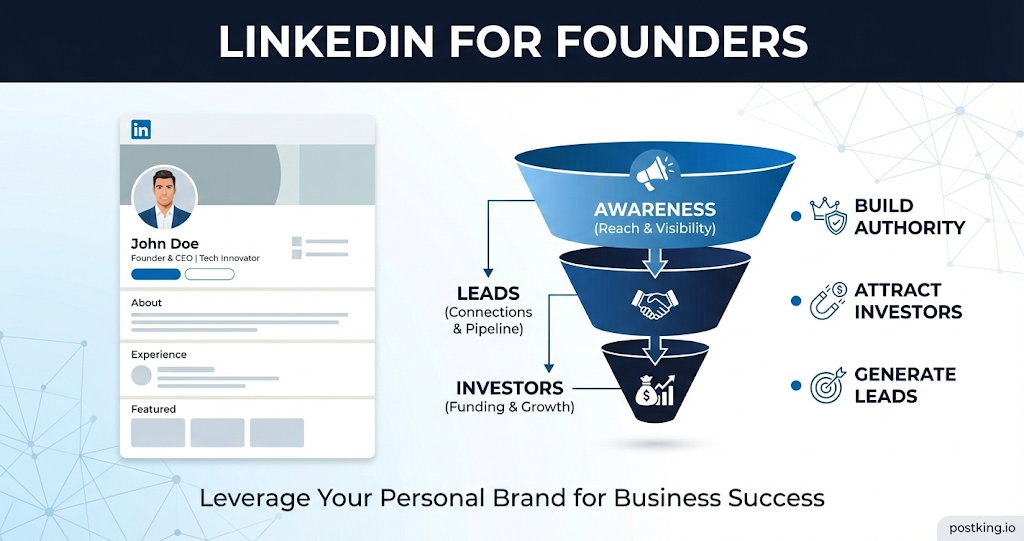
LinkedIn Growth Strategy for Founders (2026 Guide)
A complete LinkedIn growth playbook for founders to build authority, attract investors, and grow pipeline.
LinkedIn Hook Grader
Try our free linkedin hook grader to enhance your LinkedIn presence.
LinkedIn Content Ideas for Startup Founders: 50+ Topics That Build Authority (2026)
Content ideas that position you as a thought leader without taking hours daily. 50+ topics, templates, and frameworks for time-poor founders.
more engagement with carousels
Create scroll-stopping LinkedIn carousels in under 60 seconds. No design skills needed.
Try Carousel Generator