LinkedIn Content Ideas for Startup Founders: 50+ Topics That Build Authority (2026)
Content ideas that position you as a thought leader without taking hours daily. 50+ topics, templates, and frameworks for time-poor founders.

Shanjai Raj
Founder at Postking
As a startup founder, you know you should be building your personal brand on LinkedIn. But between fundraising, product development, hiring, and actually running your company, where do you find the time to create compelling content?
The secret isn't posting more—it's posting smarter. The right content ideas, used strategically, can position you as a thought leader without consuming hours of your day.
This guide provides 50+ specific LinkedIn content ideas organized into seven high-performing categories, complete with templates and frameworks you can use immediately. Whether you're pre-seed or Series B, these ideas will help you build authority while staying focused on growing your company.
Why Founders Should Post on LinkedIn (Even When Busy)
Before diving into content ideas, let's address the elephant in the room: as a founder, your time is your most valuable asset. So why spend it on LinkedIn?
The compound effect: Every post you write builds your founder brand, which:
- Attracts better investors (warm intros vs. cold emails)
- Recruits top talent (they follow you before applying)
- Generates inbound leads (customers who already trust you)
- Opens partnership doors (other founders reach out)
- Positions you as the face of your category
The efficiency factor: Unlike traditional PR or content marketing, LinkedIn gives you direct access to your exact audience—founders, investors, potential hires, and customers—without intermediaries.
For a deeper dive on why LinkedIn specifically works for founders, check out our complete guide to LinkedIn for startup founders.
The 7 Content Categories That Build Founder Authority
1. Lessons Learned (Failures, Pivots, Wins)
These posts perform exceptionally well because they showcase vulnerability and practical wisdom. Founders want to learn from your mistakes so they don't repeat them.
Content Ideas:
- "We just burned $50K on a feature nobody wanted. Here's what I learned..."
- "3 hires I regret making (and the red flags I missed)"
- "Why we pivoted from [X] to [Y] after 18 months"
- "The biggest mistake we made in our first year: [specific mistake]"
- "How we went from $0 to $100K MRR (the unsexy truth)"
- "I fired our first employee today. Here's what I learned about hiring too fast."
- "We almost ran out of money last quarter. Here's how we survived."
- "5 things I wish I knew before raising our seed round"
Template:

[Attention-grabbing opening about a mistake/lesson]

Here's what happened:
→ Context (1-2 sentences)
→ What we did wrong
→ The consequences
→ What we learned
→ What we'd do differently

If you're building [type of company], avoid this mistake.

[Optional: Ask for others' experiences]

Engagement Strategy: Vulnerability posts get high engagement. Post these on Tuesday-Thursday mornings when LinkedIn traffic peaks. Respond to every comment in the first hour—it signals to the algorithm that your post is driving conversation.
2. Industry Insights (Trends, Predictions)
Position yourself as a forward-thinking founder who understands where your industry is heading. These posts work best when you have proprietary data or a unique perspective.
Content Ideas:
- "I've analyzed 100+ [industry] companies. Here's what the best ones do differently."
- "3 trends in [industry] that most people are missing"
- "Why [common belief] is dead (and what's replacing it)"
- "The [industry] landscape is changing. Here's what we're seeing in our data..."
- "Hot take: [Technology/trend] is overhyped. Here's why."
- "I just spent 3 days at [conference]. These 5 trends stood out..."
- "Everyone's talking about [trend]. Nobody's talking about [overlooked trend]."
- "We just surveyed 500 [target customers]. Here's what they told us about [topic]."
Template:
[Bold statement about industry trend]

Here's what's actually happening:

🔍 The trend: [Explain what you're seeing]
📊 The data: [Share proprietary insights or observations]
🎯 Why it matters: [Implications for founders/companies]
⚡ What to do about it: [Actionable advice]

What are you seeing in [industry]?
Competitive Concerns: Share insights, not secrets. Discuss macro trends and patterns, not your specific product roadmap or growth metrics that could help competitors.
3. Behind the Scenes (Team, Culture, Process)
People love seeing how successful companies actually operate. These posts humanize your brand and attract talent.
Content Ideas:
- "Our team's daily standup format (and why it actually works)"
- "How we run all-hands meetings at [company]"
- "Inside our hiring process: from first contact to offer letter"
- "We just hit [milestone]. Here's what the team did to celebrate..."
- "Our office/remote setup tour [carousel format]"
- "A day in the life of a [role] at [company]"
- "How we make decisions at [company] (our framework)"
- "Why we offer [unique benefit] and how it's changed our culture"
- "Our team's Slack channel names reveal a lot about our culture..."
Template:
[Hook about company process/culture]

Here's how it works:

1. [Step/element one]
   → Why we do it this way

2. [Step/element two]
   → The impact it's had

3. [Step/element three]
   → What we learned

Stealing this? Tag me when you implement it.
Talent Attraction: These posts should make great candidates think, "I want to work there." Share processes that demonstrate your values and thoughtfulness.
4. Customer Stories (Wins, Testimonials)
Customer wins validate your company and provide social proof. They're also less "salesy" than traditional marketing content.
Content Ideas:
- "A customer just sent us this message... [screenshot + story]"
- "How [customer] used [product] to achieve [specific result]"
- "This customer was using [competitor/manual process]. Here's what changed when they switched..."
- "Customer case study: [metric] improvement in [timeframe]"
- "I just got off a call with a customer who said [emotional feedback]. This is why we build."
- "Shoutout to [customer] for this creative use of [product]"
- "A customer just hit [milestone] using [product]. Here's their journey..."
- "This customer almost churned. Here's how we turned it around..."
Template:
[Customer name/type] just achieved [specific result].

Their situation:
→ They were struggling with [problem]
→ It was costing them [time/money/opportunity]

What changed:
→ They implemented [solution]
→ Within [timeframe], they saw [result]

The best part? [Emotional/surprising element]

[Tag customer if appropriate, or ask: "Who else is solving this problem?"]
Privacy Tip: Always get permission before sharing customer stories. When possible, tag customers—they'll often share your post to their networks.
5. Tactical Breakdowns (Growth Experiments, Metrics)
Founders love tactical, actionable content. These posts establish you as someone who executes, not just theorizes.
Content Ideas:
- "We tested 10 different [element]. Here's what won..."
- "Our content strategy for Q1 (with actual metrics)"
- "How we grew [metric] by [X]% in [timeframe]: the full playbook"
- "I spent $5K testing [marketing channel]. Here are the results..."
- "Our onboarding flow had a 30% drop-off. Here's how we fixed it."
- "Email template that booked us 47 sales calls last month"
- "We A/B tested our pricing page. The results surprised us..."
- "Cold outreach experiment: 200 emails, here's what worked"
Template:
We ran an experiment: [what you tested]

The setup:
→ Hypothesis: [what you expected]
→ Method: [how you tested]
→ Timeline: [duration]

The results:
→ [Metric 1]: [result]
→ [Metric 2]: [result]
→ Winner: [what worked best]

The lesson: [key takeaway]

Swipe this if you're testing [similar thing].
What to Share: Share completed experiments and learnings. Avoid sharing ongoing tests that competitors could exploit or proprietary growth loops that are still working.
6. Contrarian Takes (Challenge Status Quo)
Bold, contrarian opinions cut through the noise—but they need to be thoughtful, not just inflammatory.
Content Ideas:
- "Unpopular opinion: [common advice] is terrible advice for [stage] founders"
- "Everyone says to [common practice]. We did the opposite and here's why..."
- "The problem with [popular tool/framework] that nobody talks about"
- "I used to believe [common belief]. Here's what changed my mind..."
- "Most founders are wrong about [topic]. Here's what they're missing..."
- "Why we don't [common practice] at [company]"
- "The [industry] playbook is broken. Here's what's next..."
- "Controversial: [industry] doesn't need more [X]. It needs [Y]."
Template:
Unpopular opinion: [contrarian statement]

Why everyone thinks [common belief]:
→ [Reason it's conventional wisdom]

Why I disagree:
→ [Your experience/data]
→ [Supporting argument]
→ [What to do instead]

The nuance: [When the conventional wisdom IS right]

Agree or disagree?
Balance: Contrarian for clicks is hollow. Contrarian backed by experience and data builds authority. Always include nuance.
7. Personal Journey (Founder Struggles, Mental Health)
The most powerful founder content is often the most personal. These posts create deep connections with your audience.
Content Ideas:
- "I had a panic attack last week. Here's what I learned about founder mental health..."
- "The hardest part of being a founder isn't [expected thing]. It's [unexpected thing]."
- "What nobody tells you about the gap between seed and Series A"
- "I almost quit last month. Here's what kept me going..."
- "Being a founder destroyed my [relationship/health/hobby]. Here's how I'm fixing it."
- "3am thoughts as a founder [honest, vulnerable reflections]"
- "What I sacrificed to build [company] (and whether it was worth it)"
- "My therapist asked me this question. It changed how I think about founder life..."
Template:
[Honest, vulnerable opening]

Here's where I'm at:
→ [Current situation/feeling]

What led here:
→ [Context/journey]

What I'm learning:
→ [Insight 1]
→ [Insight 2]
→ [Insight 3]

If you're going through something similar, [advice/solidarity]
Authenticity: These posts only work if they're genuine. If you're not comfortable being this vulnerable publicly, focus on other content categories. Forced vulnerability reads as inauthentic.
Repurposing Content: Maximum Impact, Minimum Time
As a time-poor founder, you can't afford to create content from scratch every time. Here's how to repurpose strategically:
Blog → LinkedIn Flow:
- Write a long-form blog post (like this one)
- Extract 5-7 LinkedIn posts from key sections
- Each post links back to full article
- Spaces content out over 2-3 weeks
LinkedIn → Thread Flow:
- Post performs well on LinkedIn
- Expand into Twitter thread with same structure
- Link back to LinkedIn for algorithm boost
- Repost thread as LinkedIn carousel (yes, really—different audiences)
Customer Call → Content Flow:
- Customer shares interesting insight on call
- Write it up as customer story post
- Extract tactical lesson as separate post
- Save quote for future roundup post
Metric Update → Multi-Format:
- Share monthly metrics as text post
- Next month, create comparison carousel
- Quarter-end, create visual infographic
- Year-end, create comprehensive review
Tools to Speed Up Creation:
- Hook Generator: Create scroll-stopping openings
- Post Ideas Tool: Never run out of content ideas
- Carousel Generator: Turn posts into visual carousels
What to Share vs. Keep Private
As a founder, every piece of content is a strategic decision. Here's the framework:
Safe to Share:
- ✅ Lessons from past mistakes (not current vulnerabilities)
- ✅ Industry trends and observations
- ✅ General metrics (MRR milestones, growth %)
- ✅ Customer wins (with permission)
- ✅ Team/culture insights
- ✅ Tactical experiments that have run their course
- ✅ Personal challenges and growth
Keep Private:
- ❌ Specific product roadmap details
- ❌ Active growth experiments (until complete)
- ❌ Fundraising terms or investor names (without permission)
- ❌ Detailed financial projections
- ❌ Customer data (even anonymized, be careful)
- ❌ Inter-founder conflicts (resolve privately)
- ❌ Competitive intelligence gathering
The Test: Before posting, ask: "If our top competitor read this, would it hurt us?" If yes, refine or skip it.
Posting Frequency for Busy Founders
You don't need to post daily to build authority. Here's what actually works:
Minimum Viable Posting:
- 2-3 posts per week
- Takes ~30 minutes total if you batch create
- Focus on quality over quantity
Optimal Cadence:
- 3-5 posts per week
- Mix of content types
- ~1 hour per week commitment
Best Days/Times:
- Tuesday-Thursday: 7-9am or 12-1pm
- Avoid Mondays (too busy) and Fridays (engagement drops)
- Weekend posts can work for personal journey content
Batching System:
- Set aside 1 hour on Sunday or Monday
- Draft 3-5 posts for the week
- Use native LinkedIn scheduler or Buffer
- Spend 10 minutes daily engaging with comments
The 80/20 Rule: 20% of your posts will drive 80% of your engagement. Double down on what works. If tactical breakdowns perform well, create more. If personal posts fall flat, pivot to other categories.
Engagement Strategies for Maximum Reach
Great content is only half the battle. Here's how to ensure your posts actually get seen:
First Hour Matters:
- LinkedIn algorithm heavily weights early engagement
- Respond to every comment in first 60 minutes
- Ask a team member to comment early (social proof)
- Share to relevant Slack communities if appropriate
Comment Strategy:
- Thoughtful responses > generic "Thanks!"
- Ask follow-up questions to continue conversation
- Tag relevant people when they'd add value
- Respond even if post is days old (it shows you care)
Network Building:
- Engage with 5-10 other founders' posts daily
- Leave substantive comments (not just "Great post!")
- Build relationships before you need them
- Support other founders; they'll support you
Cross-Promotion:
- Mention other founders when relevant
- Participate in comment threads on popular posts
- Join founder groups and communities
- Collaborate on joint posts or threads
Putting It All Together: Your 30-Day Content Plan
Week 1:
- Monday: Personal journey post (#50-57)
- Wednesday: Tactical breakdown (#34-41)
- Friday: Customer story (#26-33)
Week 2:
- Tuesday: Lesson learned (#1-8)
- Thursday: Behind the scenes (#17-25)
- Saturday: Industry insight (#9-16)
Week 3:
- Monday: Contrarian take (#42-49)
- Wednesday: Tactical breakdown (#34-41)
- Friday: Lesson learned (#1-8)
Week 4:
- Tuesday: Customer story (#26-33)
- Thursday: Industry insight (#9-16)
- Saturday: Personal journey (#50-57)
Rotate through categories based on what resonates with your audience. Track which post types get the most engagement and adjust accordingly.
LinkedIn vs. Other Platforms
Wondering whether to focus on LinkedIn or Twitter? We're creating a comprehensive comparison guide to help founders choose. Stay tuned for our upcoming LinkedIn vs Twitter for Founders post.
Quick comparison:
- LinkedIn: Better for B2B, fundraising, recruiting, longer-form content
- Twitter: Better for B2C, real-time commentary, viral potential, building in public
- Both: Many successful founders maintain both by repurposing content
Start Building Your Founder Brand Today
You now have 50+ content ideas, templates, and frameworks to build authority on LinkedIn without spending hours daily. The key is consistency, not perfection.
Start with one category that feels most natural to you. If you're analytical, begin with tactical breakdowns. If you're a natural storyteller, start with lessons learned. If you're passionate about company culture, lead with behind-the-scenes content.
Your next steps:
- Choose 3 content ideas from this list
- Block 30 minutes on your calendar this week
- Draft your first post using one of the templates
- Schedule it for Tuesday or Wednesday morning
- Commit to responding to every comment
The founders building the strongest personal brands aren't necessarily the most talented writers. They're the most consistent. Show up regularly, share generously, and your authority will compound.
Need help getting started? Our Hook Generator can help you craft compelling openings, and our Post Ideas Tool generates personalized content ideas based on your industry and stage.
The best time to start building your founder brand was six months ago. The second best time is today.
Related Reads
Written by
Shanjai Raj
Founder at Postking
Building tools to help professionals grow on LinkedIn. Passionate about content strategy and personal branding.
View all postsYou might also like
LinkedIn Post Ideas Generator
Try our free linkedin post ideas generator to enhance your LinkedIn presence.
LinkedIn Hook Generator
Try our free linkedin hook generator to enhance your LinkedIn presence.
LinkedIn vs Twitter for Founders: Data-Backed Platform Comparison (2026)
Should founders focus on LinkedIn or Twitter? Compare audience, engagement, ROI, and time investment with data. Includes decision framework and hybrid strategy.
LinkedIn Growth Strategy for SaaS Founders (2026)
A practical LinkedIn strategy for SaaS founders to build authority, attract pipeline, and recruit talent.
LinkedIn Carousel Generator
Try our free linkedin carousel generator to enhance your LinkedIn presence.
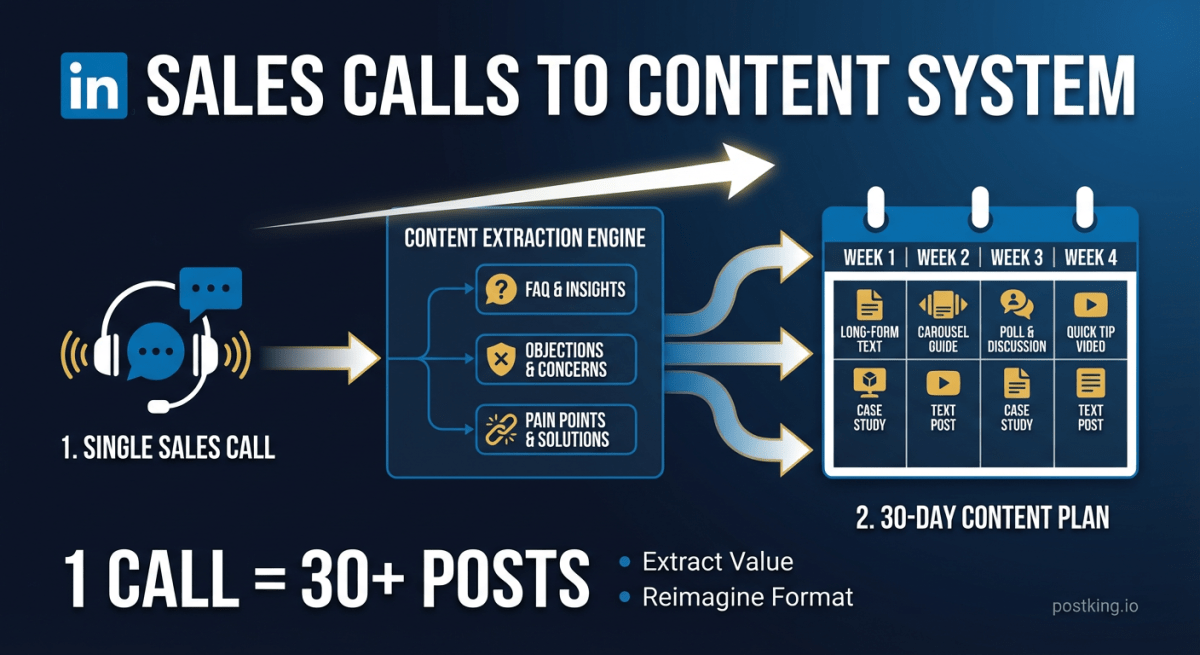
How to Turn Sales Calls into 30 Days of LinkedIn Content
Stop staring at blank screens. Your sales calls contain weeks of content hiding in plain sight. Here's the system for extracting posts from the conversations you're already having.
more engagement with carousels
Create scroll-stopping LinkedIn carousels in under 60 seconds. No design skills needed.
Try Carousel Generator