How to Get Inbound Leads on LinkedIn as a Consultant: The Authority-First Approach
Stop chasing clients. Learn how consultants build authority through content, turn engagement into natural conversations, and create a sustainable inbound lead system that works while you're serving clients.

Shanjai Raj
Founder at Postking
Cold outreach feels wrong because it is wrong. For consultants.
You're not selling software with a feature checklist someone can compare. You're selling judgment, expertise, and transformation. Those things can't be pitched in a cold message. They have to be demonstrated over time.
73% of buyers research independently before talking to sales. For consultants, that number is even higher. Before someone pays you $15K per month for strategic guidance, they need to believe you're worth it. LinkedIn content is how you build that belief.
The shift from outbound to inbound isn't just easier on your mental health. It fundamentally changes the dynamic. You're no longer interrupting someone's day with a pitch. You're creating value, and they come to you.
Why Inbound Beats Outbound for Consultants
The economics are obvious once you see them clearly.
Outbound consultant math:
- 50 personalized cold emails per week
- 2-5% response rate (1-3 replies)
- Maybe 1 exploratory call every two weeks
- That call starts with skepticism: "Why should I trust you?"
- Time investment: 10+ hours per week
Inbound consultant math:
- 3-4 LinkedIn posts per week
- Hundreds of people see each post
- 5-10 meaningful engagements from your target audience
- 2-3 DM conversations that start warm
- Those conversations begin with interest: "I've been following your content"
- Time investment: 3-4 hours per week
But the real difference isn't efficiency. It's positioning.
Cold outreach positions you as a vendor asking for business. Inbound content positions you as an authority sharing expertise. Vendors get price objections. Authorities get asked for help.
When a prospect books a call after reading your content for months, they've already decided you know what you're doing. The conversation isn't about convincing them of your expertise. It's about whether you're the right fit for their specific situation.
You can't get that positioning from a cold email, no matter how well-crafted.
The Authority-First Framework
Most consultants approach LinkedIn backwards. They post occasionally, hoping someone notices. When nobody reaches out, they conclude content doesn't work and go back to outbound.
The problem isn't content. It's the lack of a system.
The authority-first framework has three stages that work in sequence: content → trust → leads. Skip a stage, and the system breaks down.
Stage 1: Content (Demonstrate Expertise)
Your content serves one purpose: prove you understand your target client's problems better than they do.
Not "I'm an expert." Show, don't tell.
When you articulate a CEO's frustration with their team more precisely than they could themselves, you've just earned credibility. When you share a framework that helps a VP of Sales think differently about pipeline, you've demonstrated value before asking for anything in return.
The key is specificity. Generic advice about "leadership" or "growth strategy" proves nothing. Specific insights about "scaling a consulting firm from $500K to $2M without burning out" immediately filters for exactly who you serve.
What to share:
- Problems your ideal clients face (articulated better than they can)
- Frameworks you use (without giving away implementation)
- Client transformations (anonymized case studies)
- Contrarian perspectives (challenge conventional thinking in your space)
Stage 2: Trust (Build Credibility Over Time)
One good post doesn't close deals. Consistent content over months builds the trust required for high-ticket consulting.
Think about how you choose a consultant. You don't hire based on a single interaction. You watch them over time. You see how they think. You notice patterns in their insights. Slowly, you start to believe they could help you.
That's what your audience is doing. They're watching.
The first post they see: "This person knows their stuff."
The third post: "Okay, they really understand this problem."
The tenth post: "I should probably talk to them."
The twentieth post: "I need to reach out."
This is why consistency matters more than perfection. Three solid posts per week for six months beats one viral post. You're not chasing attention. You're building belief.
Stage 3: Leads (Convert Engagement to Conversations)
Here's where most consultants fail. They create content. They build trust. Then they wait passively for someone to reach out.
Inbound doesn't mean passive. It means warm.
When someone consistently engages with your content, you've earned the right to start a conversation. Not a pitch. A genuine conversation about what they're dealing with.
The framework is simple:
- Notice meaningful engagement (thoughtful comments, saves, shares)
- Acknowledge the engagement within 24 hours
- Add value in the DM (share additional context, offer a resource)
- If they respond, ask about their situation
- If there's a fit, offer to help
You're not cold messaging. You're continuing a conversation that already started through your content.
 Authority-First Framework Stages
Content Strategy for Inbound (Educational, Not Salesy)
The content that attracts consulting clients isn't promotional. It's educational.
You're not selling your services in every post. You're sharing expertise that makes people think "If they're giving this away for free, imagine what they charge for."
The Problem Articulation Post
Your ideal clients often can't articulate their own problems clearly. They feel the symptoms but haven't diagnosed the cause.
When you name their problem precisely, two things happen:
- They feel understood (builds trust immediately)
- They assume you must have the solution (creates demand)
Example for a scaling consultant:
"Your team is growing but your revenue per employee is shrinking. You hired 5 people this year. Revenue went up 30%, but profit stayed flat.
The math doesn't make sense until you realize: you're not scaling systems, you're scaling yourself. Every new person needs your time to onboard, manage, and unblock. You're now spending 60% of your week on internal operations instead of client delivery or business development.
This is the $500K to $2M trap. Hiring doesn't solve it. Structure does.
Most consultants figure this out after burning through cash for 18 months. The lucky ones figure it out earlier."
No pitch. No "DM me to learn more." Just precise problem articulation that makes the right person think "That's exactly where I am."
The Framework Preview Post
Share the structure of your methodology without the complete implementation playbook.
Give enough to be valuable. Keep enough to be hireable.
Example for a positioning consultant:
"After helping 40+ consultants clarify their positioning, I've noticed the same three-phase journey:
Phase 1: Too Broad "I help companies grow" sounds safe. But it attracts nobody. You compete with everyone. Price becomes the main differentiator.
Phase 2: Too Narrow You swing the other way: "I help Series B SaaS companies in fintech optimize their customer acquisition cost for users aged 35-50 in the northeast." So specific that your addressable market is 12 companies.
Phase 3: Just Right You find the sweet spot: specific enough to stand out, broad enough to build a business. "I help B2B SaaS founders go from $1M to $10M without scaling marketing spend proportionally."
Most consultants get stuck in Phase 1 or overcorrect to Phase 2. The shift to Phase 3 requires understanding how buyers actually think about their problems, not how you think about your solutions."
The framework is useful on its own. But it also creates curiosity: "How do I get to Phase 3?" That's when they reach out.
The Client Transformation Post
Results speak louder than credentials. But client confidentiality matters.
The solution: share the story without identifying details.
Example for an operations consultant:
"Client came to me doing $80K/month in consulting revenue. Solid business. But working 70-hour weeks. Every client engagement required their personal involvement. Couldn't take vacation without revenue stopping.
We spent the first month just documenting: every client touchpoint, every deliverable, every decision point. Realized 60% of what they were doing could be templated or delegated.
Built a three-tier service model:
- Tier 1: Junior consultants handle implementation (documented process)
- Tier 2: Senior consultants handle strategy (framework-driven)
- Tier 3: They only show up for the work only they can do
Took 6 months to implement. Revenue stayed flat initially, which freaked them out.
Then month 7 hit. $95K in revenue. 40-hour work week. Tier 1 and 2 running without them.
Month 12: $140K. Took a two-week vacation. Business ran fine.
The transformation wasn't about working harder. It was about building a machine that works without you."
No names. No industry specifics. But enough detail that someone in a similar situation sees themselves in the story.
The Contrarian Take Post
Safe opinions are forgettable. Taking a clear stand attracts the right clients and repels the wrong ones.
Example for a strategy consultant:
"Unpopular opinion: most strategic plans are expensive fiction.
You spend 3 months with a consulting firm. They interview 50 people. They build a 120-slide deck with a beautiful three-year roadmap.
It gets presented to the board. Everyone nods. It goes in a drawer. Six months later, nobody can remember what the priorities were.
Here's why: the plan was built in a conference room, not in reality. It assumes stable markets, cooperative competitors, and perfect execution.
Real strategy isn't a document. It's a decision-making framework. When an unexpected opportunity shows up, how do you decide whether to chase it? That's strategy.
The companies that win aren't the ones with the best plan. They're the ones that adapt fastest when the plan becomes obsolete.
Which is usually about 6 weeks in."
This post will lose followers who love traditional strategic planning. That's fine. It attracts leaders who want a consultant who thinks differently.
For a complete guide to content strategies that work for consultants, check out our LinkedIn for Coaches and Consultants post.
How to Turn Engagement Into Conversations
Content creates the opportunity. But engagement doesn't automatically convert to leads without intentional follow-up.
The transition from content consumer to consulting client has stages. Rush it, and you look desperate. Ignore it, and you leave money on the table.
Identifying Meaningful Engagement
Not all engagement matters equally.
High-signal engagement (strong intent):
- Thoughtful comments that share their specific situation
- Multiple interactions across different posts
- Saves and shares (they're keeping this for later or showing someone)
- Profile visits after engaging with content
Low-signal engagement (passive consumption):
- Generic "Great post!" comments
- One-off likes with no follow-up
- Engagement from people clearly outside your ICP
Focus your energy on high-signal engagers. These are people actively considering their options.
The Natural DM Sequence
When someone shows high-signal engagement, you've earned the right to reach out. But the approach matters.
Day 1: The Acknowledgment
Don't pitch. Don't hint at services. Just acknowledge and add value.
"Hey [Name] - saw your comment on my post about [topic]. Your point about [specific thing they mentioned] resonates. We've actually seen a similar pattern with [related insight].
Curious if you've tried [relevant approach]?"
You're continuing the conversation they started. Nothing salesy.
3-5 Days Later: The Value Add (Only if they responded)
"Thought of you when I came across this [article/framework/resource]. Seems relevant to what you mentioned about [their situation]. Let me know if it's useful."
You're building reciprocity. You're offering help before asking for anything.
After Genuine Rapport: The Offer
Only after you've had 2-3 genuine exchanges about their situation:
"Based on what you've shared about [specific challenge], this might be something we could help with. We worked with [similar type of client] on exactly this issue and [specific outcome].
Would a quick 15-minute chat be useful? Or if you prefer, I can send over some specifics first about how we approach this."
The offer feels natural because it's based on an actual understanding of their actual problem. You're not pitching a service. You're offering to solve a challenge they've already told you about.
What NOT to Do
Don't automate. The moment your follow-up feels templated, you've destroyed the trust your content built.
Don't pitch in the first message. Ever. The relationship isn't there yet.
Don't be pushy. If they don't respond, engage with their content instead. Stay visible without being annoying.
Don't spray-and-pray. Five high-quality conversation threads beat 50 generic outreach attempts.
For more on creating content that naturally attracts the right conversations, read our guide on LinkedIn Content That Converts.
DM Strategies That Feel Natural
The best DM conversations don't feel like sales conversations. They feel like professional peers exchanging ideas.
The Question-Based Opener
Instead of leading with your solution, lead with genuine curiosity about their approach.
"Saw you've been thinking about [topic based on their engagement]. We're working on something similar with a few clients. What's been your experience with [specific aspect]?"
This does three things:
- Shows you pay attention (builds rapport)
- Invites them to share (people love talking about their challenges)
- Positions you as a peer, not a vendor (establishes credibility)
The Resource-First Approach
Offer value before asking for anything.
"I put together a quick framework on [topic they care about] that might be relevant. No opt-in required, just [link or attachment]. Let me know if any of it applies to your situation."
Some will use it and never respond. That's fine. The ones who do respond are pre-qualified. They found your framework valuable enough to continue the conversation.
The Pattern Recognition Share
When you notice something relevant to their situation, share it without expectation.
"You mentioned [X] in your comment last week. Just worked through a similar situation with a client. The thing that actually moved the needle for them was [specific insight]. Not sure if it's relevant to your context, but thought I'd share."
You're demonstrating expertise through helpfulness, not through pitching.
The Honest Qualifier
Sometimes the best approach is direct transparency.
"Based on your posts about [topic], seems like you might be dealing with [specific challenge]. We help [specific type of client] solve this, but honestly don't know if we'd be a fit without understanding more about your situation.
If you're open to a quick chat to see if there's alignment, happy to grab 15 minutes. If not, no worries—enjoy the content either way."
This works because it's refreshingly honest in a sea of fake-casual sales DMs.
Pricing Signals in Your Content
One challenge consultants face: attracting the right budget level. You don't want to book calls with prospects who can't afford your rates.
The solution isn't listing your prices publicly. It's embedding pricing signals naturally into your content.
Signal Your Client Profile
"The clients I work with are typically doing $2M-10M in annual revenue. Below $2M, you probably don't need this level of strategic support yet. Above $10M, you likely have this handled internally."
You've just filtered without being explicit about price.
Share Client Context
"One founder I worked with was spending $40K/month on paid ads with declining returns. We restructured their entire acquisition strategy..."
The prospect reading this understands: if the client was spending $40K/month on ads, they can afford substantial consulting fees.
Reference Your Investment Level
"This isn't a quick fix. The transformation we're talking about is a 6-12 month engagement. Most clients see ROI in month 3-4, but the full value takes time to realize."
Anyone looking for cheap, fast help has been filtered out.
Describe Your Ideal Client's Situation
"If you're a solo consultant happy with your current revenue, you probably don't need this. But if you're hitting a ceiling where you're maxed on hours and can't grow without systems, this is for you."
You've pre-qualified based on ambition and readiness to invest, not just budget.
The "Not for Everyone" Frame
"Fair warning: I don't do gentle accountability. We set ambitious targets and I hold you to them. Some clients love this. Others find it too intense. If you want someone who'll just listen and validate, I'm not your consultant."
This filters for clients who value directness and are serious about results (which correlates with budget).
Measuring and Improving Conversion
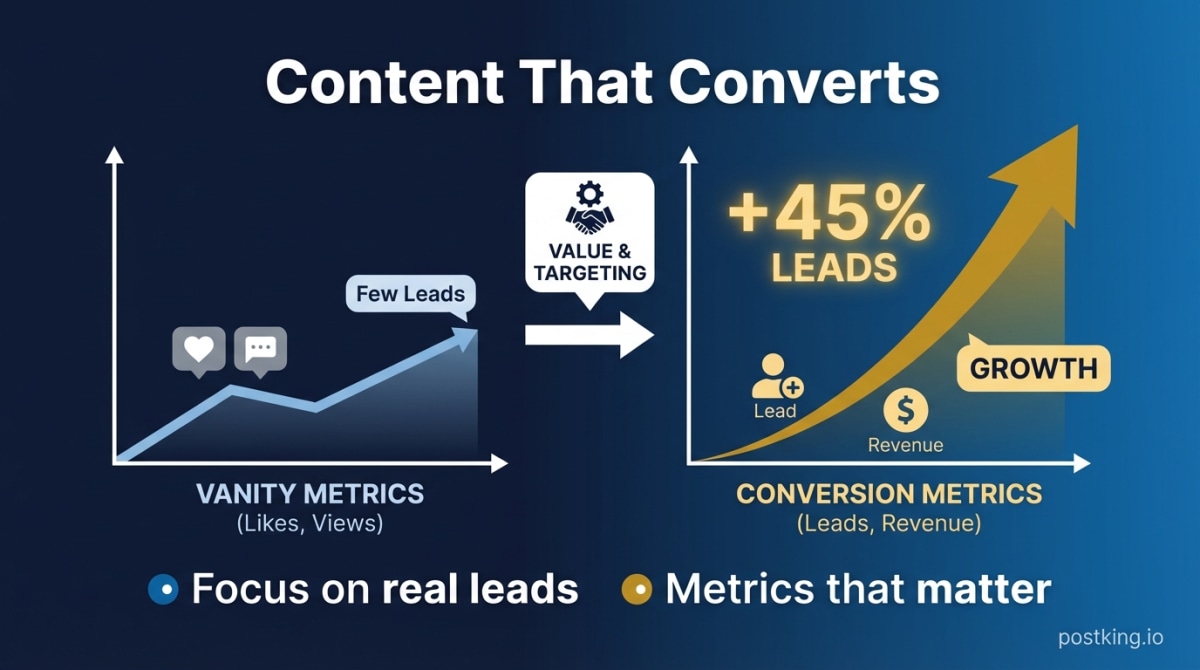
Likes don't pay your bills. Inbound conversations do.
The metrics that matter for consultants are different from influencers. You're not building an audience. You're building a pipeline.
Tier 1 Metrics (Revenue Impact)
These are the only numbers that truly matter:
- Discovery calls booked from LinkedIn leads - Track every call where the prospect says "I found you on LinkedIn"
- Proposals sent to LinkedIn-sourced leads - How many conversations convert to formal proposals?
- Clients closed from LinkedIn - Actual revenue attributed to the platform
- Average deal size from inbound vs. outbound - Inbound leads often close larger because they pre-sold themselves
Review monthly: "How much revenue came from LinkedIn this month?" That determines whether your strategy is working.
Tier 2 Metrics (Pipeline Health)
These indicate whether your content is attracting the right people:
- DM conversations with ICP members - Not total DMs, just qualified prospects
- Engagement from target companies - Are decision-makers at companies you want to work with engaging?
- Connection requests from relevant prospects - When your ICP reaches out to connect, you're doing something right
- Content saves and shares - People saving your posts for later indicates high intent
Track weekly. If you're posting consistently but not seeing engagement from your target audience, your content needs adjustment.
Tier 3 Metrics (Leading Indicators)
These suggest your content is gaining traction:
- Profile views from target industries - Check LinkedIn analytics for viewer demographics
- Follower growth in relevant segments - Quality over quantity
- Post reach within your target audience - LinkedIn shows you job titles and industries of viewers
These metrics can't be gamed. You either have genuine traction with your ICP or you don't.
The Monthly Review Process
Block 60 minutes at the end of each month for this:
-
List every LinkedIn-sourced conversation - Who reached out? What prompted it? Where are they now in your pipeline?
-
Identify your top-performing content - Which posts generated the most qualified engagement? What topics? What formats?
-
Analyze your worst-performing content - What got likes but no meaningful conversations? Stop creating that.
-
Note patterns in objections or questions - If multiple prospects ask the same question, write a post answering it.
-
Adjust your content plan - Double down on what's working. Cut what isn't.
This isn't complicated analytics. It's paying attention to what actually drives results.
For more on tracking what actually matters versus vanity metrics, see our post on Getting Demo Calls from LinkedIn Without Cold Outreach.
The 90-Day Inbound System
Here's a realistic system for consultants who don't have time to become full-time content creators:
Weeks 1-4: Foundation
Monday (60 minutes):
- Review last week's engagement patterns
- Draft 3 posts for the week (use your client insights as content)
- Schedule them for Tuesday, Wednesday, Friday
Tuesday/Thursday/Friday (15 minutes each):
- Check notifications for meaningful engagement
- Respond to thoughtful comments
- Engage with 3-5 posts from your target audience
Weekly total: ~2.5 hours
Weeks 5-8: Engagement Phase
Continue the posting schedule, but add:
Wednesday/Friday (15 minutes each):
- Review who engaged this week from your ICP
- Send 2-3 value-first DMs to high-signal engagers
- Follow up on ongoing conversations
Weekly total: ~3 hours
Weeks 9-12: Conversion Phase
Your audience now knows who you are. Time to be more direct:
- Include soft CTAs in 30% of your posts ("DM me if this resonates")
- Turn qualified DM conversations into discovery calls
- Track which content topics lead to the best conversations
Weekly total: ~3.5 hours
After 90 Days
Review your results:
- How many discovery calls came from LinkedIn?
- Which content types generated the best leads?
- What's your close rate on inbound leads vs. outbound?
If you've been consistent, you should see 2-4 qualified conversations per month by day 90. Not dozens. But 2-4 high-quality conversations beat 50 cold outreach attempts.
Month 4-6: The compounding kicks in. Your audience knows you. Referrals increase. Discovery calls start with "I've been following you for months."
Common Mistakes That Kill Inbound Momentum
Mistake #1: Inconsistent Posting
You post 5 times one week, then disappear for three weeks.
The algorithm resets. Your audience forgets about you. You have to rebuild momentum from scratch every time.
Fix: Commit to a sustainable cadence. Three posts per week for six months beats daily posting for one month then quitting.
Mistake #2: Content Without Perspective
You share industry news with "Thoughts?" or regurgitate generic advice.
Nobody knows what you actually think. You're indistinguishable from everyone else.
Fix: Have a point of view. Share what you believe, not what everyone else is saying.
Mistake #3: Waiting Passively for Inbound
You create great content but never initiate conversations with engaged prospects.
Inbound doesn't mean passive. It means warm.
Fix: When someone shows genuine interest through engagement, reach out within 24 hours.
Mistake #4: Pitching Too Soon
Someone likes one post and you're in their DMs with a calendar link.
You've just destroyed any trust your content built.
Fix: Multiple meaningful interactions before any mention of working together.
Mistake #5: No Clear Next Step
Your content is valuable, but there's no way for interested prospects to go deeper.
They move on and forget about you.
Fix: Include soft CTAs occasionally. Offer a framework, guide, or resource that captures contact information.
Frequently Asked Questions
How long before I see results from inbound?
Expect 90 days before meaningful traction. Month 1-2 feels like shouting into a void. Month 3-4, conversations start. Month 6+, it becomes a reliable lead source. Most consultants quit at week 6. Don't.
How often should I post?
Three posts per week is the sweet spot for consultants. Enough to stay visible. Not so much it consumes your life. Consistency beats intensity.
What if I don't have time to create content?
Your client work IS your content. After every client session, ask: "What insight from this call could help others?" Capture it in 3 minutes. Turn it into a post later. Tools like Postking's voice-to-content feature let you speak your thoughts and get structured posts.
Should I use video or text posts?
Both work, but text is easier to maintain consistently. Video builds connection faster but requires more production. Start with text. Add video once you have a content rhythm.
What about LinkedIn ads to boost reach?
Organic first. Master that before spending money. Ads can accelerate results, but they can't fix mediocre content.
How do I handle negative comments?
Contrarian posts attract disagreement. That's fine. Respond thoughtfully to genuine critique. Ignore obvious trolls. Your target clients are watching how you handle pushback.
Should I engage with competitors' content?
Yes. Thoughtful comments on others' posts (including competitors) put you in front of their audience. Don't be self-promotional. Add genuine value.
What if my niche is too small for LinkedIn?
Unless you serve fewer than 1,000 potential clients globally, LinkedIn has them. The issue isn't market size. It's whether you're creating content that resonates.
How do I balance giving away expertise vs. keeping something to sell?
Share what you know freely. Keep how you implement it for paying clients. People don't pay consultants for information. They pay for implementation, accountability, and personalized guidance.
What's the ROI timeframe for content?
Calculate opportunity cost. If you spend 3 hours per week on content, that's ~12 hours per month. If that generates one qualified discovery call per month, and you close 25% of those calls at $20K average, your annual ROI is significant. But measure over 6-12 months, not 6 weeks.
Your First Week: Action Steps
Enough theory. Here's what to do this week:
Day 1: Define your ICP with painful specificity. Not "B2B companies" but "founders of service businesses doing $500K-$3M who are maxed on personal capacity."
Day 2: List 10 specific problems your ICP faces. Use client conversations as source material.
Day 3: Write your first problem articulation post. Pick the issue you hear most often from prospects.
Day 4: Optimize your LinkedIn profile. Headline should state who you help and what outcome you deliver. Featured section should include one valuable resource.
Day 5: Write two more posts. One framework preview. One client story (anonymized).
Day 6: Schedule your three posts for next week (Tuesday, Thursday, Friday morning).
Day 7: Identify 10 people in your ICP who are active on LinkedIn. Engage thoughtfully with their content.
That's it. One week. Foundation set.
Then repeat: post consistently, engage genuinely, turn conversations into relationships, and relationships into clients.
Ready to build your inbound system? Start with clear, well-formatted content using our LinkedIn post formatter. Turn your frameworks into engaging visuals with our carousel generator. And if typing isn't your style, use our voice-to-content tool to speak your expertise and get polished posts in return.
The consultants winning on LinkedIn aren't the ones with the biggest followings. They're the ones who consistently demonstrate expertise, build genuine relationships, and make it easy for the right clients to find them.
Your next client is already on LinkedIn. The question is whether they'll find you or your competitor.
Related Reads
Written by
Shanjai Raj
Founder at Postking
Building tools to help professionals grow on LinkedIn. Passionate about content strategy and personal branding.
View all postsYou might also like
LinkedIn Post Ideas Generator
Try our free linkedin post ideas generator to enhance your LinkedIn presence.
LinkedIn Post Formatter
Try our free linkedin post formatter to enhance your LinkedIn presence.
LinkedIn Client Acquisition for Coaches and Consultants (2026)
A client-focused LinkedIn strategy for coaches and consultants. Build authority, attract high-ticket clients, and convert profile views into calls.
LinkedIn Content That Actually Converts (Not Just Gets Likes)
Stop chasing vanity metrics. Learn why viral posts rarely drive revenue, how to create content that generates leads, and the metrics that actually matter for founders.
LinkedIn Hook Generator
Try our free linkedin hook generator to enhance your LinkedIn presence.
LinkedIn Profile Optimization for Consultants: Convert Profile Views Into Discovery Calls
Learn how consultants should optimize their LinkedIn profiles differently than job seekers. Includes conversion-focused strategies for every profile section, how to showcase results without breaking confidentiality, and strategic CTA placement to turn visitors into paying clients.
more engagement with carousels
Create scroll-stopping LinkedIn carousels in under 60 seconds. No design skills needed.
Try Carousel Generator