LinkedIn Content That Actually Converts (Not Just Gets Likes)
Stop chasing vanity metrics. Learn why viral posts rarely drive revenue, how to create content that generates leads, and the metrics that actually matter for founders.

Shanjai Raj
Founder at Postking
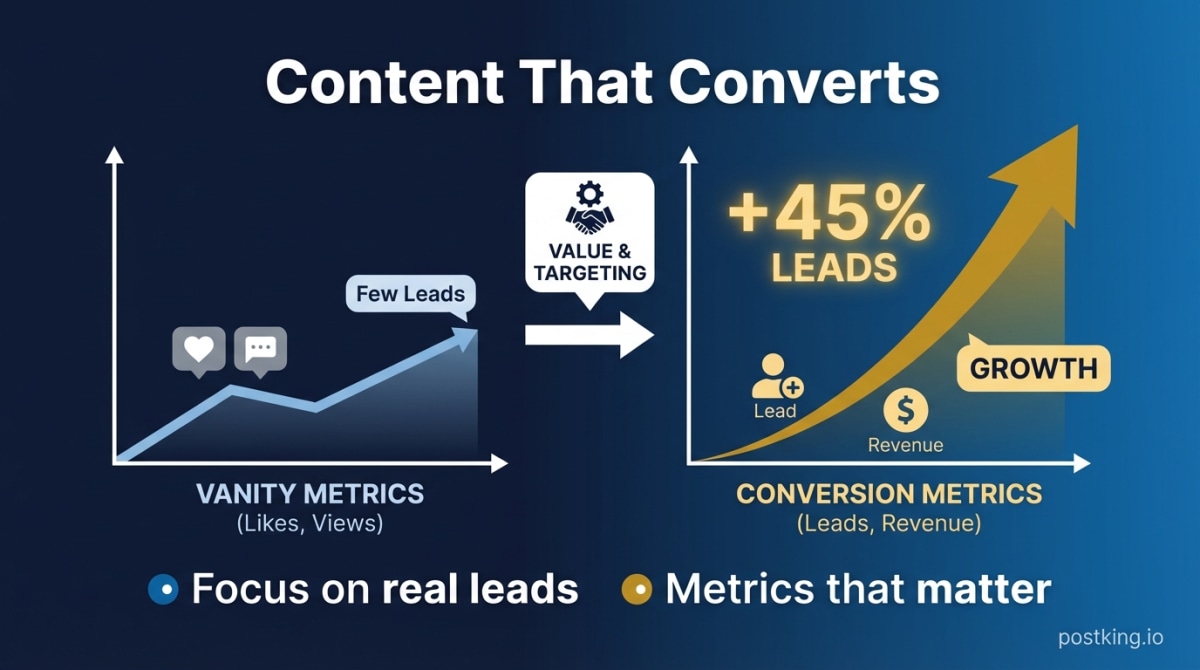
A post with 50,000 impressions and 2,000 likes sounds like a win. Until you check your inbox and realize not a single one of those people reached out. No DMs. No profile visits from decision-makers. No conversations that could turn into revenue.
Meanwhile, a founder I know posted something that got 83 likes. Just 83. But three people DMed her asking about her services, and one became a $30K client.
The gap between engagement and conversion is where most founders waste months of effort.
Engagement Is Not a Business Model
Let's be direct about what's happening when you optimize for likes.
LinkedIn's algorithm rewards content that keeps people on the platform. Broadly appealing posts get shown to more people because more people engage with them. The algorithm doesn't care whether those people are your potential customers or random scrollers who will never buy anything.
When you write a post about work-life balance, you'll get engagement from:
- Job seekers
- HR professionals
- Your college friends
- Career coaches
- Random people who agree with the sentiment
None of these groups are likely to be the VP of Operations at a mid-market company looking for exactly what you sell.
Engagement-optimized content attracts everyone. Business-optimized content attracts buyers.
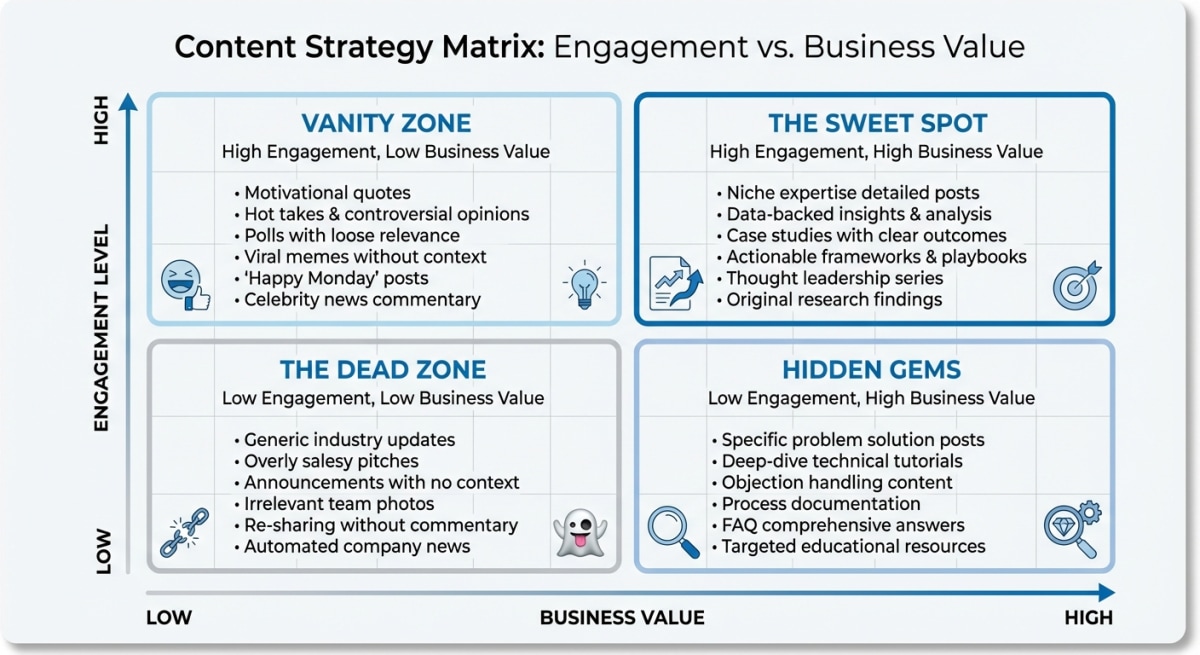 Engagement vs Business Value Matrix
Why Viral Posts Usually Fail to Convert
Here's the uncomfortable math. A post that goes viral (let's say 500K impressions) might reach 50 people in your ideal customer profile. A targeted post with 15K impressions might reach 500.
The viral post looks better on the surface. But the targeted post is 10x more valuable for your business.
Three things happen with viral content that actively hurt your conversion potential:
Algorithm confusion. LinkedIn builds a profile of what kind of content you create and who should see it. Post consistently about B2B procurement, and the algorithm learns to show your content to procurement professionals. Post something viral about hustle culture, and suddenly you're being shown to a completely different audience. It can take weeks to retrain the algorithm after a viral post.
Wrong followers. The people who follow you after a viral post expect more of that content. When you go back to posting about your actual expertise, they don't engage. Lower engagement signals to LinkedIn that your content quality dropped.
Vanity addiction. Once you've felt the dopamine hit of a post with 10K likes, posting something that gets 50 likes feels like failure. So you keep chasing the high instead of writing for your actual buyers.
The only exception: when your viral post is directly about your area of expertise and attracts exactly your target audience. This is rare. Most viral content succeeds by being broadly appealing, which is the opposite of what converts.
Content That Gets Likes vs. Content That Gets Leads
After watching hundreds of founder accounts, the pattern is clear. Certain content types are engagement machines that rarely convert. Others look modest in the metrics but quietly fill pipelines.
High-Engagement, Low-Conversion Content
Motivational stories. "I was broke, now I'm successful" narratives resonate with everyone. The comments fill with "So inspiring!" from people who will never become customers.
Hot takes on work culture. Remote vs. office debates, hustle culture opinions, generational workplace differences. These spark arguments. Arguments drive engagement. None of this identifies qualified buyers.
Universal lessons. "What my first job taught me about leadership" applies to literally everyone. That's why it performs well and converts poorly.
Humble brags disguised as lessons. "I almost gave up on my 7-figure business" gets engagement because people love comeback stories. But the comments are mostly from aspiring entrepreneurs, not your ICP.
Low-Engagement, High-Conversion Content
Specific problem articulation. When you describe a problem precisely ("If you're running a 50-person sales team and your reps are spending 4+ hours per week on CRM data entry..."), only people with that exact problem engage. Fewer reactions, but every comment is a potential lead.
Framework posts. A mental model for solving a specific challenge. These get saved and shared privately. The engagement looks modest, but people DM you asking to learn more.
Behind-the-scenes process posts. How you actually solved a problem for a client (with appropriate anonymization). Prospects read this and think, "We have that same problem."
Contrarian takes backed by experience. Not controversy for clicks, but genuine perspectives that filter for people who share your worldview. You'll lose some followers. The ones who stay are more likely to become customers.
For detailed frameworks on each of these content types, our LinkedIn content strategy guide breaks down exactly how to structure them.
The Awareness-to-Action Funnel
Converting LinkedIn content works like any other funnel. You can't ask someone to buy on first impression. But you can move them through stages.
Stage 1: Problem Awareness
Content that articulates problems your buyers face. The goal isn't to pitch anything. Just demonstrate that you understand their world better than most.
Example: "Most B2B companies track marketing pipeline but can't tell you which specific content pieces influenced closed deals. The attribution problem isn't technical. It's a process problem."
No CTA needed. People who have this problem self-identify by engaging.
Stage 2: Solution Awareness
Content that shows how problems like theirs get solved. Case studies (anonymized if needed), frameworks, process breakdowns.
Example: "We tracked 6 months of closed deals and found 73% had engaged with at least one piece of long-form content before the first sales touch. Here's what that content had in common..."
Soft CTA works here: "If you're dealing with similar attribution challenges, curious what you've tried."
Stage 3: Product Awareness
Now you can mention what you do. But frame it around the problem, not the product.
Example: "This is exactly why we built [product]. The manual tracking was killing our clients' teams. If you want to see how it works, link in comments or DM me."
The key insight: most founders jump straight to Stage 3 and wonder why nobody responds. You need to earn the right to pitch by first demonstrating understanding.
CTAs That Don't Feel Like Sales Pitches
The call to action determines whether your content generates conversations or just applause.
Most CTAs fail because they ask for too much too soon. Asking someone to "book a demo" when they just read a single post is like proposing marriage on a first date.
The Friction Ladder
Zero friction (awareness stage):
- "Anyone else seeing this?"
- "What's been your experience?"
- "Curious if this resonates"
These invite engagement without commitment. Use them for problem-awareness content.
Low friction (solution stage):
- "If this is relevant to you, DM me what you've tried"
- "Comment 'framework' and I'll send you the full breakdown"
- "Happy to share more context if useful"
These ask for a small action in exchange for value. The comment-trigger method ("comment X to receive Y") works well because it's low effort and creates public engagement that boosts reach.
Medium friction (product stage):
- "If you're dealing with this specific problem, let's chat"
- "We're doing 5 free audits this month for companies in [specific situation]"
- "Link to learn more in comments (or DM me if you want to skip the marketing page)"
Only use these after you've established credibility through consistent valuable content.
What Actually Works
The most effective CTA I've seen founders use: offering to help without expectation.
"If you're stuck on this, DM me your situation. I'll share what I've seen work." No pitch. No link. Just genuine offer to help.
Some of those conversations turn into customers. Most don't. But the ones who don't remember you as someone who helped, and they refer others.
Measuring What Actually Matters
LinkedIn's native analytics focus on vanity metrics. Impressions, reactions, comments. These tell you whether content performed well by LinkedIn's standards. They don't tell you whether it performed well by business standards.
The Metrics That Drive Revenue
Profile views from your ICP. LinkedIn shows you who's viewing your profile. Are they decision-makers at companies you want to work with? If your content is working, you should see an uptick in profile views from relevant people after posting.
DM conversations initiated. Not total DMs. Specifically: conversations started by people who match your buyer profile after seeing your content. Track this manually. Write down every qualified conversation that starts with "saw your post about..."
Connection requests from target accounts. When a Director of Marketing at a company you'd love to work with sends you a request, that's a signal. When a job seeker or coach sends one, it's not.
Website clicks (from posts or profile). If your profile links to your site, track how many visitors come from LinkedIn. If you include links in comments, track those clicks separately.
Calls and opportunities attributed to LinkedIn. The ultimate metric. When you get on a call, ask how they found you. Track every "I saw your LinkedIn content" response.
What to Track Weekly
Spend 10 minutes every Friday on this:
- Screenshot your profile viewers from the week. Note how many are in your target audience.
- Count DMs and connection requests from qualified prospects.
- Note which posts generated the most ICP engagement (not total engagement).
- Track any calls or opportunities that came from LinkedIn activity.
Over time, you'll see patterns. Certain topics generate more qualified interest. Certain CTAs drive more conversations. Double down on what works.
Balancing Reach and Conversion
Here's the honest tradeoff: you can't optimize fully for both reach and conversion. Content that converts best often reaches fewer people. Content that reaches widely often converts poorly.
The goal isn't to pick one or the other. It's to find the balance that works for your business.
A Practical Content Mix
For most founders, this split works:
60% niche expertise content (lower reach, higher conversion) Posts about specific problems your buyers face. Framework posts. Process breakdowns. Case studies. These won't go viral. They will generate qualified interest.
30% broader insight content (medium reach, medium conversion) Industry analysis. Trends affecting your market. Opinions on where things are heading. These reach more people while still staying relevant to your expertise.
10% high-engagement content (higher reach, lower conversion) Personal stories. Behind-the-scenes glimpses. Occasional takes on broader topics. These keep your follower count growing and maintain engagement momentum.
If you're posting 3 times per week, that's roughly 2 niche posts and 1 broader post. Adjust based on what the data tells you.
When to Accept Lower Engagement
Your best-converting posts might get 1/10th the engagement of your viral ones. That's fine. You're not building a media company. You're building a business.
A post with 50 likes that generates 3 qualified DMs is worth more than a post with 5,000 likes and zero business conversations.
The founders who get this stop worrying about engagement and start tracking conversations. Their content looks less impressive on the surface. Their pipelines look much better.
For more on structuring your content mix, check out our LinkedIn engagement guide which covers how to maintain visibility while staying focused on your target audience.
Example: Same Topic, Two Approaches
Let's see this in practice with a real topic: customer churn.
Version A: High Engagement, Low Conversion
Customer churn is a symptom, not the disease.
Stop treating the exit. Start treating the cause.
The real problem is almost never your product. It's the gap between what customers expected and what they experienced.
Close that gap, and churn handles itself.
Agree?
This will get likes. It's true. It's quotable. It applies to everyone. The comments will be full of people saying "So true!" and "Needed to hear this."
Zero of those commenters are likely to become customers. The post doesn't identify any specific buyer or demonstrate any particular expertise.
Version B: Lower Engagement, Higher Conversion
We analyzed churn data from 34 B2B SaaS companies with $2-10M ARR. One pattern kept showing up.
67% of customers who churned in the first 90 days had fewer than 3 logins in their first week.
It wasn't feature complaints. It wasn't price sensitivity. It was activation failure.
The fix wasn't a better product. It was a better first-week experience.
We helped one company reduce early churn by 40% by adding exactly 3 touchpoints in the first 7 days. No product changes.
If you're running CS at a SaaS company and seeing early churn, curious what your first-week activation looks like.
This post will get fewer likes. But every engagement will be from someone at a SaaS company dealing with early churn. Those are the people you actually want to talk to.
The difference: specificity. Version B targets a narrow audience with a specific problem and demonstrates actual expertise through data.
The Long Game Reality
Building LinkedIn content that converts takes longer than building content that gets likes.
Month 1-2: You're figuring out what resonates with your specific audience. Engagement looks modest. Conversions are rare.
Month 3-4: Patterns emerge. You know which topics generate qualified interest. DMs start coming in from the right people.
Month 5-6: The compounding kicks in. Your audience knows what you're about. Repeat viewers become warm prospects.
Month 6+: LinkedIn becomes a reliable source of qualified conversations. The volume isn't huge, but the quality is high.
Most founders quit at month 2 because the vanity metrics look bad. They see other people getting thousands of likes and feel like they're failing.
They're not seeing the DMs those viral posters aren't getting. They're not seeing the pipeline that isn't building.
Play the long game. Optimize for business outcomes. Let other people chase likes.
Ready to create content that actually converts? Use our free carousel generator to turn your frameworks and case studies into visual content that captures attention. Or check out our post formatter to structure your posts for maximum readability. And before you publish, preview exactly how your post will look with our LinkedIn post preview tool.
Related Reads
Written by
Shanjai Raj
Founder at Postking
Building tools to help professionals grow on LinkedIn. Passionate about content strategy and personal branding.
View all postsYou might also like
LinkedIn Post Ideas Generator
Try our free linkedin post ideas generator to enhance your LinkedIn presence.
LinkedIn Headline Generator
Try our free linkedin headline generator to enhance your LinkedIn presence.
How to Get Inbound Leads on LinkedIn as a Consultant: The Authority-First Approach
Stop chasing clients. Learn how consultants build authority through content, turn engagement into natural conversations, and create a sustainable inbound lead system that works while you're serving clients.
LinkedIn Client Acquisition for Coaches and Consultants (2026)
A client-focused LinkedIn strategy for coaches and consultants. Build authority, attract high-ticket clients, and convert profile views into calls.
LinkedIn Posting Frequency Calculator
Try our free linkedin posting frequency calculator to enhance your LinkedIn presence.
LinkedIn Content Ideas for Marketers: 50+ Topics That Actually Build Authority (Not Just Engagement)
Stop posting generic marketing tips. 50+ content ideas, templates, and frameworks that position you as a marketing expert worth hiring—organized by campaign breakdowns, industry insights, controversial takes, and more.
How to Create LinkedIn Carousels That Actually Get Engagement
Learn exactly how to create LinkedIn carousels that get 24% engagement rates. Includes hook formulas, design specs, content frameworks, and the Rehook technique most creators miss.
more engagement with carousels
Create scroll-stopping LinkedIn carousels in under 60 seconds. No design skills needed.
Try Carousel Generator