LinkedIn vs Twitter for Founders: Data-Backed Platform Comparison (2026)
Should founders focus on LinkedIn or Twitter? Compare audience, engagement, ROI, and time investment with data. Includes decision framework and hybrid strategy.

Shanjai Raj
Founder at Postking
As a founder, your time is your most valuable asset. Every hour spent on social media needs to generate measurable returns—whether that's customer acquisition, fundraising connections, or team building.
The question isn't whether you should be on social media. It's which platform deserves your limited time.
LinkedIn and Twitter dominate the startup ecosystem, but they serve fundamentally different purposes. After analyzing thousands of founder profiles, engagement metrics, and real-world outcomes, here's the data-backed comparison that will help you make the right choice.
Platform Overview: LinkedIn vs Twitter in 2026
LinkedIn has evolved from a digital resume into the world's largest professional networking platform, with over 930 million users. For founders, it's become the primary platform for B2B marketing, thought leadership, and professional credibility.
Twitter (now X, but we'll use Twitter throughout) remains the real-time conversation hub with 540 million users. It's where tech news breaks first, where founders engage in public building, and where communities form around ideas rather than credentials.
Both platforms can drive results. But they work in fundamentally different ways.
Audience Comparison: Who You'll Reach
LinkedIn Audience Demographics
LinkedIn's professional focus attracts specific audience segments:
- Decision-makers: 65 million decision-makers, 61 million senior-level influencers
- Job level: 44% of users earn $75k+, with high purchasing power
- Age range: Primary demographic is 25-55 (prime professional years)
- B2B focus: 80% of B2B leads come from LinkedIn
- Intent: Users browse with business intent—they're looking for solutions, hiring, or career advancement
Best for reaching: Enterprise buyers, hiring prospects, investors, B2B customers, corporate executives, industry thought leaders.
Twitter Audience Demographics
Twitter attracts a different crowd:
- Tech-forward: 80% of tech decision-makers are active on Twitter
- Younger skew: 38.5% are ages 25-34, with strong Gen Z presence
- Real-time focus: Users check Twitter for breaking news and trends
- Consumer orientation: Strong B2C audience, early adopters, creators
- Intent: Users browse for entertainment, news, and community engagement
Best for reaching: Tech enthusiasts, early adopters, journalists, other founders, indie hackers, crypto/web3 community, consumer audiences.
Engagement Rates: Where Your Content Performs
LinkedIn Engagement Benchmarks (2026)
LinkedIn's algorithm favors engagement over follower count:
- Average engagement rate: 2-3% (significantly higher than Twitter)
- Post lifespan: 24-48 hours (content resurfaces via algorithm)
- Organic reach: 20-30% of your network sees each post
- Video engagement: 5x higher than static posts
- Document posts: 3x higher engagement than standard posts
- Comments: Worth 2x more than likes in algorithm
What this means: Even with a small network (500-1,000 connections), you can generate meaningful engagement. Quality matters more than quantity.
Twitter Engagement Benchmarks (2026)
Twitter's timeline moves fast:
- Average engagement rate: 0.5-1% (lower but more viral potential)
- Post lifespan: 15-30 minutes (rapid decay)
- Organic reach: 5-10% of followers see typical tweets
- Thread engagement: 3x higher than single tweets
- Retweets: Primary growth mechanism (exponential reach)
- Quote tweets: Generate deeper discussion than simple RTs
What this means: You need consistent volume to stay visible. But one viral tweet can reach millions—something nearly impossible on LinkedIn.
Content Formats: What Works Where
LinkedIn Content That Performs
1. Personal Story Posts (500-1,200 words)
- Share lessons learned, mistakes made, behind-the-scenes insights
- Hook in first 2 lines, break into short paragraphs
- Average engagement: 200-500 reactions for mid-sized accounts
2. Data-Driven Insights
- Industry statistics, case studies, original research
- Use carousel posts or documents for data visualization
- Average engagement: 150-400 reactions
3. Thought Leadership
- Hot takes on industry trends, future predictions, frameworks
- Establish expertise and differentiate your perspective
- Average engagement: 100-300 reactions
4. Video Content
- Native video uploads (not YouTube links)
- Behind-the-scenes, quick tips, founder updates
- Average engagement: 300-800 views
What doesn't work: Memes, overly promotional content, short posts (under 150 words), frequent posting (more than 1-2x daily).
Twitter Content That Performs
1. Threads (5-15 tweets)
- How-to guides, frameworks, storytelling
- First tweet is critical (makes or breaks virality)
- Average engagement: 50-200 likes for mid-sized accounts
2. Hot Takes & Opinions
- Contrarian views, industry commentary, debates
- Generates quote tweets and discussion
- Average engagement: 30-150 likes
3. Personal Updates
- Build in public updates, daily wins/losses, real-time thoughts
- Creates parasocial connection with audience
- Average engagement: 20-80 likes
4. Visual Content
- Screenshots, charts, memes, GIFs
- Native images perform better than links
- Average engagement: 40-120 likes
What doesn't work: Long-form text (use threads instead), excessive self-promotion, generic advice, inconsistent posting.
Time Investment: Efficiency Comparison
LinkedIn Time Requirements
Minimum effective effort: 3-5 hours/week
- Write 1 high-quality post (1-2 hours)
- Engage with 10-15 other posts daily (30 minutes/day)
- Respond to comments on your posts (30 minutes/post)
- DM networking (1 hour/week)
Total: ~5 hours/week for solid results
Efficiency rating: ⭐⭐⭐⭐⭐
- High return on time invested
- One good post can drive conversations for days
- Less content required to maintain presence
Twitter Time Requirements
Minimum effective effort: 7-10 hours/week
- Post 3-5 tweets daily (1 hour/day)
- Write 1-2 threads weekly (2-3 hours)
- Engage with others' tweets (1 hour/day)
- Respond to mentions/replies (1 hour/day)
- Monitor trends and news (30 minutes/day)
Total: ~10 hours/week for solid results
Efficiency rating: ⭐⭐⭐
- Requires consistent daily presence
- More volume needed to stay visible
- Faster-paced, more demanding
ROI Comparison: Which Drives Better Results?
LinkedIn ROI for Founders
Customer Acquisition (B2B)
- 80% of B2B social leads come from LinkedIn
- 3x higher conversion rate than Twitter for B2B
- Average deal size: Higher (enterprise buyers)
- Sales cycle: Longer but more qualified leads
Fundraising
- 70% of VCs actively use LinkedIn for sourcing
- Direct messaging to investors more accepted
- Professional credibility carries weight
- Better for warm intros through mutual connections
Hiring
- 87% of recruiters use LinkedIn regularly
- Easier to showcase company culture
- Applicants are generally more qualified
- Built-in recruiting tools and job postings
Thought Leadership
- Builds professional brand and credibility
- Positions you as industry expert
- Opens doors to speaking, consulting, partnerships
- Better for B2B brand awareness
Winner for: B2B sales, fundraising, hiring senior talent, professional credibility.
Twitter ROI for Founders
Customer Acquisition (B2C & Tech)
- Better for viral consumer products
- Lower cost per acquisition for B2C
- Faster feedback loops on product
- Community-driven growth (word of mouth)
Fundraising
- Access to crypto/web3 investors
- Great for building in public (proof of execution)
- Connects with younger, tech-forward VCs
- Can create FOMO with traction updates
Hiring
- Attracts indie hackers and builders
- Better for remote/async culture fit
- Access to global talent pool
- Works well for early-stage, scrappy teams
Thought Leadership
- Faster path to influence in tech circles
- Better for real-time commentary
- Can reach larger audiences quickly
- Great for consumer brand building
Winner for: B2C sales, tech product launches, building in public, consumer brand awareness, indie hacker audience.
Algorithm Differences: How to Win on Each Platform
LinkedIn's Algorithm Priorities
LinkedIn's algorithm optimizes for "dwell time"—how long people stay on the platform:
- Engagement velocity: Early engagement (first 60 minutes) determines reach
- Comment quality: Thoughtful comments boost reach more than likes
- Profile relevance: Shows your content to people similar to current engagers
- Content-type bonus: Native uploads (video, documents) get priority
- Spam detection: External links, hashtag stuffing, engagement bait get penalized
How to win: Post during business hours (8am-12pm), encourage meaningful comments, use short paragraphs for readability, include your perspective (not just information).
Twitter's Algorithm Priorities
Twitter's algorithm (post-Elon) prioritizes engagement and Blue subscribers:
- Recency: Recent tweets get initial push
- Engagement rate: Likes, RTs, replies determine viral potential
- Blue verification: Verified accounts get 4x reach boost
- Video priority: Native video uploads get algorithmic boost
- Connection strength: Shows tweets from accounts you engage with
How to win: Post during peak hours (7am-9am, 12pm-1pm, 5pm-7pm), use hooks and open loops, encourage quote tweets, engage immediately after posting, consider Twitter Blue for reach.
Platform Comparison Table
| Factor | Winner | ||
|---|---|---|---|
| Audience Size | 930M users | 540M users | |
| Engagement Rate | 2-3% | 0.5-1% | |
| Viral Potential | Low | High | |
| B2B Effectiveness | Excellent | Moderate | |
| B2C Effectiveness | Moderate | Excellent | |
| Time Investment | 5 hrs/week | 10 hrs/week | |
| Content Lifespan | 24-48 hours | 15-30 minutes | |
| Fundraising | Very Strong | Strong | |
| Hiring | Very Strong | Moderate | |
| Customer Acquisition (B2B) | Very Strong | Weak | |
| Customer Acquisition (B2C) | Weak | Very Strong | |
| Thought Leadership | Strong | Very Strong | |
| Professional Credibility | Very Strong | Moderate | |
| Community Building | Moderate | Very Strong | |
| Real-Time Engagement | Weak | Very Strong |
When to Choose LinkedIn Over Twitter
Choose LinkedIn as your primary platform if:
- ✅ You're building a B2B SaaS company
- ✅ Your customers are enterprise buyers or decision-makers
- ✅ You're actively fundraising from traditional VCs
- ✅ You need to hire senior-level talent
- ✅ Professional credibility is critical to your business
- ✅ You have limited time (5 hours/week max for social)
- ✅ Your product has a longer sales cycle
- ✅ You prefer in-depth, thoughtful content
Real example: A B2B sales software founder grew from 1,000 to 25,000 followers on LinkedIn in 18 months, generated 40% of enterprise leads from LinkedIn, and closed $2M in ARR directly from platform engagement.
When to Choose Twitter Over LinkedIn
Choose Twitter as your primary platform if:
- ✅ You're building a consumer product or app
- ✅ You're in crypto, web3, or cutting-edge tech
- ✅ You're building in public and documenting the journey
- ✅ You need rapid feedback on product ideas
- ✅ Your audience is tech-savvy early adopters
- ✅ You can commit to daily engagement (1-2 hours/day)
- ✅ Community and brand awareness are priorities
- ✅ You're comfortable with real-time, unfiltered conversation
Real example: A founder building a developer tool gained 50,000 Twitter followers through daily threads, generated 10,000 beta signups from tweets, and built a community that became their primary growth channel.
Can You Do Both? (Yes, With Strategy)
Many successful founders maintain presence on both platforms—but with different strategies for each.
The Hybrid Approach
Content Repurposing Strategy:
- Create one long-form LinkedIn post per week (primary effort)
- Break key insights into Twitter threads (repurpose)
- Share quick thoughts/updates on Twitter daily
- Use Twitter for real-time engagement, LinkedIn for thought leadership
Time allocation: 60% LinkedIn, 40% Twitter (or inverse based on primary platform)
Platform-Specific Content
LinkedIn-only content:
- Detailed case studies and results
- Professional milestones and company updates
- Industry analysis and thought leadership
- Hiring announcements and team building
Twitter-only content:
- Daily wins and challenges
- Product updates and screenshots
- Hot takes and industry commentary
- Community engagement and memes
Cross-platform content:
- Major product launches
- Significant company milestones
- Core insights and frameworks (different formats)
- Event announcements
Founder Case Studies
Case Study 1: B2B SaaS Founder (LinkedIn-Primary)
- Company: Project management software
- Strategy: 80% LinkedIn, 20% Twitter
- Results: 40,000 LinkedIn followers, generated $3M ARR from platform, hired 15 people through network
- Key insight: LinkedIn drove qualified leads, Twitter provided product feedback
Case Study 2: Developer Tool Founder (Twitter-Primary)
- Company: Open-source development tool
- Strategy: 90% Twitter, 10% LinkedIn
- Results: 80,000 Twitter followers, 50,000 GitHub stars, raised $5M from Twitter connections
- Key insight: Twitter built community and credibility, LinkedIn closed investors
Case Study 3: Hybrid Approach (50/50)
- Company: AI/ML startup
- Strategy: LinkedIn for enterprise sales, Twitter for developer community
- Results: 30,000 LinkedIn + 40,000 Twitter, dual GTM motion serving both audiences
- Key insight: Different platforms reached different buyer personas in same market
The Decision Framework: Choose Your Platform
Use this framework to determine where to focus:
Step 1: Define Your Primary Goal
If your top priority is:
- Closing B2B customers → LinkedIn
- Building consumer brand → Twitter
- Fundraising (traditional VC) → LinkedIn
- Fundraising (crypto/web3) → Twitter
- Hiring executives → LinkedIn
- Hiring builders/engineers → Twitter
- Thought leadership → Both (slight edge to LinkedIn)
- Community building → Twitter
Step 2: Assess Your Time Availability
Limited time (3-5 hours/week):
- Choose LinkedIn (higher ROI per hour invested)
- Quality over quantity
More time available (7-10+ hours/week):
- Choose Twitter or hybrid approach
- Consistency is key
Step 3: Evaluate Your Content Style
If you prefer:
- Long-form, thoughtful analysis → LinkedIn
- Quick, real-time updates → Twitter
- Visual content and memes → Twitter
- Professional case studies → LinkedIn
- Building in public → Twitter
- Data-driven insights → LinkedIn
Step 4: Consider Your Personality
You'll succeed on LinkedIn if:
- You're comfortable sharing professional wins
- You can write structured, polished content
- You prefer measured, thoughtful communication
- You value professional relationships
You'll succeed on Twitter if:
- You're comfortable being unfiltered
- You can engage in real-time conversations
- You don't mind occasional controversy
- You value speed over polish
Getting Started: 30-Day Action Plan
If You Choose LinkedIn
Week 1-2: Foundation
- Optimize profile (headline, about, featured section)
- Connect with 100 relevant people in your industry
- Study top performers in your niche
- Plan content calendar (topics, angles)
Week 3-4: Launch
- Post 2x per week (Tuesday and Thursday mornings)
- Spend 15 minutes daily engaging with others' content
- Join relevant conversations in comments
- Track what resonates with your audience
Learn more in our comprehensive guide: LinkedIn for Startup Founders
If You Choose Twitter
Week 1-2: Foundation
- Optimize bio and pinned tweet
- Follow 200-300 people in your niche
- Study successful founder accounts
- Plan tweet topics and thread ideas
Week 3-4: Launch
- Tweet 3-5x daily (mix of thoughts and threads)
- Reply to 20-30 tweets daily
- Write 1 comprehensive thread per week
- Engage with replies to build relationships
Tools to Maximize Your Efficiency
Managing social media doesn't have to be time-consuming. Use the right tools to streamline your workflow:
For LinkedIn:
- Postking - AI-powered content creation specifically optimized for LinkedIn
- Schedule posts in advance
- Analyze what content performs best
- Generate post ideas based on your industry
For Twitter:
- Typefully or Tweet Hunter for scheduling
- Analytics to track growth
- Thread composers for longer content
For Both:
- Content calendar to plan topics
- Repurposing strategy to maximize content
- Analytics dashboard to track ROI
The Bottom Line
Choose LinkedIn if you're building a B2B company, need professional credibility, have limited time, or prioritize qualified leads over reach.
Choose Twitter if you're building a consumer product, value community over credentials, can commit to daily engagement, or want maximum viral potential.
Choose both if you have the time, serve different audiences on each platform, and can maintain consistent quality across both.
The wrong choice isn't picking one over the other—it's trying to do both half-heartedly. Commit to one platform, master it, then expand if it makes strategic sense.
Your audience isn't everywhere. They're somewhere specific. Find them, serve them, and build your company one post at a time.
Ready to dominate LinkedIn? Try Postking to create high-performing LinkedIn content in minutes, not hours. Our AI analyzes what works for founders and helps you generate authentic, engaging posts that drive real business results.
Need more content ideas? Check out 50+ LinkedIn Content Ideas for Founders to never run out of things to post.
Related Reads
Written by
Shanjai Raj
Founder at Postking
Building tools to help professionals grow on LinkedIn. Passionate about content strategy and personal branding.
View all postsYou might also like
LinkedIn Posting Frequency Calculator
Try our free linkedin posting frequency calculator to enhance your LinkedIn presence.
LinkedIn First Post Generator
Try our free linkedin first post generator to enhance your LinkedIn presence.
LinkedIn Content Ideas for Startup Founders: 50+ Topics That Build Authority (2026)
Content ideas that position you as a thought leader without taking hours daily. 50+ topics, templates, and frameworks for time-poor founders.
LinkedIn Posting Frequency for Busy Founders: Time-Efficient Strategy (2026)
How often should founders post on LinkedIn? Time-efficient posting strategies, batching workflows, and ROI analysis for busy schedules.
LinkedIn Headline Generator
Try our free linkedin headline generator to enhance your LinkedIn presence.
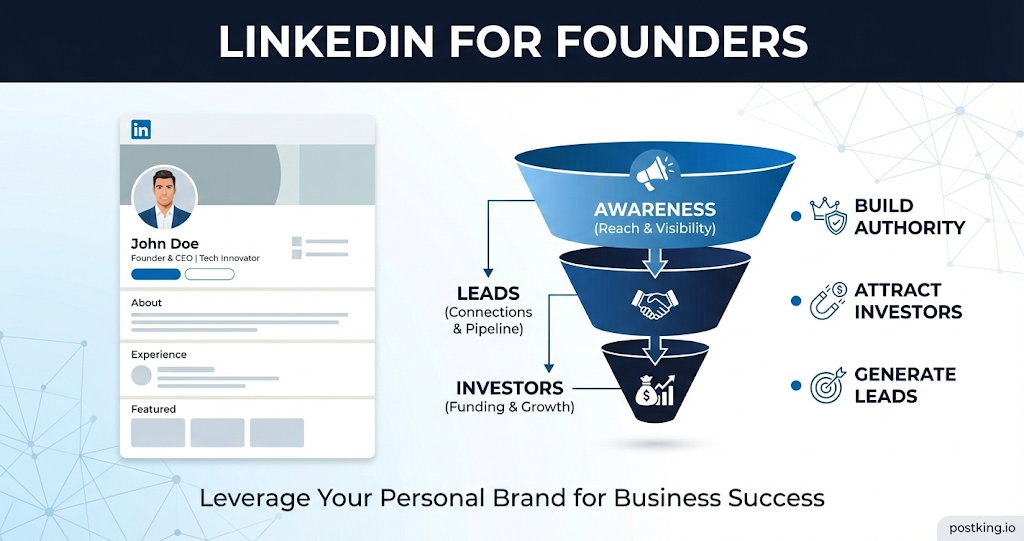
LinkedIn Growth Strategy for Founders (2026 Guide)
A complete LinkedIn growth playbook for founders to build authority, attract investors, and grow pipeline.
LinkedIn Growth Strategy for SaaS Founders (2026)
A practical LinkedIn strategy for SaaS founders to build authority, attract pipeline, and recruit talent.
more engagement with carousels
Create scroll-stopping LinkedIn carousels in under 60 seconds. No design skills needed.
Try Carousel Generator