LinkedIn Growth Strategy for Bootstrapped Founders (2026)
A practical growth playbook for bootstrapped founders. Build authority, attract customers, and grow without relying on paid spend.

Shanjai Raj
Founder at Postking
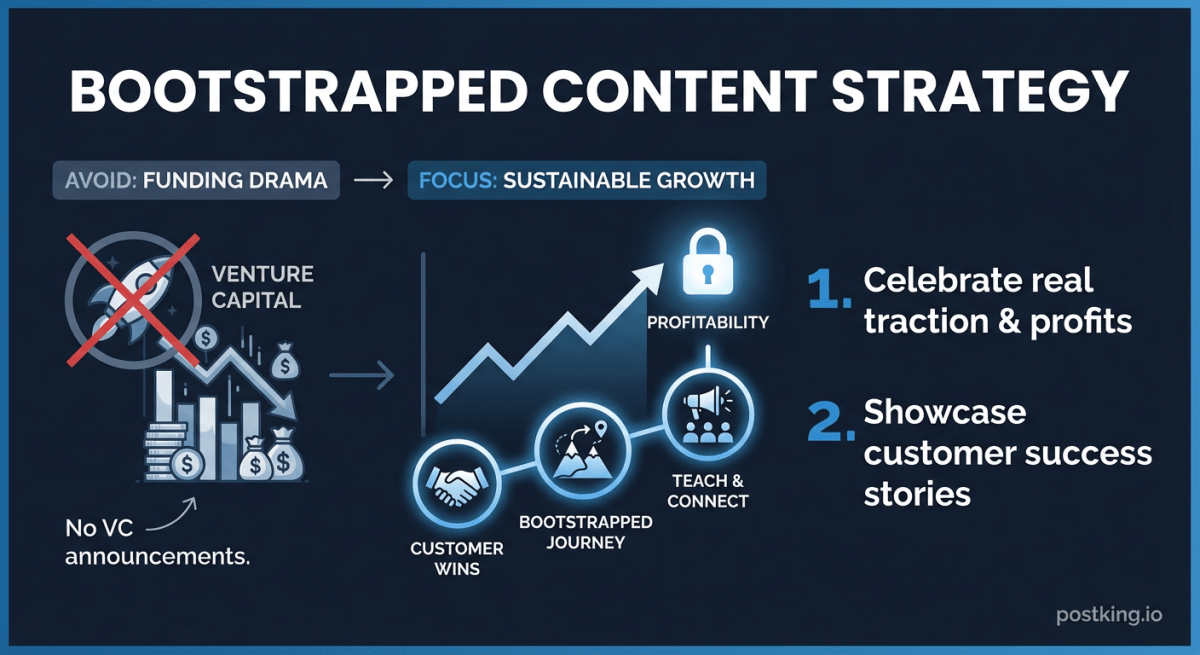
Every time a VC-backed founder posts about their $15M Series A, something strange happens. Bootstrapped founders scroll past, feel a pang of inadequacy, and close the app without posting anything themselves.
This is backwards.
The founders who've raised nothing often have more compelling stories than those drowning in investor updates. You're building something real, something sustainable, something that doesn't require explaining to a board why you spent $40K on branded hoodies.
That's content gold. You just need to recognize it.
The Bootstrapped Advantage Nobody Talks About
VC-backed founders have a content problem most people don't see. They're stuck on a narrative treadmill. Every post needs to signal growth, attract the next round, and maintain a valuation story. They can't admit uncertainty without spooking investors. They can't celebrate small wins without looking like they're not growing fast enough.
You have none of those constraints.
You can share real revenue numbers without board approval. You can pivot your messaging without worrying about LP expectations. You can admit when something isn't working and document the fix. You can celebrate a single customer win without someone asking why it's not ten customers.
This freedom is your superpower on LinkedIn. While funded founders perform for their stakeholders, you can have genuine conversations with the people who actually matter: your customers.
Why Profitability Beats Fundraising as a Content Angle
Here's a number that might surprise you: posts about sustainable business practices consistently outperform funding announcements in engagement quality. Not always in raw impressions, but in the kind of engagement that matters, comments from potential customers, DMs from people who want to learn more, shares from folks who relate.
The funding announcement crowd is impressive in volume but hollow in value. Those comments are mostly other founders saying "congrats" while secretly hoping for a referral to the same investors.
Your profitability story attracts:
Decision-makers who've been burned. They bought software from a fast-growing startup that got acquired and killed the product. They implemented a tool from a company that pivoted away from their use case. Now they're looking for stability, and you're exactly what they want.
Buyers who value relationships. Enterprise buyers at Fortune 500 companies have vendors. They want partners. A bootstrapped founder who'll pick up the phone and solve their problem directly? That's worth paying premium for.
Other bootstrapped founders. This community supports each other fiercely. They become customers, referral sources, and collaborators. Some of the best business relationships start with mutual respect over shared values.
People tired of the hype. LinkedIn is drowning in growth-at-all-costs messaging. Content that says "we're profitable, we're sustainable, and we're not going anywhere" stands out because it's different.
Content Pillars That Don't Require a Funding Announcement
Most LinkedIn content strategy advice assumes you have investor news to share. Let's build a framework that works for founders who measure success in margins, not valuations.
Pillar 1: Customer Wins Over Investor Wins
This is your unfair advantage. While funded founders celebrate closing rounds, you celebrate closing customers. Guess which one your prospects find more relevant?
What to share:
- Specific results a customer achieved using your product
- Feedback that surprised or moved you
- Problems you solved that you didn't expect to solve
- Customer milestones (their 1-year anniversary using your tool, their 1000th task completed, etc.)
The structure that works:
"Got a message from [Customer] this morning that made my week.
They started using [Product] six months ago for [initial use case].
What I didn't expect: they've now [unexpected outcome]. Their words: '[actual quote]'
Building for moments like this. It never gets old."
This isn't testimonial marketing dressed up as content. It's genuine celebration of the people who make your business possible. The authenticity comes through, and it demonstrates product value without a sales pitch.
Pillar 2: The Profitability Narrative
Being profitable isn't a consolation prize. It's the whole point of business. Own it loudly.
What to share:
- Crossing profitability milestones (first profitable month, first profitable year)
- Decisions you made to stay profitable instead of burning cash
- Why you chose margins over growth rate
- The freedom that comes from not depending on external capital
Example angles:
- "Three years in, still profitable, still just three people. Here's what we've learned about staying lean."
- "We turned down a term sheet last year. Best decision we ever made. Here's why."
- "Most startups optimize for growth. We optimize for freedom. This is what that looks like."
The key is confidence. You're not defending a choice; you're explaining a strategy that's working.
Pillar 3: Building Differently
Your constraints have forced creativity. That creativity makes fascinating content.
A team of 3 doing what competitors need 50 people to do? That's interesting. Using AI to handle what others hire for? That's valuable to share. Running a $1M business from a coffee shop in Lisbon? People want to know how.
What to share:
- Tools and systems that let you punch above your weight
- Processes you've developed that seem obvious now but took years to figure out
- Decisions that go against conventional startup wisdom
- The actual economics of running lean (not theory, your real numbers)
These posts attract two audiences: potential customers evaluating efficient vs. bloated vendors, and other founders who want to learn from your approach.
Pillar 4: The Long Game
VC-backed founders think in 18-month funding cycles. You think in decades. That perspective is content.
What to share:
- How you make decisions with a 10-year horizon
- Why you chose slow compound growth over explosive unsustainable growth
- The trade-offs you've accepted to maintain independence
- What running a business without external pressure actually feels like
This content attracts customers who value stability. A CFO evaluating software vendors cares deeply whether you'll be around in 5 years. Your content can answer that question before they even ask.
Bootstrapped Founders Actually Crushing LinkedIn
These aren't theoretical strategies. Real founders are building massive LinkedIn presence without a single funding announcement.
The transparent revenue builder. Arvid Kahl built an audience of 90K+ by documenting his bootstrapped journey with radical transparency. He shared everything: revenue numbers, failed experiments, lessons learned. His content attracts other bootstrappers who become customers for his courses and books, and potential acquirers who can see exactly what they're getting.
The customer obsession poster. Jason Fried and the Basecamp team have spent years posting about their customers, not their investors (because they don't have any). Their content focuses on how they build products, why they make unconventional decisions, and what they've learned from serving customers for 20+ years. That positioning helped build a business worth hundreds of millions without ever raising a dime.
The indie hacker documenter. Jon Yongfook grew Bannerbear while posting detailed breakdowns of what was working, what wasn't, and actual revenue numbers. His audience watched him hit MRR milestones in real-time. That transparency built trust that converted to customers.
The efficiency expert. Founders who run lean operations and share their tech stack, processes, and productivity systems attract audiences who want to replicate that efficiency. The content isn't about the company; it's about how they do what they do with minimal resources.
Common patterns across all of them:
- They post consistently (not constantly, but regularly)
- They share specifics, not platitudes
- They celebrate customers more than company metrics
- They don't apologize for their size or approach
- They engage genuinely with their audience
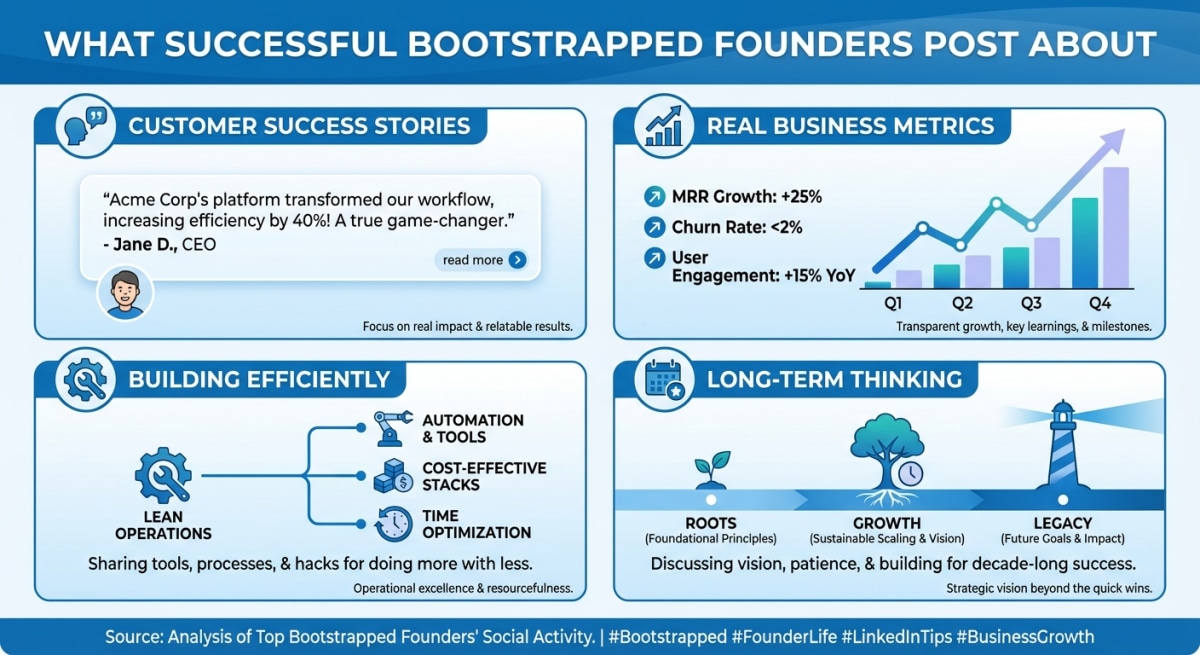 What Bootstrapped Founders Post About
Building Community Around the Bootstrapped Journey
One of LinkedIn's underrated benefits for bootstrapped founders: you're not alone, even when you're building solo.
The indie hacker and bootstrapped founder community on LinkedIn is engaged, supportive, and surprisingly tight-knit. Building relationships in this community creates more value than broadcasting to anonymous followers ever could.
How to find your people:
- Search for terms like "bootstrapped," "indie hacker," "self-funded," and "profitable startup"
- Look at who's engaging with content from known bootstrapped founders
- Join the conversations in comments on relevant posts
- Share the wins of founders you admire (genuine sharing, not strategic flattery)
Why community matters:
- Referrals come from relationships, not follower counts
- Collaboration opportunities emerge from genuine connection
- Emotional support from people who understand your reality is invaluable
- You'll learn things from peers you won't find in any course or blog post
The founders who build genuine community around their bootstrapped journey often find that community becomes their best marketing channel. A recommendation from a trusted peer beats any amount of content you could produce.
Sustainable Content Creation Without a Marketing Budget
You don't have a content team. You don't have a designer. You barely have time to respond to customer emails, let alone create LinkedIn content.
Good news: bootstrapped founder content works better when it's raw anyway. Polish often kills authenticity.
The minimum viable routine:
- Weekly: Two posts (one customer-focused, one lesson-learned)
- Daily: 10 minutes engaging with comments and other posts
- Monthly: One deep-dive post (a framework, a milestone reflection, or a decision breakdown)
That's roughly 3 hours per week maximum. Most of that is engagement, which you can do from your phone while waiting for coffee.
Content batching for founders who can't batch:
Traditional batching assumes you have a 2-hour creative block available. You probably don't. Try this instead:
- Keep a running note on your phone called "LinkedIn Ideas"
- Every time something interesting happens (customer feedback, a problem solved, a lesson learned), add one sentence to the note
- Once a week, pick 2-3 ideas and expand them into posts
- Expansion takes 10-15 minutes per post
The trick is separating capture from creation. Ideas happen throughout your day. Writing happens when you have a quiet moment.
Turning business activities into content:
Every customer call is potential content. Every bug you fix is a lesson. Every feature decision has reasoning worth sharing. You're already doing interesting things; the work is just packaging what's happening anyway.
For posts that need more visual polish, Postking's carousel generator turns your ideas into professional slides without design skills. And our post formatter helps structure text posts for maximum readability.
Authenticity as Your Unfair Advantage
Here's what VC-backed founders can never replicate: you don't have to perform for stakeholders.
When you post about a challenge, you're not worrying about investor perception. When you celebrate a win, you're not managing expectations for the next board meeting. When you share real numbers, you're not protecting a valuation narrative.
That authenticity is increasingly rare on LinkedIn. People can feel it. It's why bootstrapped founder content often generates more meaningful engagement than polished corporate messaging.
What authenticity looks like in practice:
- Admitting when something didn't work
- Sharing numbers that aren't always up and to the right
- Posting about the hard days, not just the wins
- Being specific about your constraints and how you work around them
- Not pretending to be bigger than you are
This isn't vulnerability for vulnerability's sake. It's recognition that people connect with real stories, not performance.
The 30-Day Starter Plan
Stop reading. Start posting. Here's your roadmap:
Week 1: Foundation
- Update your headline to reflect your bootstrapped status confidently (e.g., "Building [Product] | Profitable and growing since [Year]")
- Rewrite your About section to lead with customer impact, not company history
- Identify 15 other bootstrapped founders to follow and engage with
Week 2: First Posts
- Post your origin story (why you chose to bootstrap)
- Celebrate a recent customer win with specific details
- Share one lesson you learned this month
Week 3: Build Rhythm
- Post about a decision you made that prioritizes sustainability
- Share your actual numbers (revenue, customers, or team size)
- Respond to every comment and engage daily with others' content
Week 4: Find What Works
- Share a contrarian take on startup culture
- Document how you accomplish something with a small team
- Review what's resonating and plan next month's content around those themes
The Real Point
Being bootstrapped isn't a disadvantage on LinkedIn. It's a positioning strategy that most founders don't realize they have.
While VC-backed founders compete for the same investor attention with the same growth metrics, you're building direct relationships with the people who actually pay you. Your content isn't performance; it's conversation. Your wins aren't impressive to VCs; they're relevant to customers.
The founders who understand this build LinkedIn presence that compounds into real business value: customers who trust them, peers who refer them, and an audience that roots for their success.
You're not missing out by not having funding announcements to share. You're freed up to share something better.
Start this week. One post about why you chose to build this way. Watch who responds. Build from there.
Ready to create LinkedIn content that attracts customers? Use Postking's free carousel generator to turn your customer success stories into engaging visual content, or our post formatter to structure your posts for maximum readability. For more founder-specific strategies, explore our guides on LinkedIn for solo founders and LinkedIn for founders.
Related Reads
Written by
Shanjai Raj
Founder at Postking
Building tools to help professionals grow on LinkedIn. Passionate about content strategy and personal branding.
View all postsYou might also like
LinkedIn Posting Frequency Calculator
Try our free linkedin posting frequency calculator to enhance your LinkedIn presence.
LinkedIn Hook Generator
Try our free linkedin hook generator to enhance your LinkedIn presence.
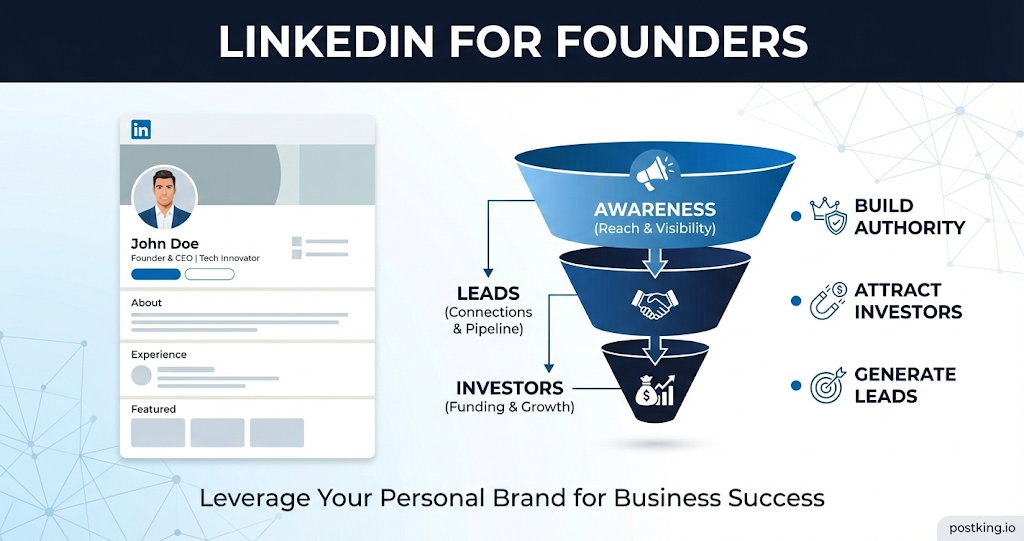
LinkedIn Growth Strategy for Founders (2026 Guide)
A complete LinkedIn growth playbook for founders to build authority, attract investors, and grow pipeline.
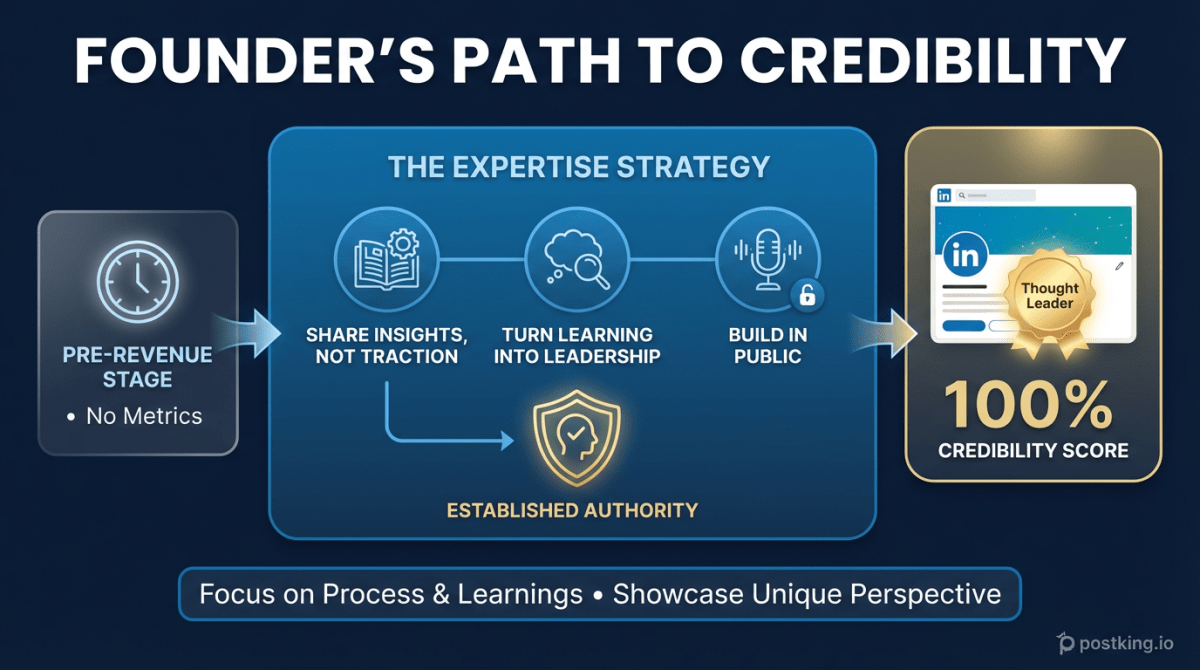
The Pre-Revenue Founder's LinkedIn Playbook: Building Credibility When You Have No Metrics
Learn how to build LinkedIn authority as a pre-revenue founder. Discover content strategies that establish credibility through expertise, not traction, and turn 'still figuring it out' into thought leadership.
LinkedIn Hook Grader
Try our free linkedin hook grader to enhance your LinkedIn presence.
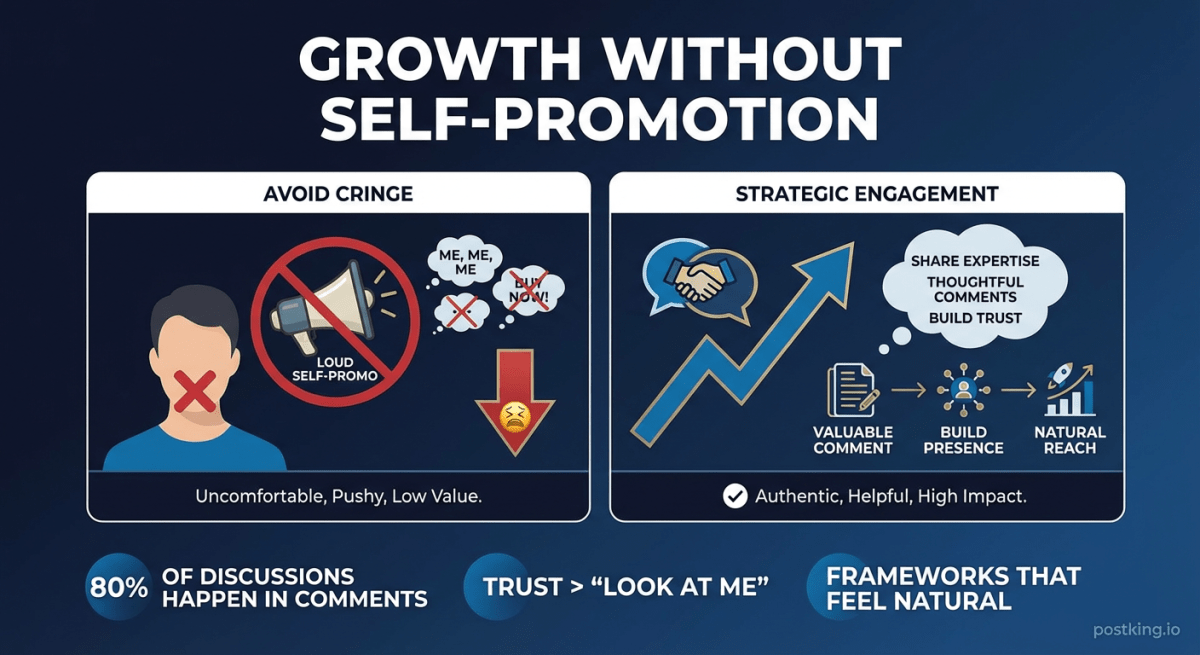
LinkedIn Strategies for Founders Who Hate Self-Promotion
A practical guide for introverted founders and anyone who finds self-promotion uncomfortable. Learn frameworks that feel natural, the comment-first strategy, and how to build presence without making yourself cringe.
LinkedIn Growth Strategy for Solo Founders (2026)
A practical LinkedIn playbook for solo founders to build visibility and customers without a team.
more engagement with carousels
Create scroll-stopping LinkedIn carousels in under 60 seconds. No design skills needed.
Try Carousel Generator