LinkedIn Strategies for Founders Who Hate Self-Promotion
A practical guide for introverted founders and anyone who finds self-promotion uncomfortable. Learn frameworks that feel natural, the comment-first strategy, and how to build presence without making yourself cringe.

Shanjai Raj
Founder at Postking
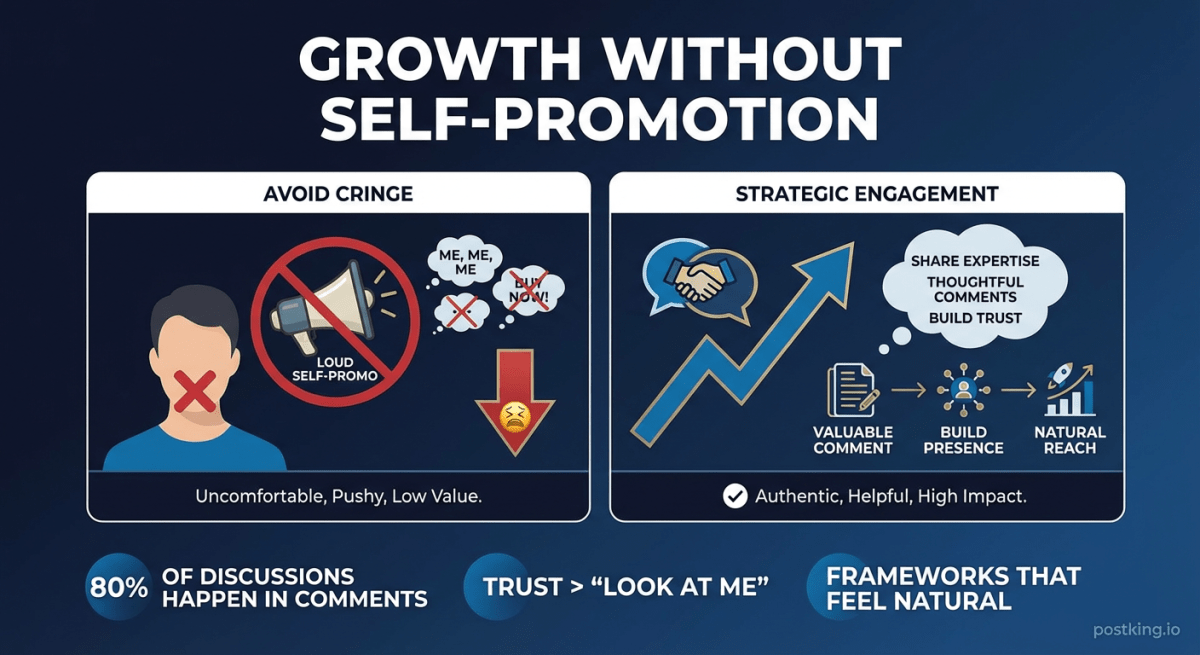
You know you should be on LinkedIn. Every founder guide says personal branding matters. Investors check your profile. Customers research you before meetings.
And yet, every time you open the app to post something, you feel your stomach tighten.
That reaction isn't weakness. It's actually a reasonable response to what dominates the platform: manufactured vulnerability, humble brags dressed as lessons, and that strange LinkedIn voice where everyone sounds like they're accepting a lifetime achievement award.
Why Self-Promotion Feels Icky (And Why That's Valid)
Let's name what's happening. When you scroll LinkedIn and see posts that make you cringe, you're responding to something real.
The platform rewards attention-seeking behavior. "Excited to announce" posts. Stories that start with failure but pivot to triumph a bit too conveniently. Engagement bait dressed as wisdom. Posts where the writer clearly cares more about reactions than about helping anyone.
If you value substance over performance, this feels hollow. Because much of it is.
Your discomfort comes from a values mismatch. You believe:
- Work should speak for itself
- Bragging is distasteful
- Authenticity matters more than attention
- You'd rather be building than broadcasting
These aren't weaknesses in the LinkedIn game. They're actually the foundation of a more effective approach, one that builds genuine credibility instead of hollow reach.
The good news: LinkedIn's algorithm caught up to what you already knew. Recent updates specifically deprioritize content that feels artificial or engagement-bait focused. The platform now rewards expertise and authenticity over growth hacks and manufactured stories.
Your instincts were right. The question is how to build presence on your own terms.
Reframing: Sharing Value vs. Bragging
Here's the mindset shift that changes everything.
Stop thinking about self-promotion. Think about teaching instead.
The founders who build genuine LinkedIn presence without feeling gross share one approach: they focus outward, not inward. Every post answers "What can I help someone understand?" rather than "What can I say about myself?"
The difference looks like this:
Self-promotion approach: "Thrilled to announce we just closed our Series A! So grateful for this incredible journey and the amazing team that made it happen."
Value-sharing approach: "We just closed our Series A after 23 investor rejections. The three specific changes that made the difference in how we pitched. Thread for founders currently fundraising..."
Both share the same news. But the second teaches something. It gives readers a reason to care beyond your success. It frames your accomplishment as their potential lesson.
This isn't a trick. It's a genuine shift in how you think about sharing. You're not performing for attention. You're documenting for others who'll face the same situations.
The Teaching Mindset in Practice
Every experience you have as a founder contains insights others would find useful. The work is extracting the lesson and leading with that instead of the accomplishment.
Instead of announcing, explain:
- Don't announce a new hire. Explain what you looked for and how you structured the interview process.
- Don't announce a feature launch. Explain the customer problem that led to building it and why you prioritized it.
- Don't share a revenue milestone. Share the specific change that drove growth and what surprised you about it.
Instead of claiming expertise, demonstrate it:
- Don't say you're great at customer development. Share a framework for running better customer interviews.
- Don't say you understand your market. Analyze a trend and explain what it means for practitioners.
- Don't say you build good products. Walk through a decision you made and your reasoning.
The paradox: by focusing less on yourself, you establish more credibility than direct self-promotion ever could.
For the complete playbook on founder LinkedIn strategy, our LinkedIn for Founders guide covers profile optimization, content pillars, and weekly routines.
Content Frameworks That Feel Natural
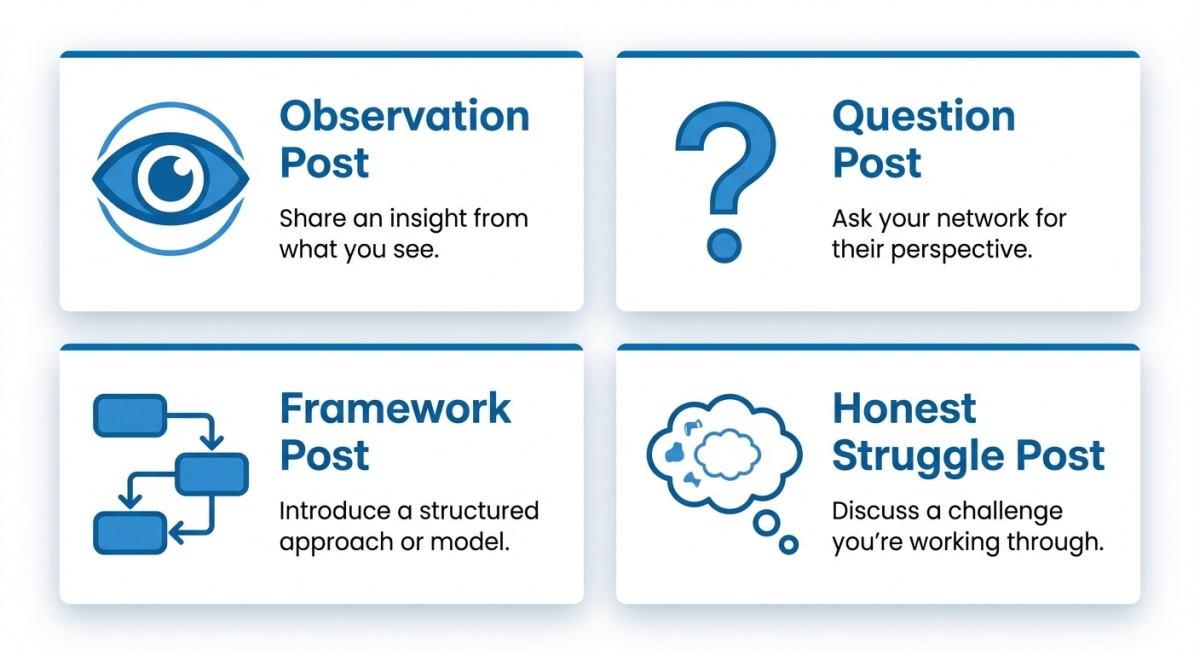
Some content formats feel less promotional than others. Here are approaches that let you share genuinely useful information without centering yourself.
The Observation Post
Share something you noticed. No personal branding angle required. Just an observation worth discussing.
Example: "Noticed something interesting in customer conversations this month. Companies that delay buying tools like ours by 3+ months end up spending 2x as much on implementation. The cost of waiting is higher than people expect when they're 'not ready yet.'"
This establishes expertise without claiming it. You're sharing data, not bragging.
The Question Post
Ask something you're genuinely curious about. This invites conversation, positions you as someone who learns, and generates engagement without requiring you to perform.
Example: "Building our sales process right now. Wrestling with this: discovery call separate from demo, or combined? What's worked in your experience?"
You're not positioning yourself as the expert. You're learning in public. That's far more authentic than manufactured authority.
The Framework Post
Take something complex and make it simple. This works especially well if you think in systems.
Example: "How we decide what to build next:
- Pull every feature request from the last 90 days
- Tag each with the customer tier that requested it
- Count revenue tied to requesting customers
- Rank by potential impact
- Gut-check against strategy
- Pick the top 3
Takes about 2 hours quarterly. Cuts our roadmap arguments in half."
You're teaching a process. The fact that it makes you look competent is a side effect, not the goal.
The Honest Struggle Post
Share something you're wrestling with. Not manufactured vulnerability, but genuine uncertainty.
Example: "Honest question for founders who've been through this: how do you know when to hire your first marketer vs. keep doing it yourself? Every framework I've seen feels too clean. What actually helped you make the call?"
This builds connection through authenticity. You're not pretending to have all the answers. That's refreshing on a platform full of people who pretend they do.
For more on building sustainable content habits, see our LinkedIn content strategy guide.
 Content Frameworks for Authentic Sharing
The Comment-First Strategy
Here's something most LinkedIn advice ignores: you can build significant visibility without posting much at all.
Comments are dramatically underrated.
When you leave a thoughtful comment on a post that gets high engagement, thousands of people see your name, your headline, and your insight. You're borrowing someone else's audience without creating content from scratch.
For founders who find posting uncomfortable, this is the entry point.
How It Works
Step 1: Find your ecosystem
Identify 15-20 people who regularly post about topics relevant to your industry, your customers, or your investors. Follow them. Turn on notifications for the most active ones.
Step 2: Show up consistently
Spend 15 minutes each day engaging with their posts. Not "Great point!" engagement. Actual contribution.
Good comments do one of these things:
- Add a different perspective or respectful counterpoint
- Share a relevant experience that extends the original idea
- Ask a thoughtful follow-up question
- Provide additional data or examples
Step 3: Be early
Comments posted in the first hour of a post's life get exponentially more visibility. The algorithm promotes posts that generate quick engagement, and early comments ride that wave.
Step 4: Track what happens
After a few weeks, you'll notice connection requests increasing. People start recognizing your name. When you eventually do post, those people engage with your content.
Sample Comments That Work
On a post about startup fundraising: "This matches our experience. One addition: warm intros weren't just nice-to-have, they were the only path that worked. Cold outreach generated 40+ conversations but zero term sheets. Every serious conversation came through network."
On a post about remote team management: "Interesting perspective on async communication. We went the opposite direction and found more synchronous time actually reduced our total meeting hours. The overhead of writing everything down ate more time than quick calls. Curious if you've experimented with that balance."
Notice what these comments share: specific details, new information, and they extend the conversation. They're mini-posts that demonstrate expertise without requiring you to start from scratch.
Sharing Others' Stories While Building Your Brand
One of the most comfortable ways to maintain LinkedIn presence: celebrate and amplify other people.
Share customer wins. Highlight team members. Repost content from peers with your perspective added. Interview others in your space and share the insights.
This approach:
- Feels less self-promotional because it genuinely isn't
- Builds relationships with the people you feature
- Still establishes your presence and perspective
- Creates content without requiring you to talk about yourself
What This Looks Like
"Had a call with [customer type] yesterday who told me they [specific result] after implementing our approach. What struck me wasn't the numbers, but how they described the shift in their team's mindset. [Insight or observation]."
"My cofounder [name] just wrote about [topic]. What she doesn't mention is [additional context]. Worth reading if you're thinking about [related challenge]."
"Learned something interesting from [person in your network]: [insight]. Made me rethink our approach to [area]."
You're still building your presence. But the focus is outward. That feels more comfortable for most people who dislike self-promotion.
Being Useful Rather Than Impressive
Here's the core principle: optimize for usefulness, not impressiveness.
Ask yourself before posting: "Will this help someone?" not "Will this make me look good?"
Useful content:
- Saves someone time
- Helps them avoid a mistake you made
- Gives them a framework they can apply
- Answers a question they have
Impressive content:
- Highlights your accomplishments
- Positions you as successful
- Focuses on outcomes rather than process
- Leaves readers thinking about you rather than their own situation
The irony: useful content makes you look far more impressive than content designed to impress. Expertise demonstrated is always more credible than expertise claimed.
The Psychology of Authentic Sharing
Let's address what's actually happening in your head when you avoid posting.
Fear of judgment: "People will think I'm full of myself."
The reality: most people are too busy thinking about themselves to spend much time judging you. And the people who do judge you for sharing useful information? You don't want their attention anyway.
Fear of looking like "those LinkedIn people": "I don't want to become someone who posts cringe content."
The reality: the fact that you're worried about this essentially guarantees you won't. Your discomfort with inauthenticity will prevent you from producing the content you dislike. Trust that filter.
Imposter syndrome: "Who am I to share advice?"
The reality: you don't need to be the world expert. You just need to be a few steps ahead of someone else. The founder who just went through fundraising has valuable insights for the founder about to start. You're not claiming to be a guru. You're sharing what you learned.
Preference for privacy: "I'd rather keep a low profile."
The reality: you've already sacrificed privacy by starting a company. Your LinkedIn profile exists whether you post or not. The question is whether that profile works for you or sits idle while competitors build their presence.
How Introverts and Modest Founders Win on LinkedIn
The assumption that extroverts dominate LinkedIn is wrong. Some of the most effective founders on the platform are deeply introverted. They just play a different game.
Pattern 1: Quality Over Quantity
Introverted founders tend to post less frequently but with more substance. Instead of daily hot takes, they post weekly insights. This matches how introverts naturally operate: think carefully, then speak.
The algorithm actually rewards this now. Two thoughtful posts per week beats fourteen shallow ones.
Pattern 2: Written Over Video
Video feels performative to many introverts. The camera pressure, the need to project energy, the awareness of being watched. It's exhausting.
Written content plays to introvert strengths. You can craft and edit. You can think before publishing. You're not performing in real-time.
Carousels, documents, and long-form text posts get strong engagement without requiring you to be on camera. Some of the most-followed founders have never posted a video.
Pattern 3: Responding Over Initiating
Many introverted founders build presence by responding to others rather than starting conversations. They engage deeply in comments. They write thoughtful replies to DMs. They share others' content with added perspective.
This "reactive" approach feels more natural for people who prefer dialogue to monologue. And it works: meaningful engagement compounds over time.
Pattern 4: Scheduled Energy
Introverts often batch their LinkedIn activity. Instead of always-on presence, they schedule focused windows: 20 minutes in the morning for comments, one hour on Sunday for content creation.
This protects energy while maintaining consistency. You're not constantly context-switching into "LinkedIn mode."
Getting Started: The Minimum Viable Approach
You don't need to become a content creator. You need enough presence that your profile works for you rather than against you.
Profile basics (one-time setup):
- A professional headshot
- A headline that explains who you help, not just your title
- An About section with your story and what you're building
- Featured section highlighting 2-3 relevant pieces
Weekly commitment (2-3 hours total):
- 15 minutes daily commenting on relevant posts
- One post per week using any format above
- Responding to comments and DMs when they come
That's it. This keeps you visible to investors, customers, and partners without requiring you to become someone you're not.
Your First Four Weeks
If you've read this far and still feel resistance, here's the smallest possible starting point.
Week 1: Update your headline to include who you help, not just your title. Leave one thoughtful comment per day on posts in your industry.
Week 2: Continue commenting. Write one post using the Question format. Spend no more than 20 minutes on it. Ask something you're genuinely curious about.
Week 3: Write one post using the Observation or Framework format. Share something you noticed or a process you use.
Week 4: Evaluate. Did anyone respond? Did you get connection requests? Did it feel as bad as you expected?
Most founders find the anticipation is worse than the reality. The first post feels uncomfortable. The fifth feels normal. By the tenth, you've found your voice.
The Real Goal
Your discomfort with self-promotion isn't something to overcome. It's something to work with.
The founders who build authentic presence on LinkedIn don't succeed despite their aversion to performance. They succeed because of it. They produce content people actually want to read, not noise to scroll past.
The goal isn't to become comfortable with self-promotion. The goal is to build presence in a way that never requires it.
Share what's useful. Teach what you've learned. Engage with others genuinely. Let your expertise speak through value delivered, not claims made.
That's a version of LinkedIn you can sustain without feeling like you've compromised who you are.
Ready to make content creation easier? Create carousels without design skills, or use the free post formatter to structure your posts for better readability. Spend your time on ideas, not formatting.
Related Reads
Written by
Shanjai Raj
Founder at Postking
Building tools to help professionals grow on LinkedIn. Passionate about content strategy and personal branding.
View all postsYou might also like
LinkedIn Posting Frequency Calculator
Try our free linkedin posting frequency calculator to enhance your LinkedIn presence.
LinkedIn Post Ideas Generator
Try our free linkedin post ideas generator to enhance your LinkedIn presence.
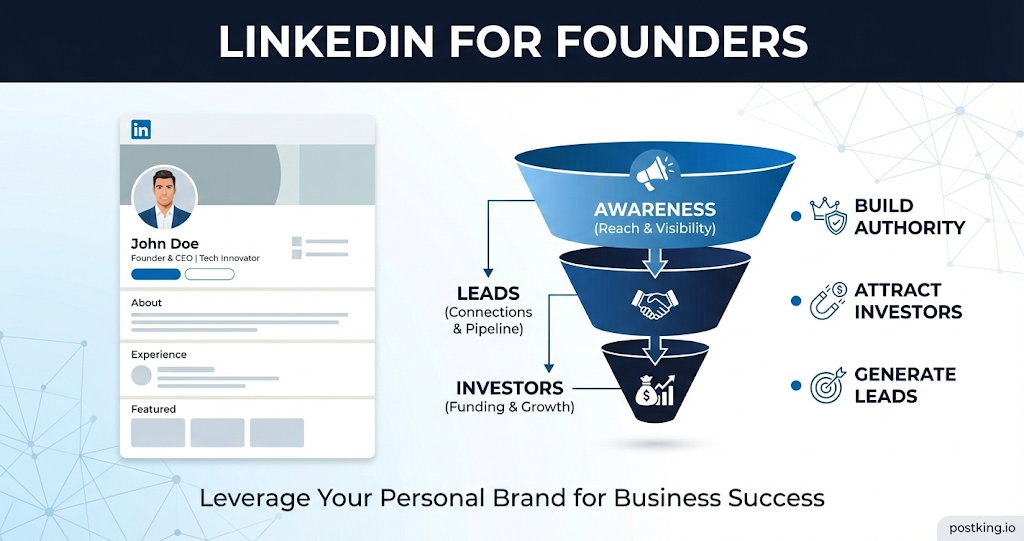
LinkedIn Growth Strategy for Founders (2026 Guide)
A complete LinkedIn growth playbook for founders to build authority, attract investors, and grow pipeline.
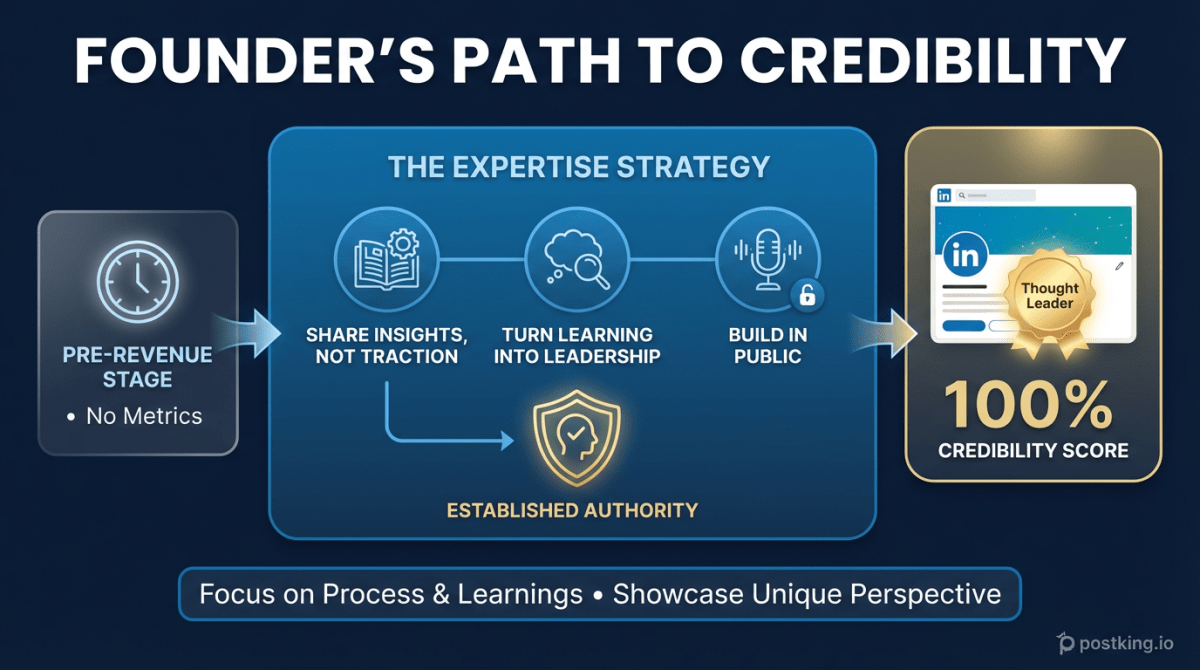
The Pre-Revenue Founder's LinkedIn Playbook: Building Credibility When You Have No Metrics
Learn how to build LinkedIn authority as a pre-revenue founder. Discover content strategies that establish credibility through expertise, not traction, and turn 'still figuring it out' into thought leadership.
LinkedIn Hook Generator
Try our free linkedin hook generator to enhance your LinkedIn presence.
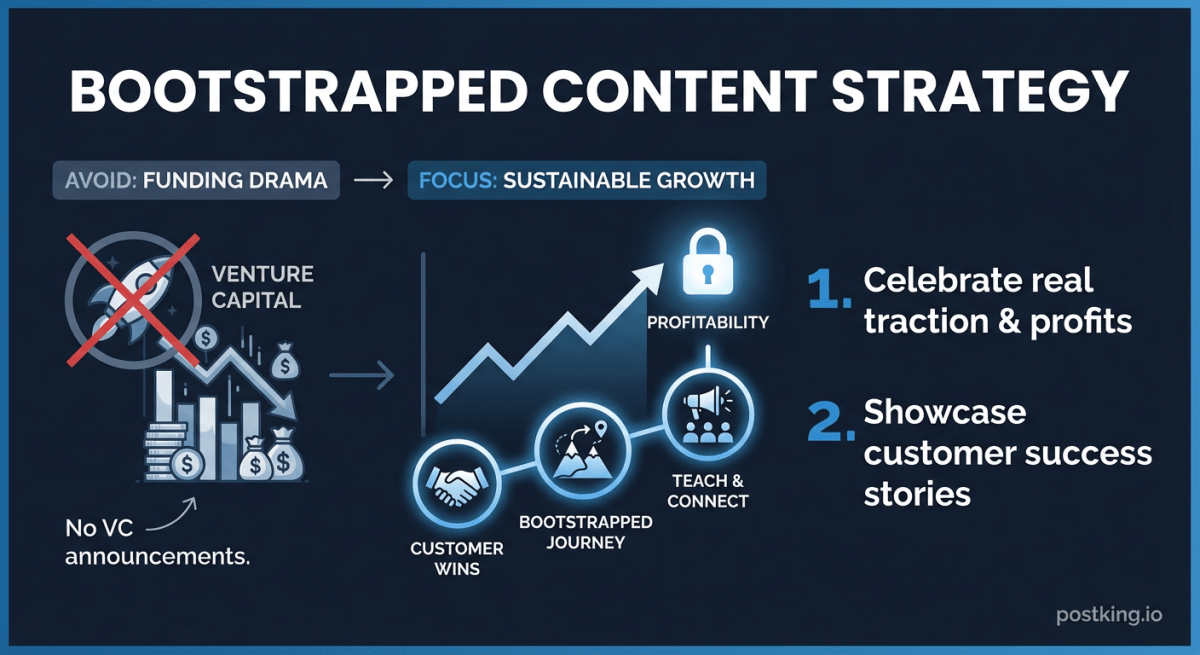
LinkedIn Growth Strategy for Bootstrapped Founders (2026)
A practical growth playbook for bootstrapped founders. Build authority, attract customers, and grow without relying on paid spend.
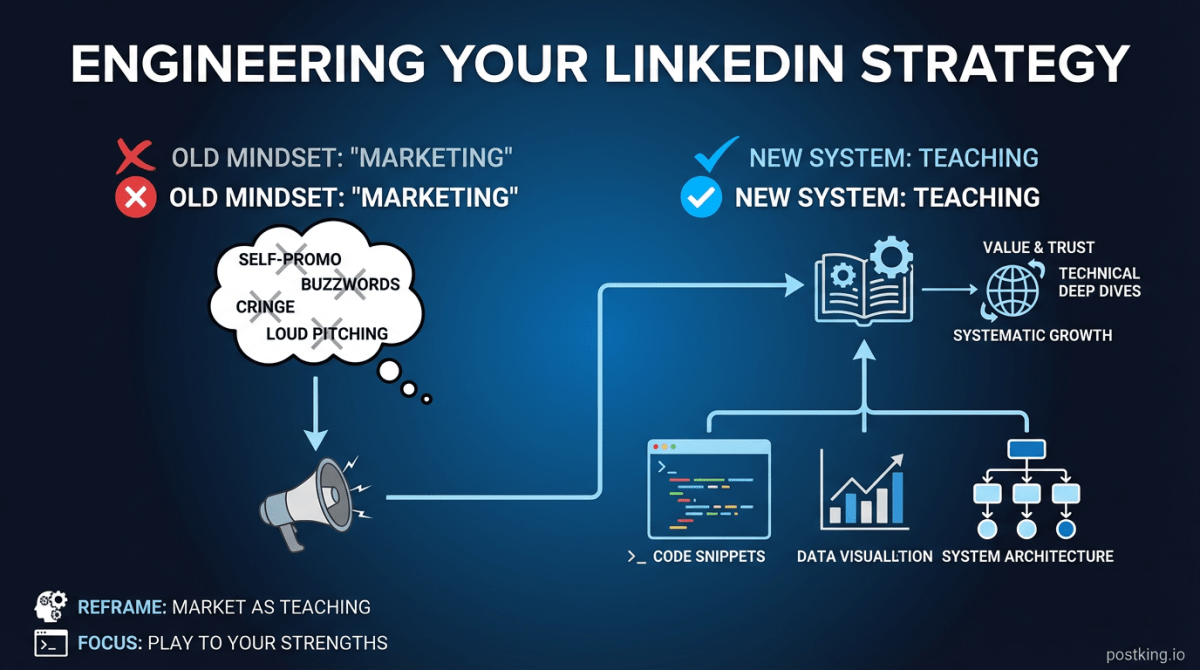
How Technical Founders Grow on LinkedIn Without Marketing
A practical LinkedIn strategy for technical founders to build authority without cringe or oversharing.
more engagement with carousels
Create scroll-stopping LinkedIn carousels in under 60 seconds. No design skills needed.
Try Carousel Generator