Building Your LinkedIn Presence Before Launching Your Startup
Learn how to build a LinkedIn audience before your startup launches. Includes a 6-month content timeline, waitlist growth tactics, and strategies for networking with customers, investors, and advisors pre-launch.

Shanjai Raj
Founder at Postking
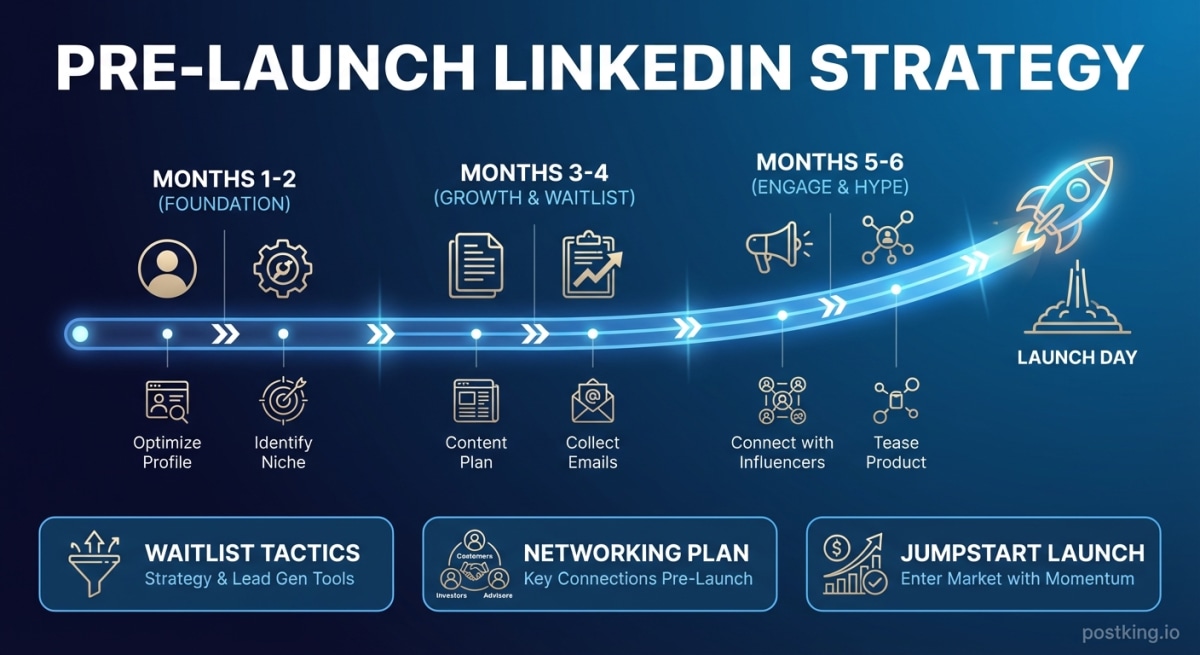
Most founders build their product first, then scramble for an audience at launch.
They spend months (sometimes years) perfecting features, tweaking designs, and optimizing performance. Then comes launch day. They post an announcement to their 300 LinkedIn connections. Crickets. A few pity likes from friends. No waitlist signups. No inbound interest. Just the deafening silence of launching into a void.
The founders who avoid this pattern start building their audience long before they have anything to sell. They show up on LinkedIn when all they have is an idea and a problem they care about. By launch day, they're not introducing themselves. They're activating a community that's been watching and waiting.
This is the playbook for building that audience before you have a product.
Why Starting Early Changes Everything
The math is simple. Building an audience takes time. Building a product takes time. Do them sequentially, and you're looking at years before you see traction. Do them in parallel, and you compress that timeline dramatically.
But there's a less obvious advantage. When you build an audience before you have a product, you're free to be curious instead of salesy. Every post is exploration, not promotion. Every conversation is research, not pitching. That authenticity resonates.
What early audience building gives you:
- Validated problem understanding. Your content sparks conversations. Those conversations reveal whether you're solving a real problem or an imagined one.
- Warm leads at launch. Instead of cold outreach, you're messaging people who've engaged with your content for months.
- Investor interest before you pitch. VCs scroll LinkedIn. A founder with a growing audience around a specific problem space gets noticed.
- Advisor and mentor relationships. The experts you need advice from are more likely to respond when they've seen your thoughtful posts for weeks.
- Early adopters who want to help. Some of your audience will become beta testers, providing feedback that shapes your product.
The alternative is launching and then spending 6-12 months building the audience you wish you'd started earlier.
Building Credibility When You Have Nothing to Sell
Here's the counterintuitive truth: having nothing to sell is an advantage.
Founders with products face constant pressure to promote. Every post feels like it needs a CTA. Every conversation carries an ulterior motive. Your audience senses it.
Pre-launch, you're pure signal. No agenda beyond learning and sharing what you learn. That makes you more trustworthy, not less.
The key is establishing yourself as a problem-space expert. You don't need a solution to be the person who understands a problem better than anyone else. And on LinkedIn, that expertise is what attracts followers.
For a deeper guide on building credibility without metrics or traction, check out our pre-revenue founder LinkedIn playbook.
What problem-space expertise looks like:
Pattern recognition. You've talked to 50 people about a problem. You see trends they can't see individually. Share those patterns.
"Interviewed 30 marketing directors this quarter. The tool fatigue is real. Not one talked about needing more features. Every single one mentioned integration headaches."
Observation without prescription. Point out what's broken without claiming to have the fix.
"Why does every project management tool assume teams work the same way? Every team I talk to has hacked together some workaround because the 'standard' workflow doesn't fit."
Informed questions. Ask questions that reveal you've been thinking deeply about a space.
"Genuine question for anyone in supply chain: is the real bottleneck data visibility, or is it that no one has incentive to share data in the first place?"
Industry context. Connect dots between trends, market shifts, and what you're observing.
"Three VC-backed companies in the procurement space failed this year. Meanwhile, the bootstrapped players keep growing. Something interesting is happening here."
None of this requires a product. It requires attention, conversations, and the willingness to share your thinking publicly.
Content Strategies When You Have Nothing to Promote
The content pillars that work pre-launch look different from post-launch founder content. You're not sharing customer wins or product updates. You're documenting a journey and demonstrating expertise.
Pillar 1: Customer Discovery Insights
Every conversation you have with potential users is content gold. Not because you're exaggerating traction, but because you're sharing genuine learnings.
What to share:
- Patterns from discovery interviews (anonymized)
- Surprising things potential customers said
- Assumptions that got challenged
- Problems that turned out bigger or smaller than expected
Example post:
Talked to 18 operations managers over the past month about their reporting workflows.
My assumption: they want faster reports.
Reality: they don't trust the reports they already have. Speed isn't the issue. Data quality is.
Three quotes that stuck with me:
"I spend more time verifying the numbers than actually using them."
"Every department has their own version of truth."
"We built a whole shadow process in spreadsheets because the official system is useless."
This completely changed how I'm thinking about the problem.
This is honest documentation. You're not claiming customers. You're sharing research.
Pillar 2: The Building Journey
People love watching things get made. Your journey from idea to product is inherently interesting, even before launch.
What to share:
- Weekly or monthly progress updates
- Technical decisions and tradeoffs
- Tools and processes you're using
- Challenges you're facing
Example post:
Week 12 of working on this full-time.
What's working:
- Finally narrowed from 6 target personas to 2
- The prototype is ugly but functional
- Got three people to actually use it unprompted
What's not:
- Still don't have a clear pricing model
- The onboarding flow is confusing everyone
- Running low on runway faster than expected
The unsexy part of building: most days feel like two steps forward, one step back.
This builds an audience invested in your success. When you launch, they're rooting for you.
Pillar 3: Industry Analysis
You understand your market better than most because you're obsessively researching it. Share that understanding.
What to share:
- Trends you're seeing
- Analysis of how incumbents are failing customers
- Predictions about where the industry is heading
- Commentary on news affecting your space
Example post:
Something strange is happening in [industry].
The big players keep adding features. Their products get more complex every quarter. But customer satisfaction scores are flat or declining.
Meanwhile, a handful of focused tools with 1/10th the features are growing faster than anyone expected.
My take: we've reached peak complexity in enterprise software. The pendulum is swinging back toward simplicity.
Not sure yet what this means for what I'm building, but it's influencing every product decision.
You don't need customers to have expertise. You need deep understanding of the problem space.
The 6-Month Pre-Launch Timeline
Your content approach should evolve as launch approaches. Here's how to structure the runway.
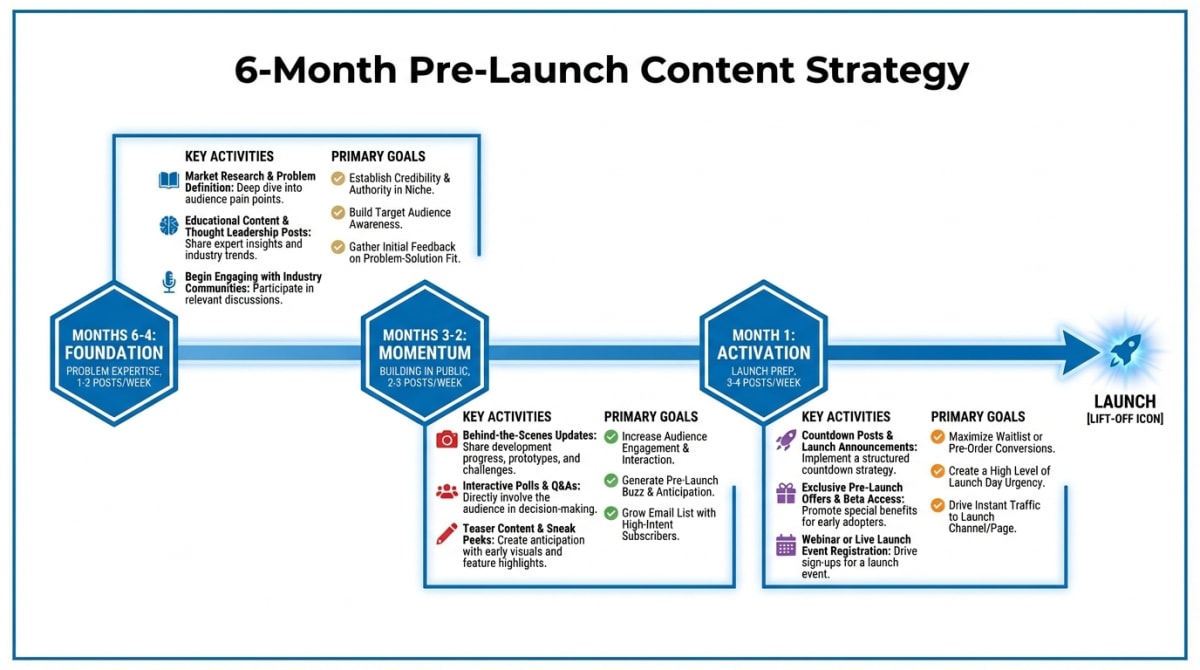 6-Month Pre-Launch Content Timeline
Months 6-4 Before Launch: Foundation Phase
Goal: Establish yourself as someone who deeply understands a specific problem space.
Posting frequency: 1-2 times per week
Content focus:
- Problem documentation and customer discovery insights
- Industry analysis and trend observations
- Your professional background and why you care about this problem
Engagement strategy:
- Identify 50-100 accounts in your space (potential customers, investors, industry voices)
- Engage thoughtfully on their posts before you start posting heavily
- Build familiarity with key people before you need anything from them
What you're building:
- A reputation as someone paying attention
- Early followers who care about your problem space
- Relationships with people who might help later
Milestones:
- 200-500 new relevant followers
- 10-20 meaningful conversations started
- Clear understanding of which content angles resonate
Months 3-2 Before Launch: Momentum Phase
Goal: Shift from pure exploration to building anticipation. Your audience should sense something is coming.
Posting frequency: 2-3 times per week
Content focus:
- Building in public updates (without revealing competitive details)
- Deeper industry insights based on your research
- Tease that you're working on something specific
Engagement strategy:
- Increase DM conversations with engaged followers
- Start building your early access list
- Connect with investors who should know about you before you pitch
What you're building:
- A waitlist of genuinely interested people
- Investor awareness before you need to fundraise
- Advisor relationships that will help at launch
Milestones:
- 500-1,500 relevant followers
- 50+ people on an early access or waitlist
- 3-5 advisor relationships forming
- Investor attention (they're watching your posts)
Month 1 Before Launch: Activation Phase
Goal: Prime your audience for launch. Build maximum anticipation.
Posting frequency: 3-4 times per week
Content focus:
- Behind-the-scenes of final preparations
- Countdown posts ("2 weeks until we open beta...")
- Direct asks for early access signups
- User stories from beta testers (if you have them)
Engagement strategy:
- Personal DMs to your most engaged followers
- Ask for help spreading the word
- Line up supporters who will engage at launch
What you're building:
- Launch day momentum
- A group of advocates ready to share your launch post
- Clear messaging for what you're launching and why it matters
Milestones:
- 100+ waitlist signups
- 10-20 people committed to supporting launch
- Final messaging tested and refined through content feedback
Launch Week
Goal: Convert months of audience building into launch traction.
Posting frequency: Daily
Content focus:
- Main launch announcement
- The story behind why you built this
- Early wins and user reactions
- Thank you posts to the community that supported you
This is when the investment pays off. You're not announcing to strangers. You're activating a community.
Growing Your Waitlist Through LinkedIn
A waitlist isn't just an email list. It's a group of people who raised their hand to say "I want this." Pre-launch, building that list is one of your most valuable activities.
Soft CTAs That Work
The key is asking without being pushy. You're inviting interested people, not hard-selling strangers.
End of posts:
"If you're dealing with [problem], I'm building something for you. DM me 'early access' and I'll add you to the list."
Standalone posts:
"Building in public update: finally ready to let a few people try what we've been working on. Looking for 20 [target users] who want early access. Drop a comment or DM me."
Profile CTA: Add to your headline or About section: "Building [description]. Join the waitlist: [link]"
Converting Engagement to Signups
When someone engages meaningfully with your content:
- Check their profile. Do they match your target user?
- Send a genuine DM. Not a pitch. A conversation.
"Hey Sarah, saw your comment about [topic]. Sounds like you've dealt with this firsthand. We're building something to solve exactly this. Would you want early access when we launch? No pressure either way, but thought I'd offer."
- Make it easy. One-click signup. Email only. Remove all friction.
Waitlist Content Ideas
The "help us build this" post:
We're 6 weeks from launching [product description].
Right now, I'm trying to decide between two approaches for [specific feature].
Option A: [Description] Option B: [Description]
If you're in [target audience] and have an opinion, I'd genuinely love input. Everyone who helps shape this gets early access.
The "limited beta" post:
Opening up 25 spots for early beta testers next month.
Looking for [specific criteria] who are dealing with [specific problem].
What you get:
- Free access during beta
- Direct line to the team for feedback
- Input on our roadmap
What we ask:
- 30 minutes of your time each week for feedback
- Honest opinions, even when they sting
DM me or comment if interested.
These posts convert because they offer genuine value (early access, influence) in exchange for attention.
Networking with Customers, Investors, and Advisors
Pre-launch is your best networking window. You have time for conversations. You have no agenda beyond learning. People can smell when a founder just wants something from them. Pre-launch, you genuinely just want to understand.
Connecting with Potential Customers
Your future customers are on LinkedIn right now, posting about the problems you're solving.
Finding them:
- Search for job titles that match your target buyer
- Look at who's commenting on industry content
- Follow hashtags relevant to your problem space
Approaching them:
- Engage with their content first (comments, thoughtful reactions)
- Wait until you've interacted 2-3 times before connecting
- Make the connection request about learning, not selling
Example connection request:
"Enjoyed your post about [topic]. I'm researching how [job function] teams handle [problem] and would love to learn from people actually in the trenches. No pitch, just curious. Would you be open to a 15-minute call?"
Many will say no. Some will say yes. Those conversations become product insights, beta users, and eventually customers.
Building Investor Awareness
You're not raising yet, but the best time to get on investors' radar is before you need their money.
What investors notice:
- Consistent, insightful content about a market they care about
- Evidence of deep problem understanding
- Growing engagement and followers
- Signs you can communicate well (crucial for fundraising)
How to get on their radar:
- Follow and engage with VCs who invest in your space
- Comment thoughtfully on their posts about your market
- Share insights they might find interesting
- Don't pitch in DMs. Just be visible.
When you do eventually reach out to raise, the response is different: "Oh, you're the person who's been posting about [problem space]. I've been following your journey."
Finding Advisors and Mentors
The experts who can help you most are often willing to help, if they know you exist.
Who to look for:
- Operators who've built in your space
- Technical experts in areas where you need guidance
- Go-to-market specialists who know your target market
- Founders a few years ahead of you
The approach:
- Start by giving. Share their content. Comment with genuine insights. Be useful.
- Build familiarity. They should recognize your name from their notifications.
- Ask one specific question. Don't ask for ongoing mentorship. Ask for help with one thing.
- Make it easy to say yes. "Would you have 20 minutes to help me think through X?"
Many of these conversations evolve into ongoing relationships. But it starts with being visible and being specific.
Turning Your Launch Into an Event
If you've been building in public for months, your launch isn't a press release. It's a payoff for everyone who's been watching.
The Week Before Launch
Prime your advocates. DM your most engaged followers. Let them know the date. Ask if they'd be willing to engage with your launch post.
Create anticipation. Posts like: "One week. After 8 months of building, it's almost time. If you've been following along, thank you. Next Thursday is the day."
Prepare your content. Write your launch post in advance. Have follow-up posts ready for days 2-5.
Launch Day
The announcement post should do three things:
-
Connect to the problem you've been discussing. "For the past 6 months, I've been posting about [problem]. Every conversation confirmed: this is broken and nobody's fixing it."
-
Introduce your solution. Clear, specific, benefit-focused. What it is and who it's for.
-
Include a clear CTA. Waitlist signup, beta access, or whatever your launch mechanism is.
Example structure:
Six months ago, I started posting about [problem].
Every conversation confirmed what I suspected: [specific insight about the problem].
Today, we're launching [product name].
[2-3 sentences explaining what it is and who it's for]
[Key benefit or differentiator]
To everyone who engaged with my posts, shared your experiences, and helped shape what we built: this is for you.
[CTA: link or action]
Post-Launch Content
The launch isn't one post. It's a week of momentum.
Day 2: Behind-the-scenes of launch day. What happened. How you felt.
Day 3: Early user reactions or feedback.
Day 4: The story of why you built this. Personal, authentic.
Day 5: Thank you post to the community.
Each post reinforces the launch and gives the algorithm multiple chances to surface your content.
Practical Weekly Routine
All of this requires consistent effort, but not overwhelming time investment. Here's a realistic routine:
Weekly Time Investment: 3-4 Hours
Sunday (1 hour): Plan and draft the week's content. Review what worked last week.
Tuesday, Thursday (30 minutes each): Publish posts. Engage with comments for 30 minutes after posting.
Daily (15 minutes): Engage with other posts. Build relationships through comments. Check DMs.
The Simple System
-
Keep a running note. Capture interesting moments from customer calls, industry observations, things you're learning.
-
Weekly content planning. Review notes. Pick 2-3 things to turn into posts.
-
Batch creation. Write multiple posts in one session. Edit the next day.
-
Schedule strategically. Tuesday and Thursday tend to perform best. Morning or lunch hours.
-
Engage after posting. The first hour matters most. Be present.
For more on content planning and strategy, see our LinkedIn content strategy guide.
Start Before You're Ready
The founders who build the strongest pre-launch audiences start before they feel ready.
They don't wait until they have the perfect post. They don't wait until they've figured out their positioning. They start sharing what they're learning, what they're building, and what they're thinking.
Your first posts will be mediocre. That's fine. The goal isn't viral content. The goal is starting the flywheel.
Six months from now, when you're ready to launch, you'll either have an audience waiting for you or you'll be starting from scratch. The only difference is whether you start today.
Write one post this week about the problem you're solving. Share one insight from a conversation you had. Document one thing you learned.
That's how it begins.
Ready to build your pre-launch LinkedIn presence? Use Postking's free post formatter to structure your posts for maximum readability, or create professional carousels that get 3x more engagement when sharing your building journey.
Related Reads
Written by
Shanjai Raj
Founder at Postking
Building tools to help professionals grow on LinkedIn. Passionate about content strategy and personal branding.
View all postsYou might also like
LinkedIn Post Ideas Generator
Try our free linkedin post ideas generator to enhance your LinkedIn presence.
LinkedIn Post Formatter
Try our free linkedin post formatter to enhance your LinkedIn presence.
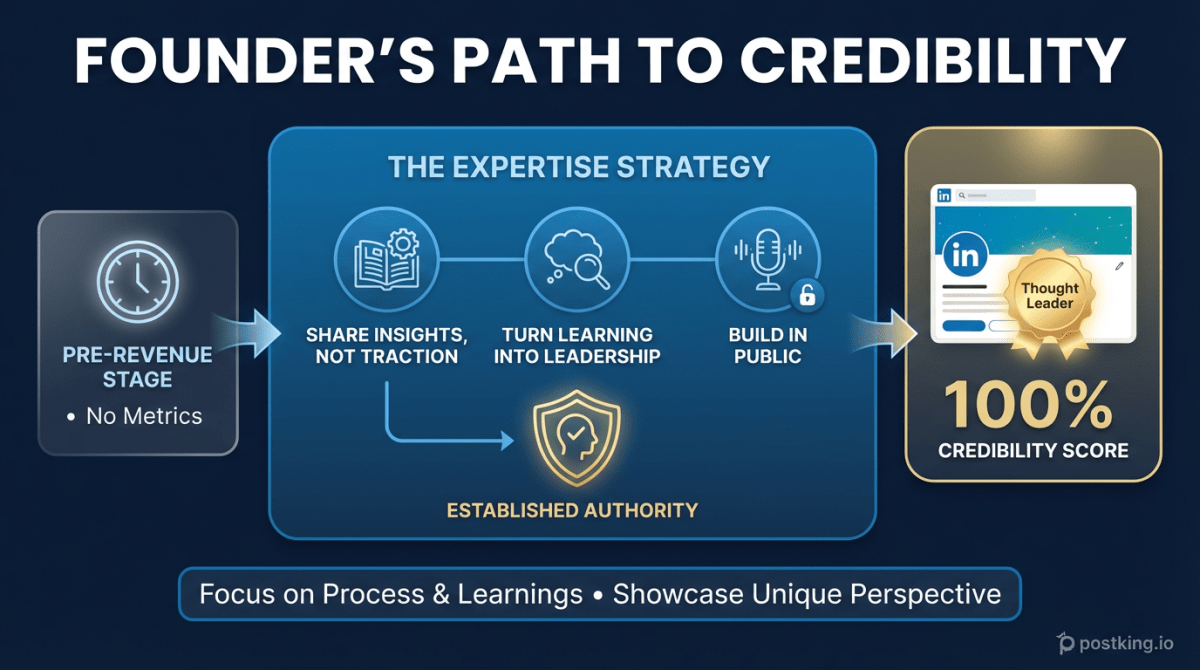
The Pre-Revenue Founder's LinkedIn Playbook: Building Credibility When You Have No Metrics
Learn how to build LinkedIn authority as a pre-revenue founder. Discover content strategies that establish credibility through expertise, not traction, and turn 'still figuring it out' into thought leadership.
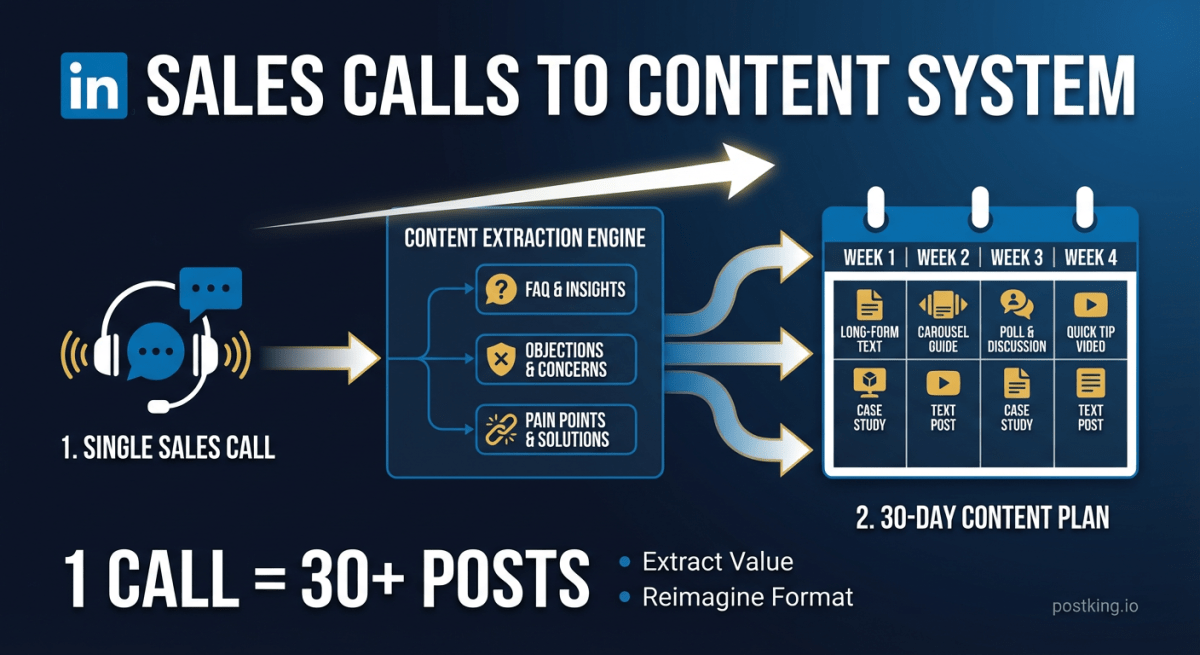
How to Turn Sales Calls into 30 Days of LinkedIn Content
Stop staring at blank screens. Your sales calls contain weeks of content hiding in plain sight. Here's the system for extracting posts from the conversations you're already having.
LinkedIn Posting Frequency Calculator
Try our free linkedin posting frequency calculator to enhance your LinkedIn presence.
How to Get Inbound Leads on LinkedIn as a Consultant: The Authority-First Approach
Stop chasing clients. Learn how consultants build authority through content, turn engagement into natural conversations, and create a sustainable inbound lead system that works while you're serving clients.
How to Get Demo Calls from LinkedIn Without Cold Outreach
Learn how to generate inbound demo requests from LinkedIn using the niche problem post format, profile optimization for conversion, and warm DM sequences that don't feel spammy.
more engagement with carousels
Create scroll-stopping LinkedIn carousels in under 60 seconds. No design skills needed.
Try Carousel Generator